
Active Suspension vs. Adaptive Suspension
Understanding Active and Adaptive Suspension Systems: A Complete Guide to Operation and Repair
In my years of working on high-tech automotive systems, few components have advanced as quickly as vehicle suspension. Two of the most sophisticated designs you’ll find on modern vehicles are active suspensions and adaptive suspensions. While they may sound similar, they function differently, offer different benefits, and require different approaches to repair. If you understand how each works and how each fails, you’ll be in a far better position to diagnose problems and restore your customer’s ride quality.
Active Suspension vs. Adaptive Suspension — The Key Difference
Although people often use the terms interchangeably, active suspension and adaptive suspension are not the same thing.
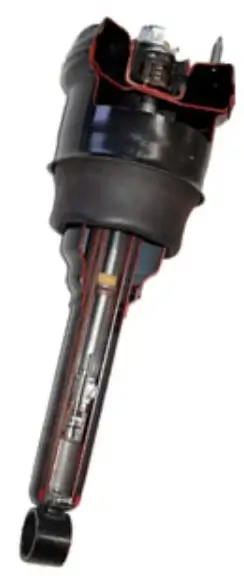 • Active suspension— An active suspension system can add
or remove energy from the suspension system, actively changing the vehicle’s ride height and wheel position. In other words, it doesn’t just respond to the road — it can proactively move the suspension to keep the ride level and controlled.
• Adaptive suspension— Adaptive suspensions are sometimes referred to as “semi-active.” They can change the stiffness of the shocks or struts in response to driving conditions, but it does not actively raise or lower the vehicle during normal operation.
Both systems rely on electronics, sensors, and actuators, but their goals and capabilities are distinct.
How An Active Suspension Works
An active suspension system uses electronically controlled actuators, hydraulic systems, or air systems to control each wheel’s movement independently. Sensors measure body motion, wheel position, steering angle, and vehicle speed in real time. The control module then adjusts the suspension to keep the vehicle level and stable.
Key components include:
1) Electronic control unit (ECU) – Processes sensor data and commands actuators.
2) Ride height sensors – Monitor each wheel’s position.
3) Hydraulic or air actuators – Physically raise or lower the suspension.
4) Compressor and air reservoir (in air-based systems) – Provide the pressure needed to adjust ride height.
For example, in a luxury sedan equipped with active suspension, the system can counteract body roll in corners by adjusting the suspension on the outside wheels to keep the cabin level. On rough terrain, it can raise the ride height to increase ground clearance, then lower it again for highway driving to improve aerodynamics.
How An Adaptive Suspension Works
An adaptive suspension system focuses on adjusting the 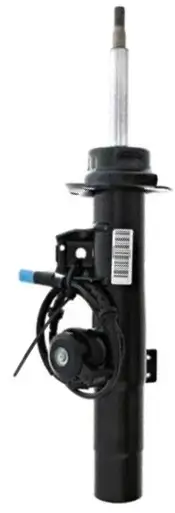 damping force of the shocks or struts rather than actively moving the wheels. The system uses electronically controlled valves inside the dampers to change how quickly they respond to road inputs.
Key components include:
• Electronic dampers or struts – An active suspension damper is a shock absorber that’s part of a fully active suspension system, designed to adjust
its performance in real time based on road conditions, vehicle motion, and driver input.
Unlike a conventional damper, which passively resists suspension movement with fixed or semi-adjustable settings, an active suspension damper is electronically controlled. It can add or remove force to control wheel and body movement. In some designs, an air bag can raise or lower vehicle height.
• Suspension control module – An active suspension control module is the electronic module that manages a vehicle’s active suspension system. It constantly monitors road conditions, driver inputs, and vehicle dynamics, then commands the suspension components to adjust for optimal ride comfort, handling, and stability.
The active suspension control module receives data from multiple sensors, including:
• Wheel-speed sensors
• Steering-angle sensors
• Yaw and acceleration sensors
The active suspension control module then processes that data in real time, using programmed algorithms to determine how the suspension should respond.
• Sends commands to the active dampers, hydraulic actuators, to:
• Alter damping force
• Conteract body roll, pitch, and dive
How An Active Suspension Control Module Differs from Adaptive Suspension Control
An adaptive suspension control module can adjust damping rates based on conditions, but it only modifies shock absorber stiffness. An active suspension control module can also change the suspension’s position and movement by actively adding or lowering ride height.
• Sensors – Ride-height sensors, also
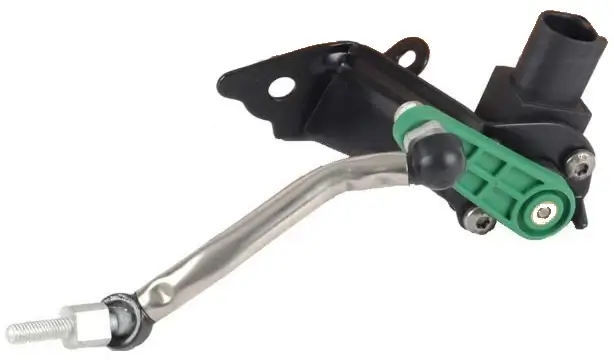
Ride height sensor
referred to as suspension-position or wheel-displacement sensors, provide data used to track suspension movement.
The ride height sensor body itself is attached to the chassis, and the rod is linked to the wishbone or control arm. By measuring both the distance and speed of that movement, the control module can adjust the damper’s internal orifice size to regulate compression and rebound precisely. Any time a sensor is replaced, a control module is reprogrammed, or the vehicle’s battery is disconnected or goes dead, these sensors should be recalibrated to ensure accurate operation.
Ride-height sensors, for example, monitor not only the suspension’s position but also the speed at which it moves. They typically operate on a 5-volt reference signal supplied by the vehicle’s control module. As a magnet passes over an internal coil, the sensor alters the return signal voltage to reflect suspension movement. Most ride-height sensors use a three-wire configuration consisting of a ground, a power feed, and a signal wire.
In practical terms, if you’re driving a sports coupe with adaptive suspension and hit a pothole, the system instantly adjusts the damper stiffness to absorb the impact. If you then take a sharp turn, it can stiffen the outside suspension to reduce body roll. Many adaptive systems also let drivers choose modes like “Comfort,” “Sport,” or “Track” to tailor the ride.
Advantages of Active Suspension
• Ride height control – Can lower the vehicle at high speeds for efficiency and stability, and raise it for rough terrain.
• Superior comfort – Actively cancels out road irregularities.
• Improved handling – Adjusts in real time to counteract body roll and pitch.
Advantages of Adaptive Suspension
• Lower cost than full active systems – Fewer moving parts.
• Selectable ride modes – Driver can tailor the ride to conditions.
• Quick response – Adjusts damper settings in milliseconds.
Common Failures in Active Suspension
Working on active suspension systems, I’ve seen the same failure points repeatedly:
Air leaks – Cracked hoses, worn fittings, or damaged air springs cause compressors to run constantly.
Failed compressors – Often a result of overuse due to leaks.
Damaged ride height sensors – Give false readings and cause incorrect adjustments.
Leaking hydraulic actuators – Loss of pressure leads to sagging corners or uneven ride height.
Faulty control modules – Cause erratic or no adjustment.
Common Failures in Adaptive Suspension
Adaptive suspension systems tend to fail in these areas:
Worn or leaking dampers – Loss of fluid or internal wear reduces control.
Failed solenoids or valves – The Damper can no longer adjust stiffness.
Electrical faults – Broken wires or bad connectors stop signals from reaching the dampers.
Sensor issues – Faulty wheel speed or steering angle sensors can cause the system to default to a “safe” mode.
How to Diagnose Active Suspension Problems
When a vehicle with active suspension comes into my shop, I start by scanning the suspension control module for fault codes. Then I:
1. Visually inspect air lines, springs, and actuators for leaks or damage.
2. Listen for the compressor running excessively.
3. Use a scan tool to command ride height changes and see if the suspension responds.
4. Check ride height sensor data for accuracy.
If a compressor runs too often, it’s usually a leak, not the compressor itself. Replacing the compressor without finding the leak means the new part will fail prematurely.
How to Diagnose Adaptive Suspension Problems
For adaptive suspension, diagnosis starts with a scan tool as well. I then:
1. Check for damper leakage or physical damage.
2. Use the scan tool to command damper stiffness changes and feel for a difference.
3. Inspect wiring to each damper for breaks or corrosion.
4. Verify related sensor data (wheel speed, steering angle).
If the system is stuck in one mode or feels excessively soft or stiff, chances are the damper’s internal valve, or the control solenoid has failed.
Repairing Active Suspension
Repairing active suspension can range from simple to complex. Common repairs include:
1. Air line or fitting replacement – Often inexpensive and quick.
2. Air spring or strut replacement – Requires proper depressurization and recalibration.
3. Compressor replacement – Be sure to address the root cause of failure first.
4. Height sensor replacement – Follow manufacturer calibration procedures.
In some cases, customers opt for delete kits to replace air or hydraulic components with conventional shocks and springs. This can save money but often requires reprogramming to remove warning lights.
Repairing Adaptive Suspension
Adaptive suspension repairs are typically more straightforward:
1. Damper replacement – Always replace in pairs for even handling.
2. Solenoid or valve replacement – Requires careful disassembly.
3. Wiring repair – Inspect connectors for corrosion before replacing expensive parts.
After replacing components, a calibration or reset procedure is often needed so the control module can adapt to the new parts.
Preventive Maintenance for Both Systems
While neither active suspension nor adaptive suspension requires much day-to-day maintenance, you can extend system life by:
• Inspecting for leaks and damage during routine service.
• Keeping suspension components clean and free of road debris.
• Addressing warning lights or fault codes immediately to prevent further damage.
The Future of Suspension Technology
Manufacturers are pushing both active suspension and adaptive suspension further with faster processors, lighter components, and predictive systems that use cameras and GPS to anticipate road conditions. As the technology evolves, repair techniques and tools will also need to keep pace.
©, 2025 Rick Muscoplat
Posted on by Rick Muscoplat