
Control Arm Bushing: What it does and when to replace it
Control Arm Bushing Symptoms You Should Never Ignore
Quick Summary
When a control arm bushing fails, you’ll often feel steering vibration, hear clunking noises, notice uneven tire wear, and experience wandering or unstable braking. As it deteriorates, excess play develops in the suspension, which in turn affects alignment, steering precision, and ride comfort. Replacing a bad control arm bushing restores proper suspension geometry, improves handling, and prevents premature tire wear.
Article
Control Arm Bushing: What It Does, Symptoms of Failure, and How to Replace It
Every vehicle on the road today relies on at least one control arm bushing at the point where the control arm attaches to the frame. If you picture your suspension like a human skeletal system, the control arm bushing acts like cartilage in a joint. It cushions movement while keeping everything aligned and controlled.
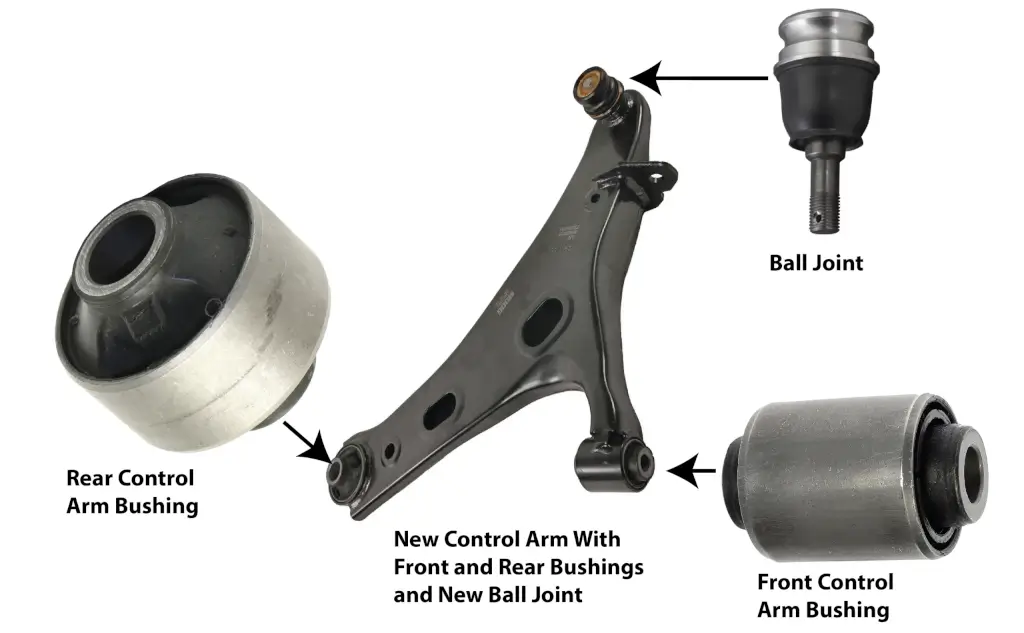
Typical control arm with a front and rear mount control arm bushing
The control arms themselves connect the vehicle’s frame to the steering knuckle, where the wheels and tires mount. In most front-wheel-drive vehicles, you’ll find lower control arms only. Trucks and vehicles with double-wishbone suspension use both upper and lower control arms. At the outer end of the control arm sits the ball joint, allowing steering movement. But at the inner mounting points, it’s the control arm bushing that keeps everything tight and stable.
The typical control arm bushing is made of rubber or polyurethane bonded between two metal sleeves. That rubber core absorbs vibration and isolates road shock while allowing limited movement. Without it, every bump in the road would transmit directly into the chassis.
Over time, however, that rubber deteriorates. Heat, oil contamination, age, and road stress break it down. And when a control arm bushing wears out, the symptoms start showing up in ways most drivers don’t initially connect to suspension problems.
5 Symptoms of a Bad Control Arm Bushing
1) Steering vibration on acceleration — One of the first things I notice when diagnosing a worn control arm bushing is steering wheel vibration. During normal acceleration, that vibration increases. It can feel like a tire imbalance, but it’s actually excessive suspension play. When the bushing allows too much movement, the wheel doesn’t stay firmly positioned, and you get that shaky, unsettled feeling.
2) Steering Wander — Another classic symptom of a failing control arm bushing is steering wander. If the steering wheel pulls left or right without explanation, and the alignment checks out, I immediately inspect the bushings. Even if you align the vehicle perfectly, worn bushings allow the control arm to shift under load. That movement throws alignment off dynamically while driving.
3) Noise — Clunking or banging noises over bumps are another giveaway. When the control arm bushing becomes loose, the control arm can shift and knock against its mounting bracket. You’ll often hear it when driving over rough roads or during braking. Hard braking exaggerates the forward shift of the control arm, making the noise more noticeable.
4) Uneven Tire Wear — Worn control arm bushings create slop that causes excessive tire wear. Many people assume it’s strictly an alignment issue, but worn control bushings are one of the factors that cause alignment to change under load. The result? Tires that look fine one month and show inner or outer edge wear the next.
5) Braking instability — Since the control arm bushings are the attachment points of the control arm to the body, any wear/movement can cause the arm to move forward/backward during braking. During a sudden stop, the front end may rock or feel unstable. That’s because the control arm is shifting instead of holding the wheel firmly in place.
How to Diagnose a Bad Control Arm Bushing
When I suspect a worn control arm bushing, I get the vehicle safely lifted and inspect the bushings visually.
Torn rubber — I check the rubber for bonding to the outer collar or inner spindle. If the rubber is tearing away, it’s time for replacement. Cracks in the rubber are a sign of aging, but not necessarily a reason to replace it.
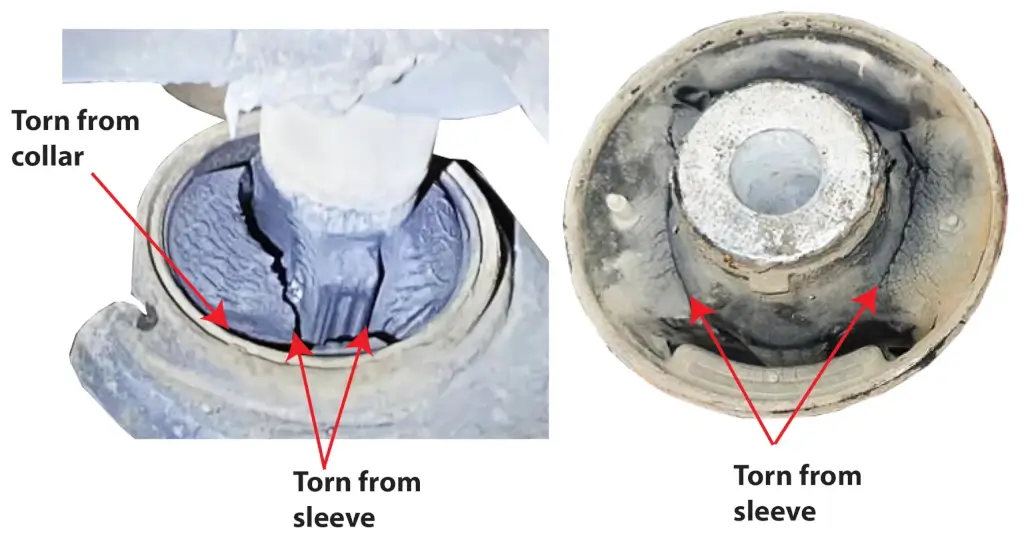
These bushings are beyond just cracking. They’re torn away from the sleeve. On a scale of 1-10, these are both 9s. Replace immediately
Excessive movement between the spindle and the retaining bolt — A bolt secures the bushing to the frame. Rust and wear can cause excessive clearances, causing tire wear and noise. I use a pry bar to gently load the control arm. Excessive movement means the control arm bushing is no longer doing its job. You should see controlled flex — not slop.
How to Replace a Control Arm Bushing
Replacing a control arm bushing can be straightforward — or challenging — depending on the design.
In many modern vehicles, it’s often more cost-effective to replace the entire control arm assembly because it includes new bushings and a ball joint already installed. That saves labor and avoids the difficulty of pressing out old bushings. In other words, you’ll spend more in parts, but less in labor if you replace the entire control arm versus replacing the control arm bushing.
Here’s the general process I follow to replace just the bushing:
• Safely support the vehicle and remove the wheel.
• Disconnect the ball joint from the steering knuckle.
• Remove the control arm mounting bolts securing the control arm to the frame.
• Use a bushing remover/installer tool or a hydraulic press to push the old bushing out and the replacement in. This is often the hardest part. Old bushings can be extremely stubborn. Press the new control arm bushing into place carefully, ensuring correct orientation if it’s directional.
• Reinstall the control arm, torque all bolts to factory specifications. In some cases, the torque specification is for tightening with the vehicle on the ground with the control arm fully loaded. In other cases, you can tighten the bolts with it in the air. Don’t assume! Check the shop manual. Also, sometimes the retaining bolts are torque-to-yield (TTY) and can’t be reused. Check the shop manual and obtain new bolts if yours are TTY. ,
• 4-wheel alignment— Always get a professional alignment after replacing suspension components. Even slight changes in control arm position affect alignment angles.
Replacement Cost
The cost to replace a control arm bushing varies widely. The bushing itself can cost anywhere from $5 to $150. The flat-rate labor guide shows 2-3 hrs of labor to remove the control arm and replace just the bushing. At an average of $140/hr, that’s $280-$420 per side plus parts and an alignment.
If you replace just the bushings, you’re left with an old control arm and ball joint.
However, if you opt to replace the entire control arm, you end up with all new parts. The labor to replace a control arm is typically around 1.5 hrs. per side. As I mentioned earlier, the cost of the control arm adds to the cost, so a control arm replacement typically runs $600 to $750 per side, plus an alignment. But at least you’re getting all new parts.
©, 2026 Rick Muscoplat
Posted on by Rick Muscoplat