
Avoid Paint Failure: How to Prepare Bondo for Primer
Professional Guide: How to Sand and Seal Bondo Before Paint
Quick Summary
The key steps to preparing Bondo for priming are simple but critical:
1) Shape the Bondo with 80-grit.
2) Refine it with 180 grit
3) Finish it with 320-grit
4) Feather the edges correctly
5) Eliminate pinholes
6) Seal everything with epoxy primer before painting.
If you rush the sanding process or don’t fully cure the filler, it will shrink, pinhole, or bleed back through the paint. When you prepare Bondo correctly for primer application, you can skip unnecessary re-priming and go straight to epoxy and paint with confidence.
How I Prepare Bondo for Primer Application (Without Re-Priming the Whole Panel)
I’ve learned that what separates a straight, long-lasting paint job from one that shrinks, cracks, or shows ghost lines is how you handle the Bondo application and finishing before you apply the primer. That’s because most problems don’t show up immediately. They show up weeks or months later. And that’s almost always because you didn’t properly prepare Bondo for primer application.
Pay Attention to Bondo Thickness
There’s no minimum thickness for Bondo, but there is absolutely a maximum — and that’s where a lot of people get into trouble.
I’ve seen guys skim a panel razor-thin and get excellent results. I’ve also seen people pile on body filler like they’re frosting a cake. That’s where repairs start to fail.
As a rule, you don’t want body filler thicker than about 1/4 inch. Can it be done? Sure. Will it hold up long term? That’s a different story. When filler gets too thick, it becomes unstable. Over time, it can shrink, crack, or peel through the paint, or in worst-case scenarios, separate from the panel entirely. And yes — I’ve seen slabs of filler literally pop off years later because someone tried to fix metal damage with mud instead of metal work.
Here’s the guideline I follow: if the dent is deeper than about 1/8 inch, you should do metal correction first. That means hammer and dolly work, pulling, shrinking — whatever it takes to bring the metal back close to its original contour before you ever mix filler.
Bondo is not meant to rebuild panels. It’s meant to fine-tune them.
Your paint job is only as good as what’s underneath it. That deep gloss and smooth finish depend on a solid foundation. Simply troweling on thick filler might feel like the easy button in the moment, but shortcuts in bodywork have a way of coming back to haunt you. The repair might look fine today — straight, smooth, ready for primer — but years down the road, that heavy filler can shrink, crack, or fail.
If you want repairs that last, move the metal first. Then use filler sparingly, as it was intended — as a thin shaping material, not a structural solution.
Steps to Apply and Sand Bondo
Identify the Low Spots
Before applying fresh Bondo, I block-sand the area with 80-grit. Not aggressively — just enough to break through the primer and expose the low areas. The goal isn’t to destroy the panel; it’s to create a mechanical “tooth” so the new filler bonds properly.
This step is critical. If you try to skim over the slick primer without breaking it down, the Bondo won’t adhere correctly. And if it doesn’t adhere correctly, it will fail later.
Blend and Mix the Bondo Properly
Mix the Bondo with the hardener,
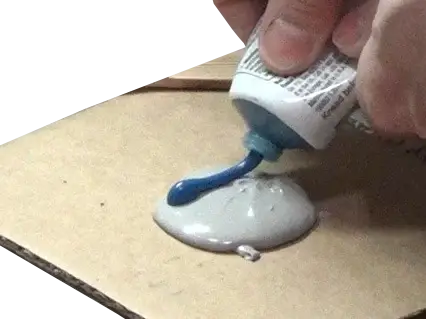
Scoop out a dollop of Bondo and place it on a non-porous mixing board (NEVER cardboard). Then apply a ribbon of hardener down the middle. Then mix thoroughly.
then add a small amount of polyester finishing glaze to improve flow and reduce pinholes. That gives you a creamy, smooth consistency that spreads easily and sands predictably.
The mix is crucial. Use a 1:1 ratio. For every 1-inch diameter of filler, add 1 inch of hardener. In other words, a 4-inch-diameter puddle of filler requires a 4-inch ribbon of hardener at room temperature.
If it is hotter (above 85 degrees), use slightly less; if it is colder (below 65 degrees), use slightly more. If your filler hardens too fast, you used too much; if it takes too long, you didn’t use enough. You only want to mix what you can use in about 10 minutes. Properly mixed, body filler will begin to thicken in 10-15 minutes and be fully cured in 30 minutes. Until you get the hang of mixing, it is wise to buy a bit more plastic body filler than your project needs so you have room to try again without running back to the store.
Once applied to the mixing board, slowly pull the filler across itself to mix it in an X pattern. then scoop up the Bondo and turn it over. This will reduce the air pockets, which become pinholes in your body work. Don’t stir or whip the body filler while mixing it. That will form air bubbles in the filler, which means more pinholes to fix later. Mix in a slow and deliberate figure-X pattern, wiping the filler across itself.
Let the filler cure for a full 30–45 minutes, depending on shop conditions. There’s no rushing this process.
Shape the Filler — Not the Whole Panel
Once cured, I hand-sand the Bondo with 80-grit. And I mean hand sand— no air tools. Concentrate only on the repaired area. Don’t sand across the entire panel.
Use a long sanding block and apply pressure toward the front of the sanding block, allowing the trailing edge to feather the edges of the Bondo smoothly into the surrounding primer.
Feathering is everything
When you properly apply and sand Bondo for primer application, the edges should disappear into the panel. You should not feel a ridge when you close your eyes and run your hand across it.
Refine the Scratch Pattern
Once the filler is shaped with 80-grit sandpaper, I switch to 180-grit and extend my sanding slightly beyond the repair. That blends the surrounding primer and refines the scratch pattern.
Never stop with just 80-grit. If you don’t move up the grits, those 80-grit scratches will telegraph through the paint.
Then finish with 320-grit dry. In my experience, 320 dry is comparable to about 600 wet in terms of paint readiness. At this stage, the surface should feel glass-smooth and look uniformly feathered. If you see pinholes, stop and address them now. Never ignore them.
Clean and Seal with Epoxy Primer
Once the sanding is complete, blow off the dust and wipe the panel down. At this point, the repair area is ready.
Apply a coat of epoxy primer. If you’ve done your job, the epoxy primer will permanently seal everything. Epoxy doesn’t shrink like 2K primer can. It locks the repair down.
If the bondo is fully cured and sanded properly before epoxy, it stays stable. From the epoxy, go straight to paint.
What Happens If You Don’t Do It Right?
If you rush the curing time, the Bondo will shrink.
If you don’t feather correctly, you’ll see rings in the paint.
If you don’t refine the scratch pattern, sanding marks will show.
If you don’t properly prepare Bondo for primer application, the repair may look good today and terrible six months from now.
Bodywork, patience, and discipline.
Learn how to properly prepare Bondo for primer application to prevent shrinkage, pinholes, and paint failure with pro sanding techniques.
Posted on by Rick Muscoplat