
Battery Maintainer vs Trickle Charger: Understanding the Difference
What’s the difference between a battery maintainer vs a trickle charger?
While they may seem similar at first glance, these tools serve different purposes and are best suited for different situations. In this article, we’ll explore the differences between a battery maintainer vs trickle charger, discussing their functions, benefits, and when to use each one.
Understanding Battery Maintainers
A battery maintainer, often referred to as a smart charger or a battery tender, is an advanced device designed to keep a battery at its optimal charge level over extended periods. Unlike traditional chargers, which may continuously apply a charge until turned off, a battery maintainer monitors the battery’s voltage and only provides power when necessary. Once the battery reaches full charge, the maintainer either stops charging or switches to a “float” mode, where it supplies just enough power to offset the battery’s natural self-discharge.
How a Battery Maintainer Works
Battery maintainers are equipped with microprocessors that monitor the battery’s condition. They adjust the charge rate based on the battery’s needs, preventing overcharging and ensuring the battery stays at the correct voltage. After the battery reaches full charge, the maintainer switches to a float mode, where it supplies a small current to maintain the battery’s charge. This is particularly useful for vehicles or equipment that are stored for long periods, such as seasonal vehicles, boats, or lawnmowers.
Many battery maintainers come with built-in safety features, such as reverse polarity protection, short circuit protection, and automatic shutoff, making them safe to use for extended periods without supervision.
When to Use a Battery Maintainer
If you have a vehicle or piece of equipment that you don’t use frequently, a battery maintainer is ideal for keeping the battery fully charged and ready to go when you need it. This is especially useful if you’re working remotely and rarely use your vehicle or use it only for short trips. That kind of usage can leave your car battery in a constant state of discharge, causing battery sulfation and early failure.
A battery maintainer is also great for keeping the battery fully charged in a classic car, motorcycles, boat, RV, and seasonal small engine equipment that may sit idle for months at a time.
A battery maintainer extends the life of your battery by keeping it fully charged without overcharging it, as it possible with a trickle charger.
What is a trickle battery charger?
Trickle battery chargers work by providing a very small (sometimes less than 0.03-amps) of constant current to the battery to maintain its capacity. A trickle charger is not designed and should not be used to recharge a completely discharged battery. Its sole purpose is to maintain a battery at its full state of charge, over a long period, by replacing the amount of the battery lost through normal self-discharge.
Normally, trickle chargers don’t contain voltage-regulation circuitry, so the small current, when used over a long period may cause lead plate grid corrosion, ultimately damaging the battery.
In reality, a trickle charger is an obsolete device, being replaced by modern battery maintainers.
What is a float charger?
Unlike trickle chargers that supply a constant low current (low amps), float chargers maintain the battery at a full charge by supplying a constant voltage that is slightly higher than open-circuit, but lower than a typical charge voltage. This causes a very small current to flow. At the ideal voltage, a float charger causes less lead plate grid corrosion when compared to a trickle charger.
Key Differences: Battery Maintainer vs Trickle Charger
Charging Process
• Battery Maintainer— Automatically adjusts the charge rate and switches to float mode once the battery is fully charged. Prevents overcharging and deep discharging.
• Trickle Charger— Provides a constant low-level charge without automatic adjustments. Requires manual monitoring to avoid overcharging.
Safety Features
• Battery Maintainer— Equipped with safety features like reverse polarity protection, automatic shutoff, and short circuit protection, making it safe for long-term use.
• Trickle Charger— Typically lacks advanced safety features, requiring careful monitoring during use to prevent potential battery damage.
When to use each type
• Battery Maintainer— Ideal for long-term storage and battery preservation, particularly for vehicles and equipment that are not used frequently.
• Trickle Charger— Suitable for short-term charging needs, where the battery needs a slow charge over a limited period.
Cost and Complexity:
Battery Maintainer: Generally more expensive and complex due to its smart technology and safety features.
Trickle Charger: More affordable and straightforward, making it a good option for those with simpler charging needs.
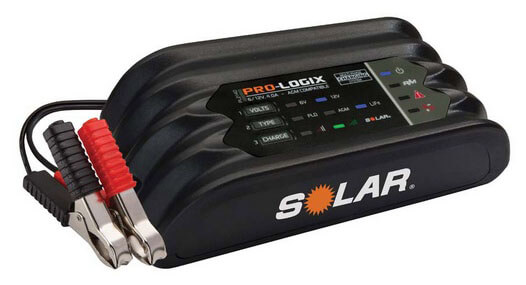
Clore/Solar ProLogix PL2140 battery maintainer
Since batteries self-discharge at the rate of up to 4% per month, the battery maintainer remains in a standby state until the voltage falls to a set level, at which point it activates to recharge the battery to a full state of charge.
Example of a Clore/Solar ProLogix battery maintainer
The Clore/Solar ProLogix PL2140 battery maintainer uses a proprietary Multi-Stage charging process designed to optimally charge and maintain batteries.
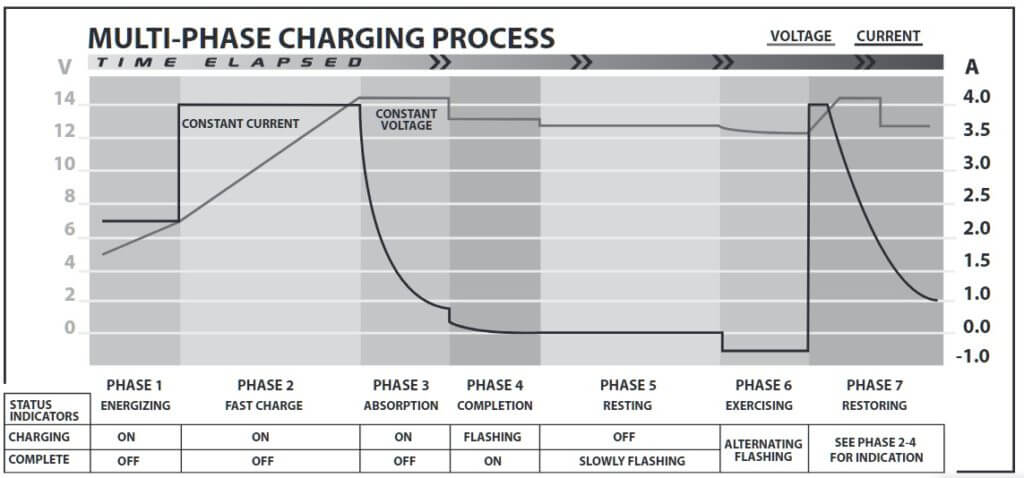
PL2140 charging process
ENERGIZING PHASE
The charging process includes an initial energizing mode in which the charger determines the best charging path for the connected battery. From there, the charger can enter the Fast Charge stage (most cases), Soft Start Mode, Battery Recondition Mode or stop the charging routine because unsafe battery conditions (short, etc.) are detected.
SOFT START MODE
Soft Start Mode is activated when the charger is connected to a deeply discharged battery. This mode protects the battery during the initial charge period, as the battery’s voltage rises to a more normal level, and is beneficial for the long-term health of the battery.
BATTERY RECONDITION MODE
During the Energizing Phase, if the charger detects the presence of battery sulfation, it will activate this mode. If this occurs, the CHARGING LED will flash. This indicates the charge time will be extended while the charger attempts to recondition the battery.
PHASES 5-7: IDEAL BATTERY MAINTENANCE
A key feature of this charger is how it manages a battery that remains on the charger after a complete charge has been achieved, such as during the storage of a seasonal use vehicle. Once the charger reaches the Resting Phase, its output is virtually turned off, except to occasionally monitor battery condition. This is beneficial for the connected battery, as it reduces chemical reactions within the battery compared to traditional charger maintenance modes. This greatly reduces the chance of damaging a battery in long-term storage. In the resting phase, the charger will enter a low power mode, when only the green “Complete” LED flashes slowly. To resume normal operation, press any key to reactivate the display. In addition, in Phase 6 Exercising, we introduce a load on the battery, simulate active use, and then recharge the battery.
For all uses a battery maintainer outperforms the other types
By constantly monitoring the battery’s condition and
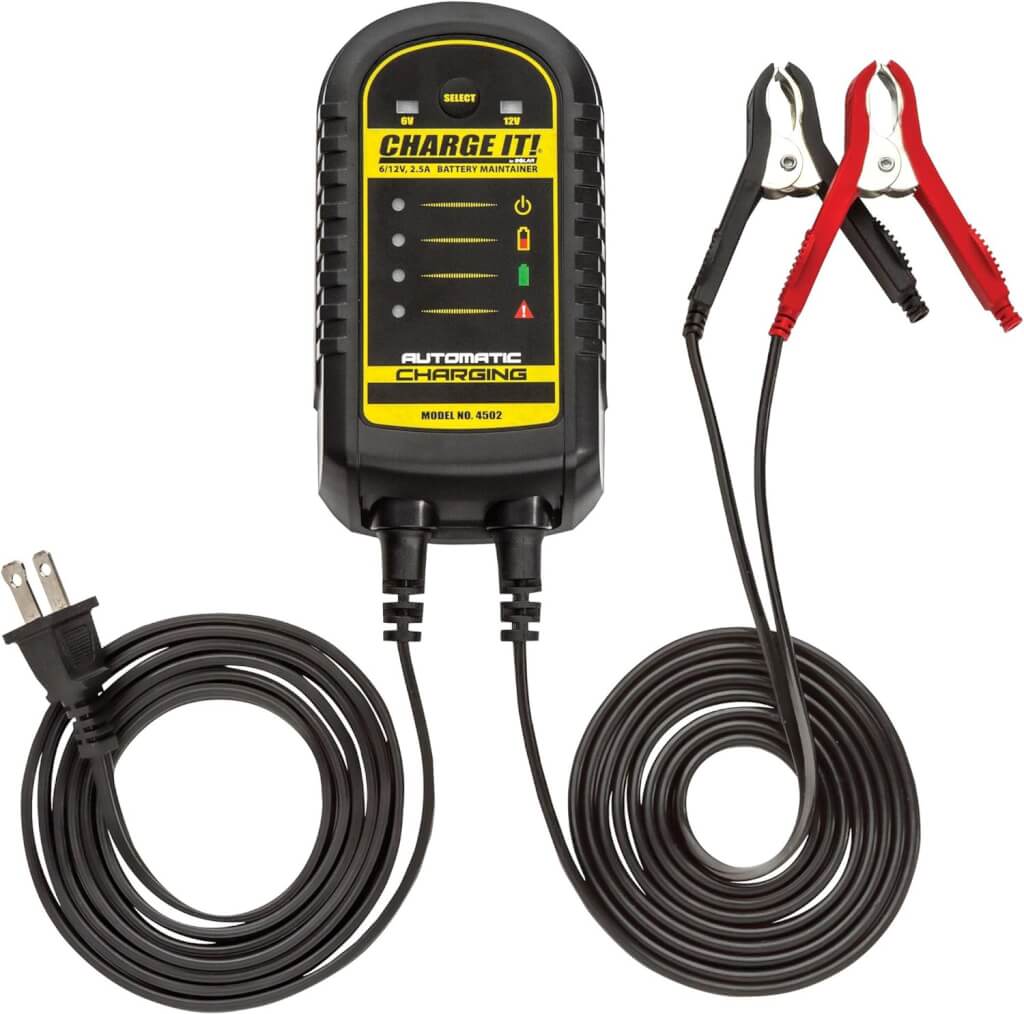
Clore Automotive CHARGE IT! 4502 6/12 Volt 2.5 Amp Battery Maintainer
adapting the charge to meet the battery’s needs, a battery maintainer is a much better choice than a trickle charger or float charger.
©, 2020 Rick Muscoplat
Posted on by Rick Muscoplat