
Brake Fluid Flush Cost: What You Should Expect to Pay
Real Cost of a Brake Fluid Flush (And What Affects It)
Quick Summary
Most drivers will pay between $150 and $250 for a brake fluid flush. The biggest factor isn’t the cost of the fluid—it’s the labor. Brake fluid itself is cheap, but the time, equipment, and potential complications drive the price. If everything goes smoothly, it’s a quick job. But if bleeder screws are seized or components are corroded, the cost can climb fast. Understanding what affects brake fluid flush cost helps you avoid overpaying—and spot when something isn’t right.
What a Brake Fluid Flush Really Is (From a Technician’s Perspective)
I’ve done hundreds of these over the years, and I can tell you—this isn’t just a “fluid swap.”
A proper brake fluid flush involves pushing fresh fluid through the entire system while forcing out the old fluid, moisture, and contaminants. It’s done under pressure using specialized equipment connected to the master cylinder reservoir.
The process typically involves:
• Pressurizing the system (usually around 15 psi)
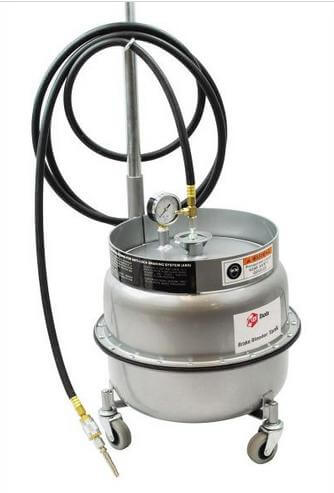
Pressurized brake fluid bleeder
• Opening bleeder screws at each wheel
• Flushing fluid until clean fluid appears
• Repeating the process at all four wheels
Done correctly, it replaces nearly all the old fluid—not just what’s in the reservoir.
Average Brake Fluid Flush Cost (Real-World Numbers)
Let’s get right to the numbers. A typical brake fluid flush procedure takes .75-1,0 of shop labor. At an average hourly rate of $140/hr (2026 – independent shop, but upwards of $200/hr at a dealer)
• Typical brake fluid flush cost: $150 to $250
• Fluid cost: Under $20
That tells you everything you need to know—the fluid is cheap. You’re paying for labor and expertise.
What Factors Affect The Final Brake Fluid Flush Cost
This is where things get interesting, because not all brake fluid flushes cost the same. Here’s what actually drives the price.
1. Labor Rate (The Biggest Factor) — The number one driver of brake fluid flush cost is the shop’s hourly rate.
• Dealerships: Highest cost
• Independent shops: Moderate
• Quick lube shops: Lowest (but often lowest quality)
Since the job takes about an hour, even a small difference in hourly rate makes a noticeable impact.
2. Condition of Bleeder Screws — This is something most customers never think about—but technicians deal with it all the time. If the bleeder screws open easily, the job is straightforward.
But if they’re:
• Rusted
• Seized
• Rounded off
Now the job gets complicated.
• A seized bleeder may require extra labor — Worst case: drilling it out or replacing the entire caliper
That’s when a simple brake fluid flush can turn into a much larger repair bill.
3. Type of Vehicle — Not all vehicles are equal when it comes to brake service.
• ABS system complexity
• Electronic brake systems
• Number of bleed points
• European vs domestic designs
Some vehicles require scan tools to cycle ABS valves during a flush, which adds time and cost.
4. Brake Fluid Type — While fluid is relatively inexpensive, the type still matters.
DOT 3: cheapest
DOT 4: slightly more expensive
DOT 5: Most expensive
DOT 5.1: Slightly more expensive than DOT 3 or DOT 4
Specialty fluids (performance or Euro): higher cost
Even then, fluid rarely adds more than $20–$40 to the total bill.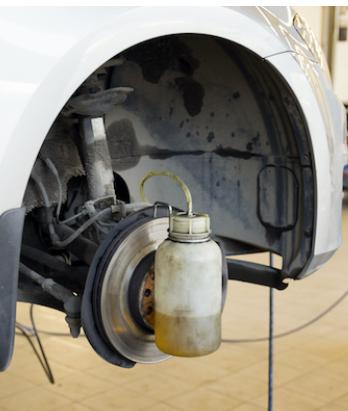
5. Shop Equipment and Method — A professional shop uses a pressure bleeder or vacuum system. That ensures a complete flush.
• Cheaper shops may:
• Gravity bleed
• Do partial fluid exchanges
That might lower the price—but it also lowers the quality of the service.
The technician raises the vehicle and attaches a drain tube and drain bottle to one of the bleeder screws on the rear wheel.
Where You Get the Service Matters
If you want to control brake fluid flush cost, where you go matters just as much as what you get.
• Dealership: Highest price, factory-trained techs (although it doesn’t really take factory training to perform a brake fluid flush. Don’t get this service done at a dealer, thinking that you’re getting a better job. Any shop can perform this service, and it will always cost less at an independent shop)
• Independent shops: Significantly lower price than a dealer.
• Quick lube shops: Cheapest—but higher risk of mistakes
I’ve seen more brake service issues come out of quick lube shops than anywhere else. This isn’t the job to cut corners on.
When a Brake Fluid Flush Costs More Than It Should
Here’s where I tell people to pay attention. If you’re quoted well above $250, ask why.
Legitimate reasons include:
• Seized bleeder screws
• Additional repairs needed
• ABS system service requirements
But if the only justification is “your fluid is dark,” that’s not a valid reason by itself. (As you already know, color alone doesn’t determine condition.)
©, 2021 Rick Muscoplat