
Brakes squeak when stopping slowly: Common Causes
Why Brakes Squeak When Stopping Slowly
Experiencing squeaking brakes when stopping slowly can be a common yet concerning issue for drivers. Understanding why this happens can help diagnose and address the problem effectively. This article delves into the reasons behind brake squeaks during slow stops and what can be done to fix them.
What causes brake squeaking?
Brake squeaking/squealing is actually a medium frequency noise in the 300Hz to 5,000Hz range in the 0 to high 50’s dB range. It’s caused by vibration between the brake pad friction material and the backing plate or shoe and the caliper or brake plate.
When new brakes are installed, the technician installs new anti-rattle clips that prevent the brake pad backing plate “ears” from vibrating in the abutment or caliper bracket areas. They also apply a dab of high-temperature synthetic brake grease in that same area to dampen the vibrations.
They also install noise reduction shims that dampen the transfer of vibrations from the friction material to the caliper. Noise reduction shims can be as simple as a stamped piece of aluminum to more complicated multi-layer designs with elastomeric vibration absorbing layers between metal layers

Multi-layer brake pad shim
Finally, the technician applies a thin layer of brake grease to the back of the noise reduction shim to further reduce vibration transfer to the caliper.
Degradation of vibration reduction components causes brake squeak when stopping
When the anti-rattle clips, brake grease, and noise reduction shims are degraded, they lose their vibration-dampening qualities. Vibrations outside the hearing range are then transferred to the brake caliper, spindle, and steering knuckle, where they are amplified, causing an irritating squeal.
The brake squeaking happens more often when stopping slowly because you’re using lower pressure, putting your brakes in the medium frequency noise range. As you press harder, the squeaking usually stops.
Worn friction material causes brake squeaking when stopping
New brake pads contain materials to dissipate heat and absorb and dampen vibration while providing adequate stopping power and long life. As the friction material wears down to its service limit, the reduced mass can’t dampen normal brake vibration sufficiently, so it transfers the vibration to the caliper, which amplifies it.
Brake pad backing plate rust and corrosion cause brake squeak
Brake pad backing plates are steel and often painted with an anti-corrosive coating. Over time, that anti-corrosive coating degrades, exposing the steel to water and road salt, causing it to corrode. Rusted brake pad backing plates degrade the noise-dampening ability of the brake pad and the noise-reduction shim.
Rust on rotors causes brake squeal
All rotors rust. Most surface rust is wiped away with successive brake applications. However, if rust is left for long periods, the rotor surface begins to pit, and that rust can cause brake squeaks.
Corroded caliper slide pins cause brakes to squeak at slow speeds
The caliper must move smoothly and retract easily during brake application and release. If the slide pins are corroded, the caliper can stick, causing uneven brake pad pressure, resulting in overheating, glazing, and brake squeaks.
Stop brake squeaking when stopping
In the automotive industry, brake squeaks are common and referred to as NVH, Noise, Vibration, Harshness
Step 1: Buy high-quality brake pads— Avoid economy and store brand brake pads.
Cheaper store-branded brake pads are designed to make more profit for the store. So they’re made with older less expensive materials that are guaranteed to squeak. They’re also made with low-quality steel backing plates that corrode. See this post on backing plate corrosion.
High-quality pads come with new noise-reducing shims and new anti-rattle clips (where factory-equipped). Noise reduction shim quality also varies widely.
Cheap brake pads have cheap single-layer shims that don’t dampen the transfer of brake vibration. If you buy a set of pads and they don’t come with shims or clips, buy them separately.S ee this post on the noise reduction shims.
Read this post on brake pads and brake jobs
Step 2: Clean everything— Clean all rust off the wheel hub and apply a light coating of moly grease or anit-seize to reduce rusting.
In addition, remove all rust from the abutment areas below the anti-rattle clips. Once you’ve cleaned off the rust, apply a light film of high-temperature brake grease to prevent rust.
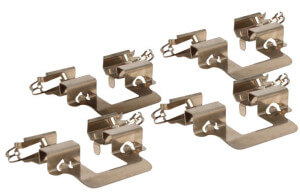
Anti-rattle clips
Then install new anti-rattle clips.
Step 3: Install new shims— Never reuse old noise reduction shims because they lose their vibration-reducing qualities due to heat. Apply a light film of brake grease between the backing plate and the shim to reduce vibration transfer further.
Avoid sticky “disc quieting” products
Several aftermarket manufacturers also sell disc quieting products that attempt to glue the brake pad backing plate to the caliper surface. Use these products ONLY if your vehicle was designed to operate without noise-reduction shims. Do NOT apply these products to noise reduction shims. See this quote from the April ’15 issue of Motor Magazine.
“Disc brake quiet is a gluelike product that’s marketed by several manufacturers. Its purpose is to stop brake squeal and noise by dampening vibration at the caliper/brake pad interface. Manufacturers also claim it provides a tighter fit, allows for easier disassembly, and protects against corrosion. The important thing to be aware of is that this product contains an elastomeric polymer and is designed for use with brake pads that do not have antisqueal pad shims. Use of this product with pad shims may actually be detrimental.”
— Karl Seyfert Motor Magazine, April 2015
Step 4: Clean the caliper slide pins/bolts and lube with fresh high temp brake grease
Fresh grease on the caliper slide pins ensures smooth movement and even brake pad pressure against the rotor.
©, 2015 Rick Muscoplat
Posted on by Rick Muscoplat