
Why Are My Brakes Squeaking After A Brake Job?
Understanding the Most Common Causes of Brake Squeaks
Brake squeaks can be one of the most irritating sounds for drivers, often leading to concerns about the safety and reliability of their vehicle. While some squeaks are harmless, others may indicate underlying issues that need attention. This article will delve into the most common causes of brake squeaks, helping you understand and address these issues effectively.
#1 Cause: Lack of noise-dampening shims and brake grease
Brake squeaks are caused by vibration when the pad contacts the rotor. Think of the rotor as an LP record and the pad itself as the stylus. The pad rides in the microscopic grooves on the rotor and the pad vibrates. The brake pad backing plate is in contact with the caliper and the backing plate steel-to-caliper contact is what “plays” the music. In this case the music is a screeching noise.
Noise reduction shims dampen the vibrations
Car makers utilize noise-reduction shims mounted to the back of the backing plate to dampen the vibrations between the brake pad backing plate and the caliper.

Although they may look like just a piece of metal, high-quality noise reduction shims are actually built with several layers of vibrating dampening materials.
If you’ve had a brake job or done a brake job yourself and didn’t replace the noise reduction shims with new ones, that alone can cause brake screech and brake squeak or squeal. Sometimes, it takes new noise reduction shims to stop the brake squeal and brake screech.
Brake grease also dampens the vibrations
Next, many carmakers recommend the application of high-temperature brake grease between the brake pad backing plate and the areas where the backing plate contacts the caliper. The purpose of the grease is to dampen vibrations. The grease can be plain high-temperature synthetic (silicone), high-temperature synthetic with embedded ceramic particles, or molybdenum. Apply this grease as a light film only. Apply to only those areas of the backing plate that contact the caliper.

Brake grease should be applied to all these spots on the caliper
#2 Cause: Not installing new hardware clips
Most car makers utilize anti-rattle clips to hold the pads in
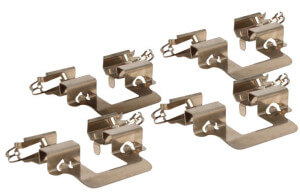
High quality brake pads come with new anti-rattle clips
the caliper or abutment area. These anti-rattle clips are made from stainless steel to prevent rust.
Many DIYers and some shops reuse these clips during a brake job. Bad idea! The clips can rust over time, and the high heat can cause them to lose their tension.
The job of the anti-rattle clip is to apply some pressure to the ears of the brake pad to reduce vibration. High-quality brake pads come with new anti-rattle clips. But economy pads don’t. If you haven’t installed new clips and encounter brake squeal or brake screech, install new anti-rattle clips.
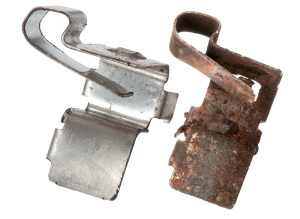
Old rusted anti-rattle clips lose their tension and allow the pad backing plate to vibrate and cause brake squeal
Remove the old anti-rattle clips and clean all rust off the clip mounting surface. Then apply a very light coat of high temperature brake grease to the mounting surface UNDER the anti-rattle clip. The synthetic grease will slow down rust formation and reduce the “rust jacking” effect of rust buildup.
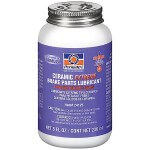
High temperature ceramic brake grease
#3 Cause: Low-quality brake parts
Cheap brake pads make more noise
High-quality brake pads are a perfect blend of abrasive, adherent, and lubricating particles. Cashew shell oil is often used in the mixture to bind and lubricate. However, cashew shell oil is costly, and many cheap brake pads skimp on it or use an inexpensive imitation. As a result, some cheap brake pads chatter and squeal when they hit the brake rotor.
Cheap brake rotors are more prone to the grooving that produces brake squeal
The same quality issues apply to brake rotors. Disc brake rotors are made from grey cast iron. Grey cast iron has a graphitic microstructure due to the inclusion of 6 to 10% graphite. Carbon and silicone are also added to the iron. Silicone works as a graphite stabilizing element.
The solidification rate is just as important as the amount of graphite, carbon, and silicone. Cast iron can take a long time to cool properly, so the crystalline structure forms a peralitic matrix and relieves internal stresses. Economy brake rotors are forced to cool with air or liquid to cut corners, which results in a ferritic matrix.
For more information on brake rotor quality, see this post.
©, 2014 Rick Muscoplat
Posted on by Rick Muscoplat