
Can You Use Your Alternator to Charge a Dead Battery
Dead Battery? Here’s Why Your Alternator Won’t Save You
Quick Summary
A car’s alternator is designed to maintain a fully charged battery — not recharge a dead one. Relying on the alternator to charge the battery from zero can overheat the alternator, shorten battery life, and leave you stranded again soon. Always use a proper smart charger to safely and fully recharge a discharged battery.
Article
Why You Shouldn’t Count on Your Alternator to Charge Your Dead Battery
As a professional who has diagnosed thousands of electrical system failures, I’ve seen a widespread myth that just won’t die: people believe their alternator can fully recharge a dead battery. Sure, the engine might start after a jump, and you drive off thinking everything is fine. But the truth is, the alternator was never engineered to revive a dead battery — only to maintain a healthy one. When you force the alternator to charge a dead battery, you set both parts up for premature failure.
Why Charging a Dead Battery is Bad for Your Alternator
High current draw: A deeply discharged battery behaves like a large electrical load when the engine starts. It can draw 50, 100, or even more amps from the alternator while it charges. That heavy draw forces the alternator to operate at maximum output, generating far more heat than it was designed to handle for a prolonged period. When that heat builds up, it begins to take a toll on the internal components — bearings dry out, diodes overheat and fail, and the stator windings can literally cook themselves. It’s one of the quickest ways to burn out a perfectly good alternator.
Voltage issues: There’s also a serious voltage control problem. Charging a dead battery while driving causes the alternator to constantly adjust the charging voltage and current as engine RPM fluctuates (as you speed up and slow down). The result is voltage spikes that threaten the most sensitive electronics in the car — the modules, sensors, and computer systems that keep modern vehicles running.
Finally, the alternator simply isn’t capable of delivering the type of charge a dead battery needs. A heavily depleted battery requires a slow, controlled, multi-stage charge cycle to restore its chemistry properly. Instead, the alternator delivers an unstable, high-current surge that overheats the plates, accelerates sulfation, and leaves the battery still weakened even if it appears to recover briefly.
A smart battery charger doesn’t have either of those issues. It controls charging current and voltage.
Why a Smart Battery Charger Does a Better Job Than Your Alternator
Multi-stage charging is a process used by smart battery chargers to safely and efficiently recharge lead-acid batteries. It works by applying different charging phases, each with a specific purpose to maximize battery life and performance. Here’s how it works:
1. Stage 1: The Bulk Stage — The charger outputs a constant current to restore most of the battery’s charge quickly. The bulk stage continues until the battery reaches about 70–80% of its capacity. This is the fastest stage, but it stops before overcharging can occur.
2. Stage 2: The Absorption Stage — Now the charger maintains a constant voltage to bring the battery close to full charge while slowly lowering the amperage. This prevents damage to the plates and electrolyte by slowing down the charge rate.
3. Stage 3: The Float Stage — Next, the charger lowers the voltage to supply just enough current to counter self-discharge.

This chart shows the multi-stage approach used in Clore solar ProLogix battery chargers.
The Best Reason to Recharge a Battery With a Smart Charger: It costs less
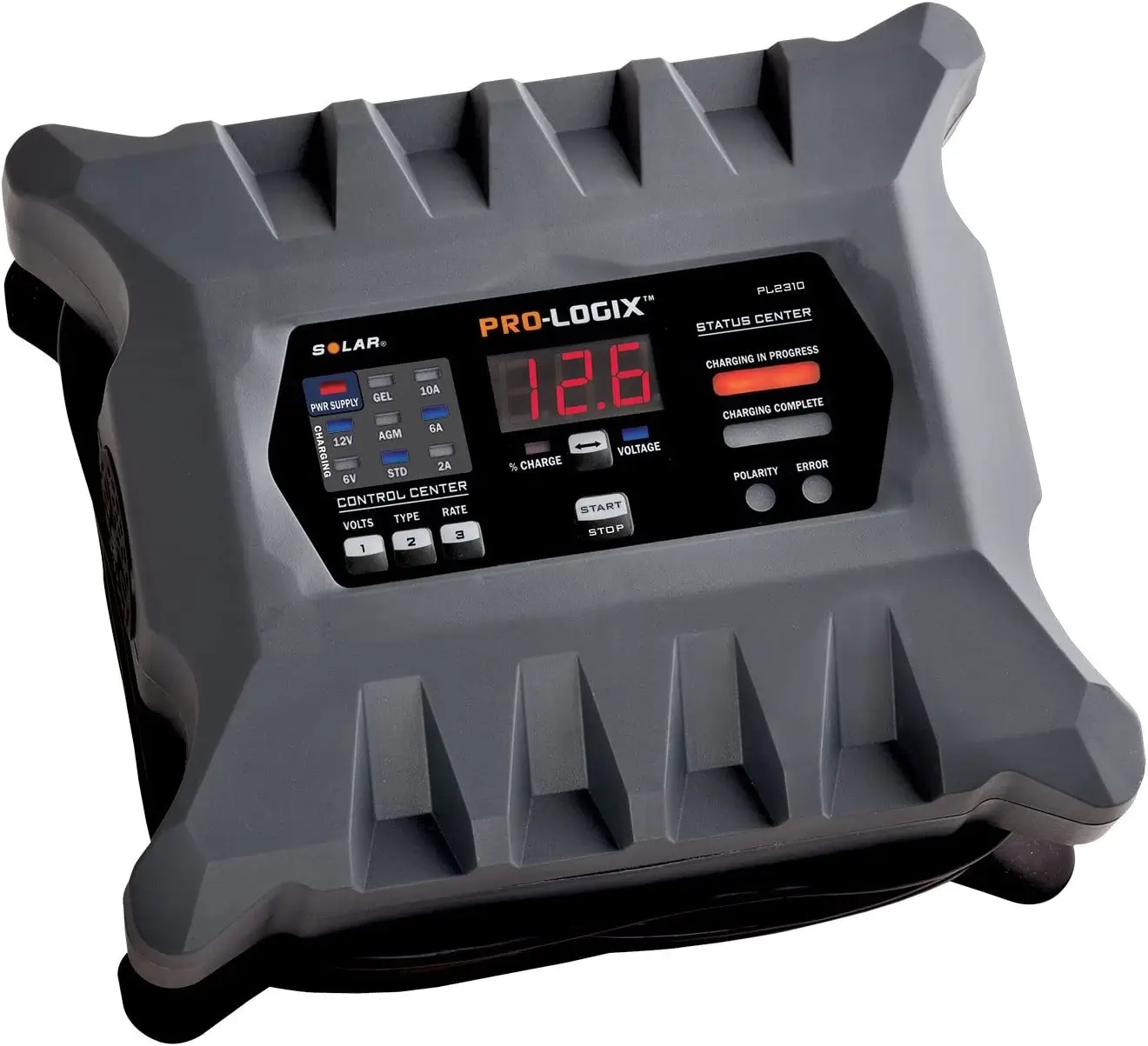
When people rely on the alternator to revive a dead battery, they usually do so to avoid spending money on a charger. But the financial reality couldn’t be more backwards. The image below shows a Clore ProLogix smart battery charger. It costs less than $100 from online sellers. It’s a one-time purchase that can be used for every vehicle in the household for years.
Now compare that to the cost of replacing a cooked alternator. Even a low-output alternator on a small sedan can run $350 to $600 installed. For trucks, SUVs, or vehicles with high-output alternators or tight engine packaging, that cost can easily rise to $800, $1,200, or even higher — especially if labor involves removing brackets, intake manifolds, or other components. And that doesn’t include the potential for collateral damage — voltage spikes from an overworked alternator can fry modules and sensors that cost thousands more.
So the math is simple: Spend $100 once… or spend $600–$1,200 later.
If the battery is already weak or sulfated, you may still end up buying a replacement.
When you look at the real financial consequences, investing in a smart charger isn’t expensive — it’s cheap insurance. You’re protecting your alternator, preserving your battery, and preventing a roadside breakdown that could cost you even more in towing and lost time.
©, 2025 Rick Muscoplat