
Car AC Condenser vs Radiator vs Intercooler: Complete Guide
Why Your Car Has Three “Radiators” (And What Each One Does)
Quick Summary
If you’re trying to understand the difference between a car AC condenser versus radiator, charge air cooler, and intercooler, here’s the straight answer from years of hands-on diagnostics:
• The car AC condenser removes heat from the refrigerant so your AC can blow cold air
• The radiator removes engine heat from the coolant (anti-freeze) to prevent engine overheating
• The charge air cooler (intercooler) removes heat from the compressed air from a turbo or supercharger for better performance
All three look similar, but they operate in completely different systems
Most failures come down to leaks, airflow restriction, or internal blockage
I’ve diagnosed countless overheating engines and AC systems that “just needed a recharge”—but the real problem was a plugged condenser or restricted radiator. So let’s break this down the right way.
Car AC Condenser vs Radiator: Why People Confuse Them
I get this question all the time: “Is the condenser the same as the radiator?” They’re not—even though they sit right next to each other and look similar. Both are heat exchangers. Both rely on airflow. But they serve completely different systems.
• The radiator is part of the engine cooling system
• The car AC condenser is part of the air conditioning system
• The charge air cooler (intercooler) belongs to the forced induction system
What a Car AC Condenser Does (And How It Works)
The condenser’s job is simple in theory—but critical in practice. When refrigerant leaves the compressor, it’s:
• Hot
• High pressure
• In a gaseous state
The condenser removes heat, causing the hot gas to condense into a liquid. The condenser is like a mini radiator for your AC system—but instead of cooling coolant, it cools refrigerant.
As air passes through the condenser fins:
• Heat is pulled out of the refrigerant
• The refrigerant condenses into a liquid
• That liquid then moves to the expansion device
If the condenser can’t remove heat, your AC won’t cool—period.

This image shows a car AC condenser
Where is the condenser located?
Your car’s AC condenser is located behind the grille but in front of the radiator, as it needs direct exposure to outside air to dissipate heat efficiently.

This image shows how the car’s AC condenser is located in front of the radiator. In this image, notice how much dust and dirt the condenser has collected. This dramatically reduces the vehicle’s AC efficiency.
What a Radiator Does (And Why It’s Critical)
Now let’s talk about the radiator. The radiator removes heat from the engine coolant. Without it, your engine would overheat in minutes. Hot coolant leaves the engine and enters the radiator, where:
• Airflow pulls heat away
• The coolant cools down
• It cycles back into the engine
The key difference in the car AC condenser versus radiator comparison:
• The condenser handles the refrigerant heat
• The radiator handles engine heat
Different fluids. Different systems. Same basic principle—heat transfer.
The Types of Radiators and the Pros and Cons of Each
Downflow design — In a downflow radiator, coolant enters at the top tank, flows vertically downward through vertical tubes, and exits at the bottom tank. This was the dominant design for most of the 20th century.
Advantages: Simple and reliable, gravity assists coolant flow, and they’re generally easier to manufacture. They also tend to have a taller profile, which suits older vehicle engine bays well.
Disadvantages: The vertical tube length limits the coolant’s contact time with the fins, reducing cooling efficiency. They also require more vertical space, which is increasingly scarce in modern, aerodynamically designed engine bays.
Crossflow Radiators — In a crossflow design, the tanks sit on the left and right sides, and coolant flows horizontally across the core. This became the standard in most modern vehicles from the 1980s onward.
Advantages: The wider, lower profile fits modern engine bays much better and allows for a larger core surface area without increasing height. Horizontal flow also integrates more naturally with pressurized cooling systems and enables better coolant distribution throughout the core.
Disadvantages: Slightly more complex plumbing and, in some designs, coolant can stratify (separate by temperature) across the horizontal span if not engineered carefully. They can also be marginally harder to bleed air from than a downflow design.
In practice, crossflow radiators win out in almost every modern application simply because of packaging — the engine bay’s shape dictates the design more than any thermodynamic preference.

Typical downflow or vertical flow radiator
What a Charge Air Cooler (Intercooler) Does
Now we add the third player: the charge air cooler, often called an intercooler.
This is where a lot of DIYers get tripped up.
If your engine is turbocharged or supercharged, air gets compressed before entering the engine. That compression creates heat, and hot air is less dense. The intercooler fixes that.
What it does:
• Cools compressed intake air
• Increases air density
• Improves power and efficiency
Types of charge air coolers:
• Air-to-air intercooler (most common)
• Air-to-water intercooler (more complex systems)
So, in the car AC condenser versus radiator, charge air cooler, intercooler comparison:
• Condenser = cools the refrigerant
• Radiator = cools coolant
• Intercooler = cools intake air
Three different systems, three different fluids, one common goal—heat removal.
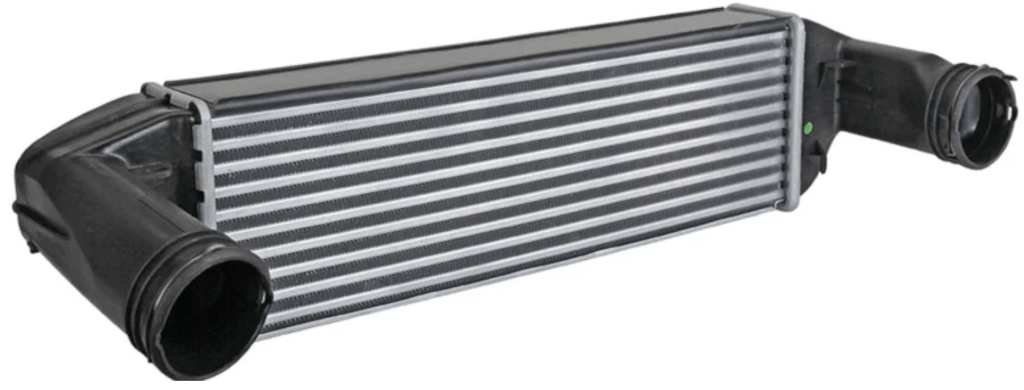
This image shows a typical charge air cooler, also called an intercooler
Why These Components Sit in the Same Location
You’ll usually find all three stacked at the front of the vehicle. From front to back, it typically looks like:
• Car AC condenser
• Charge air cooler (if equipped)
• Radiator
Why?
Because they all need maximum airflow. And airflow is everything when it comes to heat exchangers.
How a Car AC Condenser Fails
After years in the shop, I can tell you most condenser failures fall into a few categories.
Common failure modes:
• External damage (rocks, debris, road salt corrosion)
• Leaks at seams or tubes
• Clogged fins from dust and dirt, bugs that restrict airflow
• Internal restriction from degraded oil, acids, degraded rubber hose, and sludge (especially after compressor failure)
Real-world symptoms of a failed AC condenser:
• AC blows warm even after a recharge
If head pressure is too high, suspect airflow or condenser efficiency—not just low refrigerant.
How a Radiator Fails
Radiators fail in different ways, but the root causes are similar.
Most common failures:
• Internal clogging (old coolant, corrosion)
• External blockage (bugs, dirt, debris)
• Leaking tanks or seams
• Plastic tank cracking
What I see most:
Engines that overheat at highway speeds? That’s often a restricted radiator—not a bad thermostat.
How a Charge Air Cooler (Intercooler) Fails
The charge air cooler is often overlooked in diagnostics.
Typical failures:
• Boost leaks from cracked end tanks or hoses
• Oil contamination from turbo seals
• Internal clogging (rare but possible)
• Physical damage from debris
Symptoms I look for:
• Loss of power
• Turbo lag
• Whistling or hissing under boost
• Rich or lean fuel trim issues
A leaking intercooler can throw off airflow readings and cause drivability problems that get misdiagnosed as sensor issues.
Diagnostic Insight: What Most People Get Wrong
Here’s the mistake I see all the time: Someone replaces a compressor, refills refrigerant, and the AC still doesn’t work. Why?
Because they didn’t check:
• Condenser airflow
• Cooling fan operation
• Internal restrictions
The same goes for overheating:
• People jump to the thermostat
• But ignore a partially clogged radiator
And with turbo engines:
• They blame sensors
• Instead of pressure-testing the charge air cooler system
• Car AC Condenser vs Radiator vs Intercooler: The Bottom Line. When you really understand the differences between the car AC condenser, the radiator, the charge air cooler, and the intercooler, diagnosing problems gets a whole lot easier.
They may look similar—but they:
• Handle different fluids
• Serve different systems
• Fail in different ways
And if you misidentify one, you’ll misdiagnose the problem.
See this post to learn about AC condenser replacement cost
©, 2024 Rick Muscoplat
Posted on by Rick Muscoplat