
Common Causes of Brake Pulsation and Judder
Debunking the Myth of Warped Rotors: Brake Pulsation Explained
As someone who has spent decades diagnosing brake problems, I can tell you firsthand that when a driver complains their car shakes when braking or their brake pedal pulses, the knee-jerk explanation of warped rotors is almost always wrong. What’s really happening is a condition called disc thickness variation (DTV), caused by lateral runout. Yet, the myth of warped brake rotors persists—even among professional technicians.
Why the “Warped Rotors” Story Doesn’t Hold Up
The idea that brake rotors warp under heat is a long-standing myth. In truth, rotors don’t physically bend like a potato chip. Brake rotors don’t really “warp” in the sense of softening and bending from heat. They’re made of cast iron, and the temperatures reached in normal and even heavy braking are well below the point where iron loses shape.
Scientific facts to back up the statement that brake rotors don’t warp
1) There isn’t a street vehicle on the planet that can produce the 2,150°F needed to soften cast iron rotors enough to warp them, not even after braking down the mountainside. Here’s why:
• Normal braking temperatures: Under everyday braking, rotor surface temperatures typically range from 200°F to 400°F (93°C to 204°C).
• Hard braking: Aggressive braking can push rotors into the 700°F to 1,200°F (371°C to 649°C) range. However, OEM and street use aftermarket pads experience brake fade at 570°F – 662°F. Brake resin odor is present, and fade has reduced your braking ability to almost zero, using OE and street brake pads.
• At 850°F, brake pads begin to smoke
• At 1,200°F, the brake pad friction material begins to carbonize.
2) Cast iron stability: Cast iron doesn’t begin to plastically deform (“warp” like sheet metal) until it’s above 1,600°F (871°C), and it doesn’t soften or melt until around 2,150°F (1,177°C).
So What Causes Brake Pedal Pulsation?
What causes the pulsation is uneven friction material transfer from the brake pads to opposite sides of the brake rotor. This is called Disc Thickness Variation, and it’s the cause of brake pedal pulsation.
em>
Disc Thickness Variation Caused By Lateral runout is the single most common cause of brake pulsation.
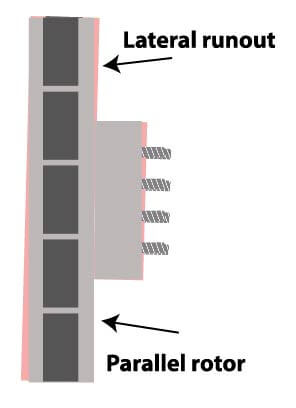
This is an exaggerated image of a rotor that’s not parallel with the wheel hub or steering knuckle, causing it to rotate in a slight wobble.
Car makers post specifications for maximum lateral runout. On some vehicles, the allowable lateral runout is as low as .002.” If the runout exceeds that, you’ll wind up with a slight rotor wobble, causing opposite sides of the rotor to contact the brake pads.
If the pads are made from NAO or ceramic material, they’ll deposit excess pad material onto the rotor face. If the pads are semi-metallic, they’ll wear down opposite sides of the rotor. Both cause brake pedal pulsation.
DTV is felt in the brake pedal, with the pedal rising and falling slightly with each rotation of the rotor. This type of brake pulsation is different than the judder described below that’s felt in the steering wheel or the driver’s seat.
1) Rust on the wheel hub is the #1 cause of lateral runout that causes DTV and brake pulsation
The image on the right shows a wheel hub covered in rust. If you slap a new rotor on that wheel hub, you will get lateral runout, disc thickness variation, and brake pulsation. Cleaning the rust off the hub is critical to performing a proper brake job.
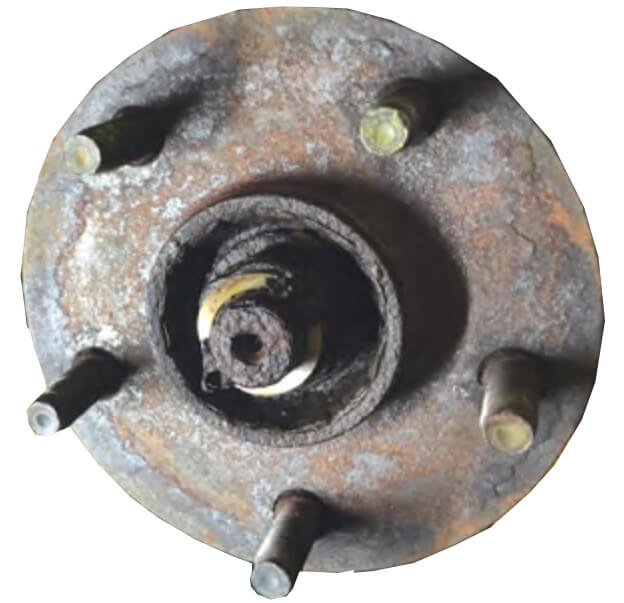
Rust/corrosion on the wheel hub prevents the rotor from sitting perfectly parallel to the hub.
2) Not using a torque wrench when tightening lug nuts is the #2 cause of lateral runout, DTV, and brake pulsation
There is no way you can achieve even lug nut torque without a torque wrench or torque stick (when using an impact wrench). Uneven lug nut torque causes lateral runout because the rotor isn’t evenly torqued to the wheel hub.
3) Worn wheel bearings are the 3rd most common cause of lateral runout and DTV
The caliper and caliper bracket are attached to the steering knuckle. However, the rotor is attached to the wheel hub, which is held in place by the wheel bearing. If the wheel bearing is worn, the rotor won’t run perfectly parallel with the caliper, which will cause lateral runout and disc thickness variation
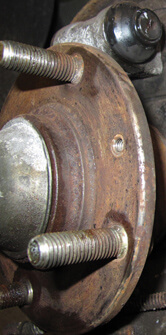
If the wheel bearing is worn, the wheel hub and rotor will rotate in a wobbl,e causing brake pulsation
What is Brake Judder and How Does It Differ From Pulsation?
A pulsation or rhythmic vibration that’s felt in the steering wheel or the driver’s seat is referred to as brake torque variation (BTV) or brake judder.
It occurs when there is a variation of torque across the face of the rotor that causes the rotor to slip and catch as brake pads pinch the rotor. An inconsistent rotor finish may cause BTV, metallurgical flaws or poor metal quality, patches of corrosion on the rotor face, or uneven deposits of friction material on the face of the rotor (the transfer layer). The varying rotor surface condition causes the brake pads to grip and then slip.
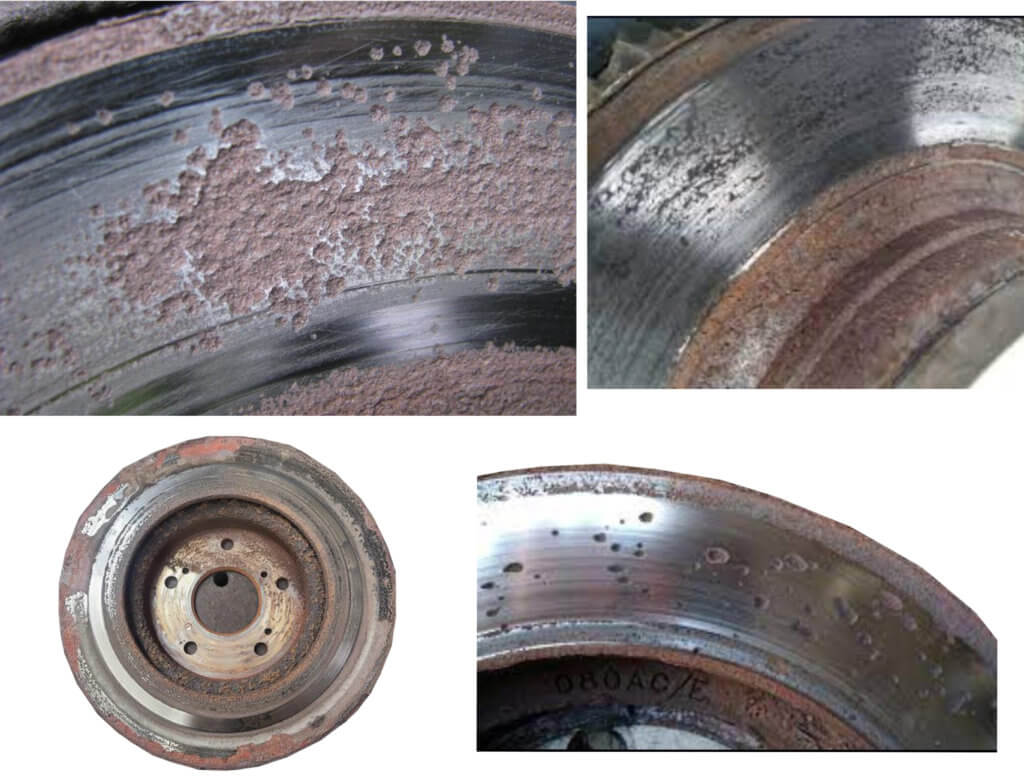
Patches of rust on a brake rotor cause a slip/stick condition that’s referred to as brake torque variation.
Here’s a List of Poor Brake Job Practices That Cause Lateral Run-out and Disc Thickness Variation?
• Not inspecting the hub for lateral run-out before reusing old rotors or installing new ones.
• Not cleaning rust off the wheel hub and inside the rotor hat area of used rotors.
• Improper brake pad bedding procedure, resulting in an uneven transfer layer.
• Not using a calibrated torque wrench to tighten lug nuts. Uneven lug nut torque can cause enough lateral runout to result in DTV.
Other things to check when you have a vibration when braking, brake pedal pulsation, or vibration in the steering wheel or driver’s seat
• Does the rotor have blue discoloration from overheating
When cast iron or steel overheats, it changes color, and the heat alters the hardness of the metal.
Pale Yellow (straw): ~430°F (220°C)
Brown: ~470°F (243°C)
Purple: ~520°F (271°C)
Dark Blue: ~575°F (302°C)
Light Blue: ~600–640°F (315–338°C)
So if you see a blue tint on a cast iron rotor, it means that spot reached roughly 550–650°F.
That’s a sign of localized overheating (often from a stuck caliper, dragging pads, or repeated hard braking). It doesn’t mean the rotor is structurally ruined. Still, it does indicate the friction surface has been heat-cycled enough that the pad material and surface hardness may have changed — which can lead to uneven braking and pulsation if not corrected.
The Connection of Brake Discoloration to Brake Pulsation
Bluing on the rotor tells us the surface got unevenly hot. When one small patch gets hotter than its neighbors:
• The pad material deposits more heavily in that spot.
• The rotor develops Disc Thickness Variation (DTV).
• You feel it as a brake pedal pulsation or the car shaking when braking.
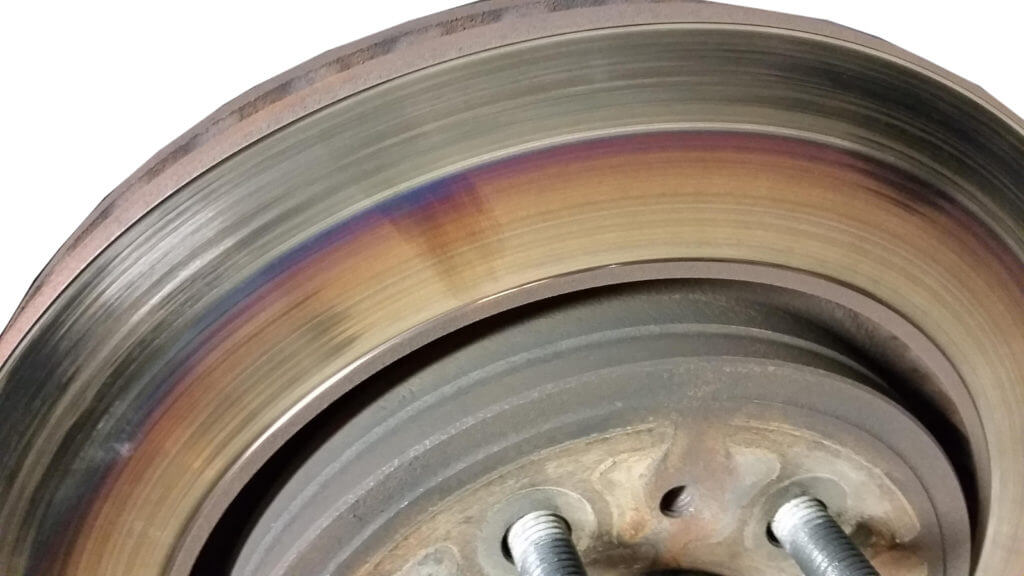
An overheated brake rotor will cause a variation in braking grip, which causes vibration.
Corrosion on the hub prevents parallel rotor mating, and that causes lateral runout and disc thickness variation
What is a Transfer Layer? For more information on the transfer layer, see this post
If you still believe that brake pedal pulsation is caused by warped rotors, see this Youtube Video.
©, 2019 Rick Muscoplat
Posted on by Rick Muscoplat