
Brake rotor warp symptoms and fixes
Learn the symptoms of brake rotor warp and how to prevent it
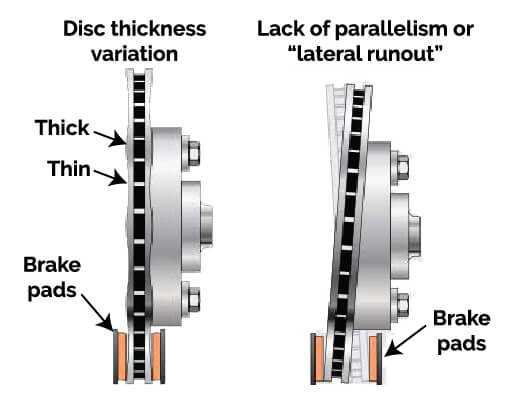
Brake rotors don’t warp. That’s a myth. Yet that’s what people and even technicians blame when your car shakes when you brake, or you feel your brake pedal pulsating. The real cause is disc thickness variation (DTV) caused by lateral runout. In the meantime, since everyone refers to DTV as brake rotor warp, that’s what I’ll call it for the purposes of this article.
Brake rotor warp symptoms
• Your car shakes when braking— If the brake rotor isn’t rotating perfectly parallel with the steering knuckle, it will accumulate excess brake friction material on opposite sides of the brake rotor, or it will wear on opposite sides of the brake rotor (depending on the type of brake pads used). The shaking starts out as mildly annoying but gets worse to the point where the car shakes violently when braking at high speeds.
• Brake pedal pulsation— The brake pedal rises and falls slightly as you brake, causing a pulsation or vibrating brake pedal.
What causes it?
Many people claim that heavy braking causes excessive heat and that causes the rotors to warp. However, if you understand the science of brake systems and metallurgy, you’d know that there isn’t a street vehicle on this planet that can produce anywhere near enough heat to warp a cast iron brake rotor. On the contrary, the brake pad friction material would be burned up and turned to ash by the time the rotor reached 800°F, let alone the 2,000°F required to soften cast iron. So, It’s actually impossible to warp brake rotors. So what’s really going on?
It’s all about the lack of parallelism
In a perfectly designed brake system, the brake rotor would sit perfectly parallel with the wheel hub, which would be perfectly parallel with the wheel bearing and steering knuckle. Carmakers post maximum lateral runout specifications in their factory shop manuals, and the tolerance for lack of parallelism is quite small, in some cases, as little as .002″ (human hair measures about .003″).
What causes a lack of parallelism?
• Rust on the wheel hub— Not cleaning rust off the wheel hub will cause the rotor to spin in a wobble
• Not using a torque wrench to tighten lug nuts— Uneven lug nut torque can cause the rotor to mate unevenly with the wheel hub
• Wheel hub lateral runout— A good curb hit or hub pothole can cause lateral runout on the hub
• Worn wheel bearing— A worn wheel bearing can cause the rotor to wobble as it spins
Why doesn’t the shaking doesn’t happen right away?
If lack of parallelism is the cause, why doesn’t the car shaking start immediately after a brake job?
Because the brake caliper can ride the wobble without causing shaking or pulsation. Most cars are manufactured with floating calipers, allowing them to move as the rotor spins
However, over a period of 2,000- 3,000 miles, the wobble causes disc thickness variation, and the caliper can’t ride that. Disc thickness variation is what causes the shaking and pulsation.
As the rotor wobbles, opposite sides of the rotor hit the brake pads. If the brake pads are made with adherent-style friction material found in ceramic and NAO brake pads, excess friction material will build up on the rotor surface, causing high and low spots.
If the brake pads are made with abrasive friction material found in semi-metallic brake pads, the rotor will wear on opposite sides, causing similar high and low spots.
Here’s how to prevent brake rotor warp
Clean the wheel hub
The best way to eliminate car shaking when braking caused by disc thickness variation is to clean the hub and make sure it doesn’t have more than .006 lateral run out. Your job is to clean the rust off the hub
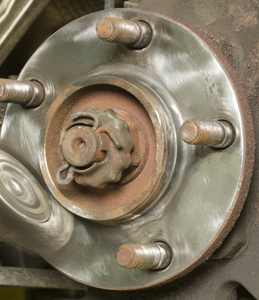
Clean hub with 3M hub cleaning pads or wire wheel
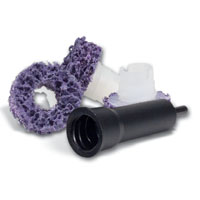
3M 07547 Hub Cleaning Kit
without removing metal. 3M makes some hub cleaning products. You can also use a drill and wire wheel, sandpaper, or scrub pad.
If you’re reusing an old rotor, clean the inside of the rotor “hat” area if you plan to re-use the old rotor.
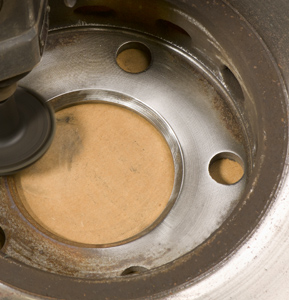
Clean the inside of the rotor hat
Always use a torque wrench to tighten lug nuts
Proper lug nut torque is CRITICAL to maintaining true rotors. In a recent GM seminar, an engineer disclosed that if you under-torque a single lug nut, you can cause up to .003” of lateral runout. That means you MUST use a torque wrench. I’m not a big fan of those cheapies you can buy at Harbor Freight. But, if you buy one of those, at least you have a chance that each of the lug nuts is tightened to the same torque (or close to it). The correct way is to tighten the lug nuts to 50% of the spec and in a criss-cross pattern. Then, return and tighten to the full spec.
Check for lateral runout on the wheel hub
Royal Automotive Service prepared this video showing the effect of lateral runout on a wheel hub. The shop did the brake job on this car and has since replaced the “warped rotors” multiple times. The customer has returned again, and they’re finally measuring lateral runout on the rotor and hub. The runout is more than .010″. No wonder the car shakes when braking.
© 2012 Rick Muscoplat
Posted on by Rick Muscoplat