
Complete Guide to Moen Cartridges by Faucet
Moen Shower Faucets Explained: Every Valve Series, Cartridge, and How They Work
Quick Summary
Since the 1950s, Moen has produced several key shower valves—Standard, Moentrol, Posi-Temp, ExactTemp, and M-CORE—each defined by how the handle operates and which cartridge it uses. Understanding Moen cartridges by faucet is the fastest way to identify, diagnose, and repair any Moen shower. Most systems fall into just a few cartridge families like 1225, 1222, 1212/1213, and 1224, and each has a distinct operating method and failure pattern.
Article
A Complete Guide to Moen Shower Valves and Cartridges
Moen has produced dozens of trim styles, but only a handful of core valve platforms. So when you need to service a Moen shower faucet, ignore the trim design and concentrate on how the faucet operates.
There are four main shower cartridge families: the 1200/1225, the 1222 (Posi-Temp), the 1255 (Duralast), and the 1213 (M-CORE).
1. The Moen Standard Valve (1960s–1980s) #1200 cartridge
The early Moen shower faucet featured a straightforward single-handle design — one lever
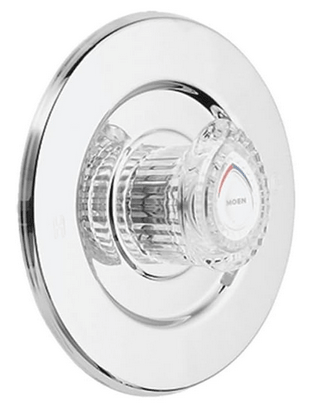
Moen Standard Series shower faucet
or plastic knob that controlled both temperature and water flow simultaneously. Pull the knob to adjust water flow and then rotate the knob or lever left for hot and right for cold.
Volume and temperature are controlled by a cartridge — a removable brass, plastic, and rubber insert that sits inside the valve body. This was a major change from older ball-and-seat or two-handle faucets, because when something leaked, you didn’t have to replace the whole faucet. You just pulled out the cartridge and swapped in a new one.
The valve body itself was brass and mounted inside the wall, with a trim plate (called an escutcheon) covering the hole in the tile. The handle is attached directly to the cartridge stem and is usually held on with a single screw hidden under a decorative cap.
For DIYers, the design was pretty friendly — shut off the water, pop the handle, pull the cartridge straight out, and install a new one. Moen also made the same cartridge fit across many of their faucet lines for years, so finding a replacement was rarely a headache.This early design uses a push/pull + rotate mechanism.
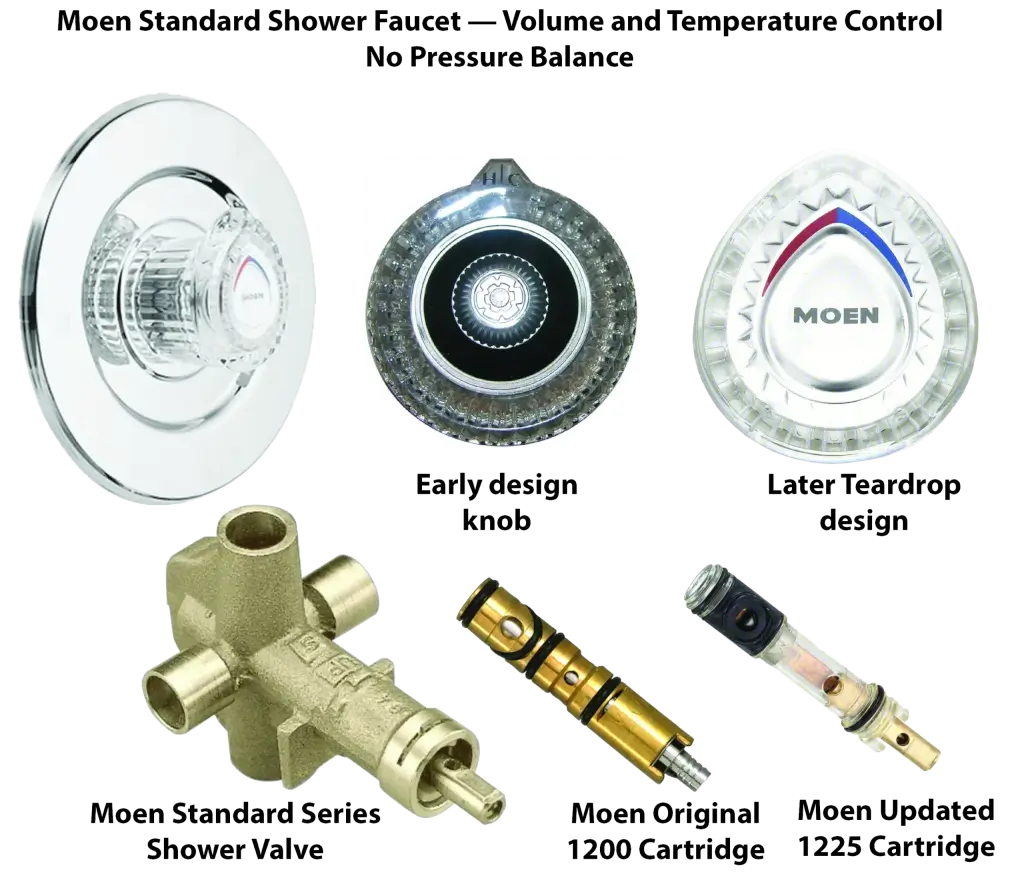
Moen standard series shower faucet. The plastic knobs in the standard series can point in any direction when the water is shut off. That’s a distinguishing feature from the Posit-Temp series faucet, where the teardrop knob always faces DOWN when the water is off.
The cartridge situation
The original Moen Standard Series used a brass #1200 cartridge. Later, Moen updated the cartridge to a plastic version #1225.
The #1225 cartridge has an improved seal design and provides smoother operation than the #1200 cartridge. It is backwards compatible with the #1200. If you have a #1200 cartridge, replace it with a #1225.
2) Moentrol Pressure Balancing Shower Faucet
Moen introduced its first pressure-balanced Moentrol shower valve in the late 1960s and refined it through the 1970s. What sets the Moentrol apart from the Standard Series is its pressure-balancing feature and a dual-control function built into a single handle. It operates like the Moen Standard Series valve: pull the handle to start and vary the water flow, and rotate the knob to adjust the mix of hot and cold water. To prevent scalding in the event someone in the home flushes a toilet, the valve incorporates a pressure-balancing spool built into the valve body, not the cartridge. The spool valve reacts to pressure changes between the hot and cold supplies. So it automatically maintains a stable temperature while still allowing the user to fine-tune both flow and heat.
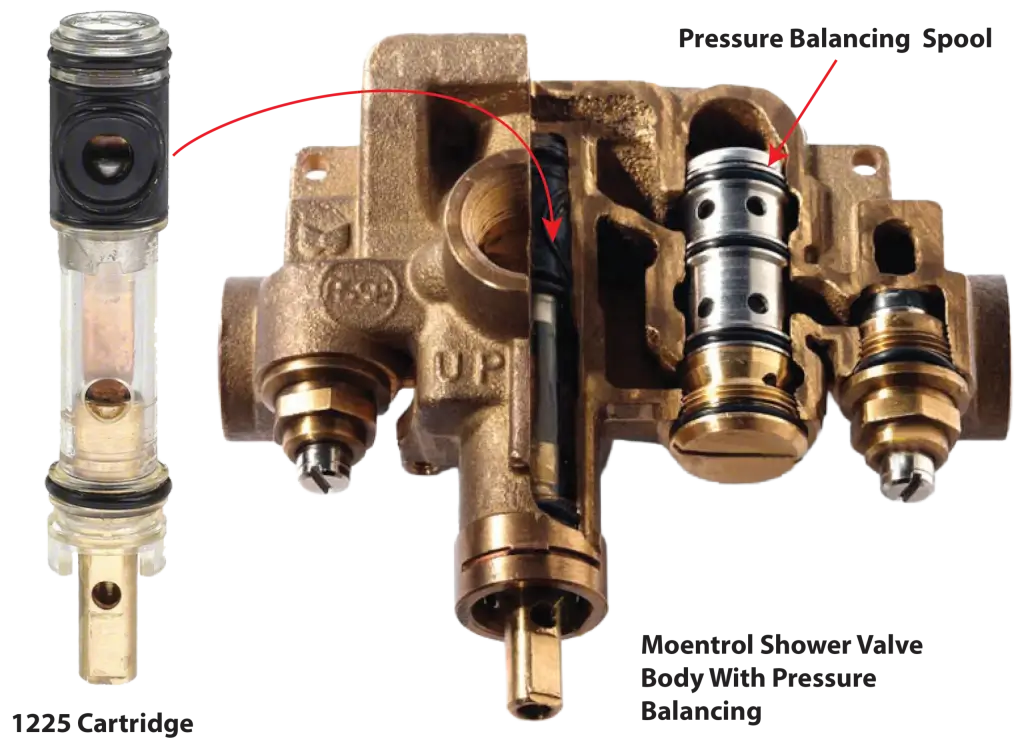
Cutaway view of the moentrol shower valve showing the 1225 cartridge and the pressure balancing spool valve.
Even though it became the workhorse of the Moen lineup, it was too costly to build for the mass market. Eventually, Moen retired this series after it introduced the Posi-Temp valve and, later, the M-CORE system.
How the Moentrol Valve works
The Moentrol valve body itself is larger than later designs like Posi-Temp, and it
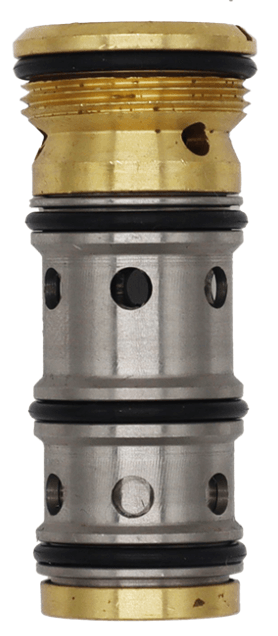
The pressure balancing spool valve is still available
requires its own dedicated trim and internal components. It uses a standard 1225 cartridge, which
handles the on/off and temperature regulation. The spool valve regulates the pressure.
Most failures come down to worn seals, mineral buildup, or sticking components—but the overall design is robust, which is why Moentrol valves are still in service today and still one of the most recognizable Moen systems in the field.
3. Posi-Temp Valve (1985–Present)
Moen introduced the Posi-Temp shower valve in the mid-1980s. It was a direct response to rising safety standards and plumbing codes requiring better protection against scalding. Up until that point, systems like Moentrol offered pressure balancing, but they still allowed user-controlled volume, which could introduce variability. The Posi-Temp simplified the design to a single rotating handle, eliminating a separate volume control and making it easier for homeowners to operate safely.
The 1222 cartridge incorporates a sliding spool that reacts instantly to pressure changes between the hot and cold supply lines. If cold-water pressure drops, the spool shifts to proportionally reduce hot-water flow, keeping the temperature stable. The key thing to understand is that the handle only rotates—it doesn’t control volume separately. As you turn it, you’re sweeping from full cold to full hot, and the valve automatically maintains a safe temperature regardless of what’s happening elsewhere in the plumbing system.
How to identify the Posi-Temp Shower Faucet
• The knob/lever only rotates; it doesn’t pull out like the Standard or Moentrol Series valves
• If the knob is the teardrop plastic design, it will always point down when the water is turned off.
• The cartridge is made from white plastic, not the amber colored plastic used in the 1225 cartridge.
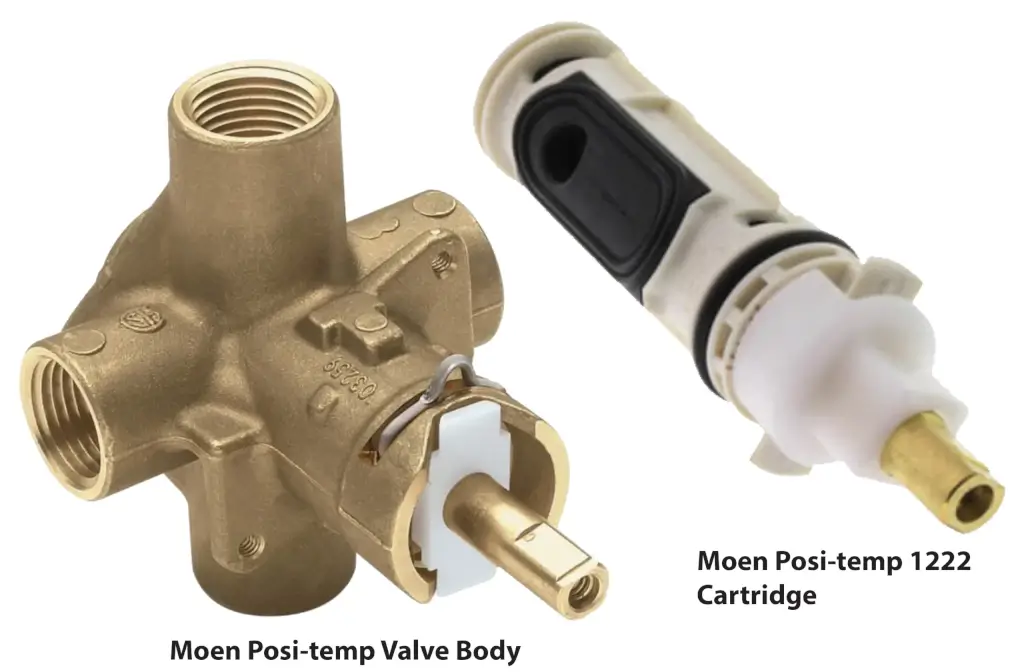
Moen Posi-temp shower valve
Problems with the Posi-Temp shower valve
From my experience, most issues come down to mineral buildup locking the internal spool or wear in the seals, both of which are straightforward to diagnose once you understand the design.
Removing the cartridge is the most difficult part of the repair, and I strongly recommend buying the right removal tool. The standard T-handle puller shown below works fine with most 1200 and 1225 cartridges. But it does NOT work well with the Posi-Temp 1222 cartridge. The 1222 tends to get stuck and not rotate. I only use the ONA Puller Premier Moen Cartridge Extractor Tool ($80 on Amazon). Amazon sells less expensive copycat versions. The cheaper tools are great for people who love to save a buck and don’t mind spending the entire day doing a job that can be done in 5 minutes with the more expensive tool. Get the point?
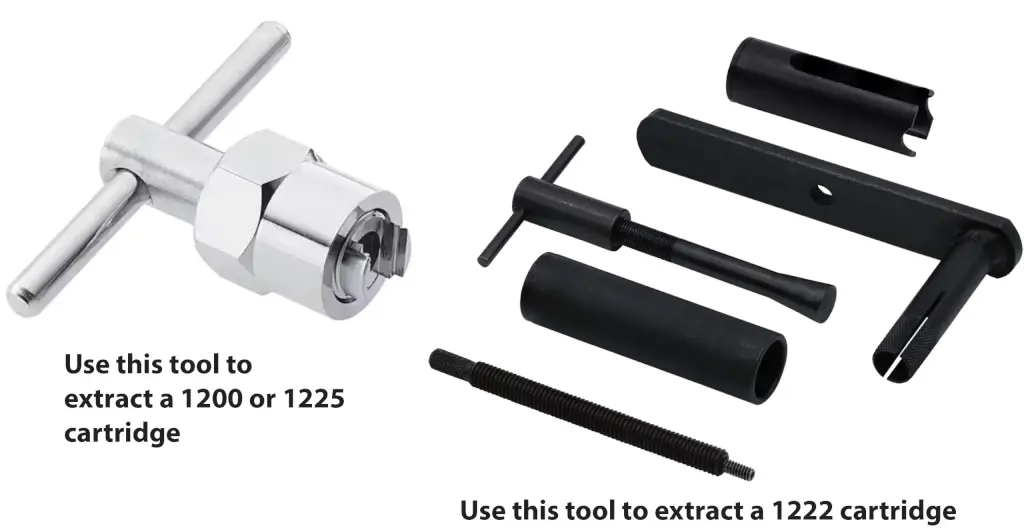
I’ve included a link to the Ona Manufacturer’s video so you can see how it works.
4. Moen ExactTemp thermostatic valve (2000s–Present)
The Moen ExactTemp thermostatic valve is a very different animal compared to ordinary pressure-balancing faucets. The problem with a pressure-balancing faucet is that it can only respond to pressure changes. In other words, if someone flushes a toilet while you’re showering and there’s a drop in cold pressure, a pressure-balancing faucet responds by dropping hot water pressure. The Moen ExactTemp faucet monitors temperature and pressure, adjusting both to maintain your shower temperature and prevent scalding.
So you set the temperature you want, and the valve actively adjusts the mix of hot and cold
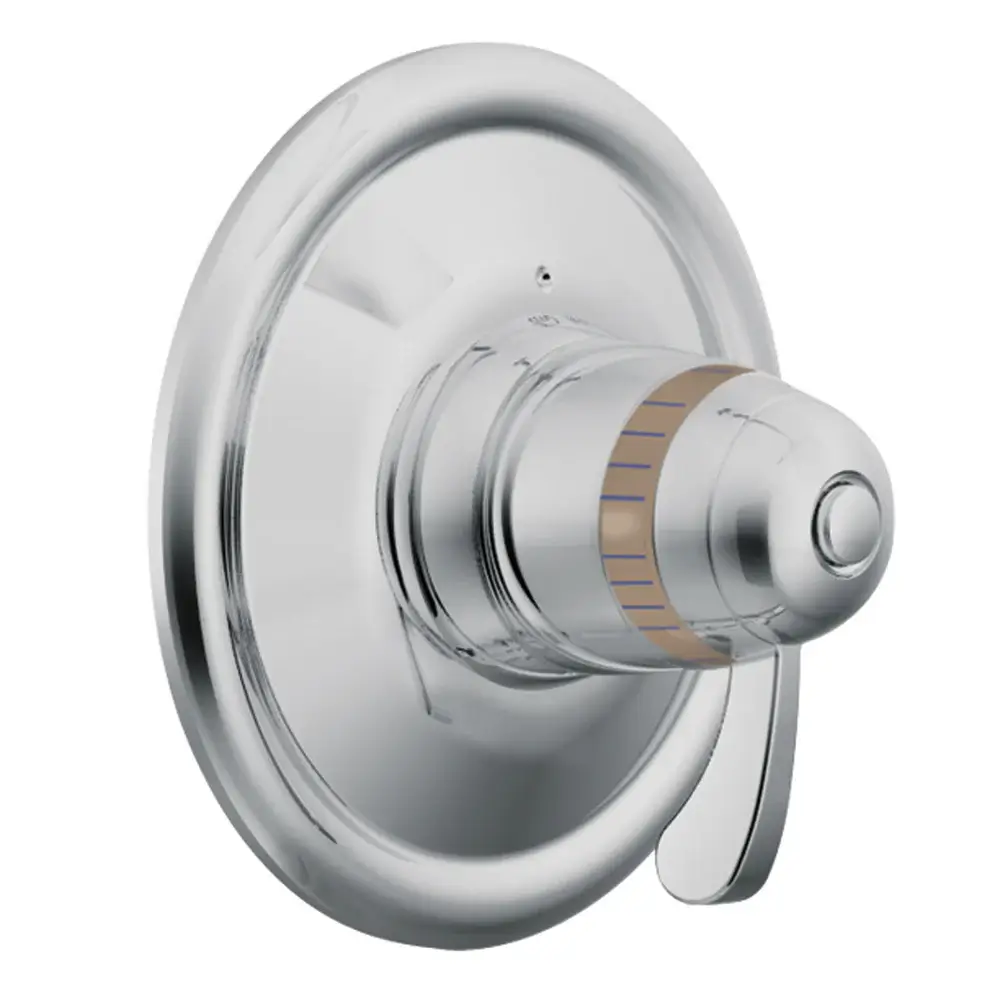
Moen ExactTemp shower faucet
water to hold that temperature steady. The design typically uses two separate controls: one handle for volume (on/off and flow rate) and another dedicated to temperature. Internally, the thermostatic element constantly responds to changes in incoming water temperature and shifts the internal mixing ports to compensate, giving you much tighter, more precise temperature control than a pressure-balanced valve ever could. You’ll find the ExactTemp shower faucet in luxury homes or multi-head showers.
Moen ExactTemp Cartridges
The ExactTemp System has two valves and two cartridges. The main valve controls water temperature. The second valve controls water volume. Moen’s first-generation ExactTemp was made from 2006 to 2009. They revised it in 2009. The two generations use different thermostatic and volume cartridges, and they are not interchangeable.
First generation 2006-2009 Thermostat cartridge #130156, volume cartridge #130157
Second generation 2009- Present Thermostat cartridge #147208, volume cartridge #147210
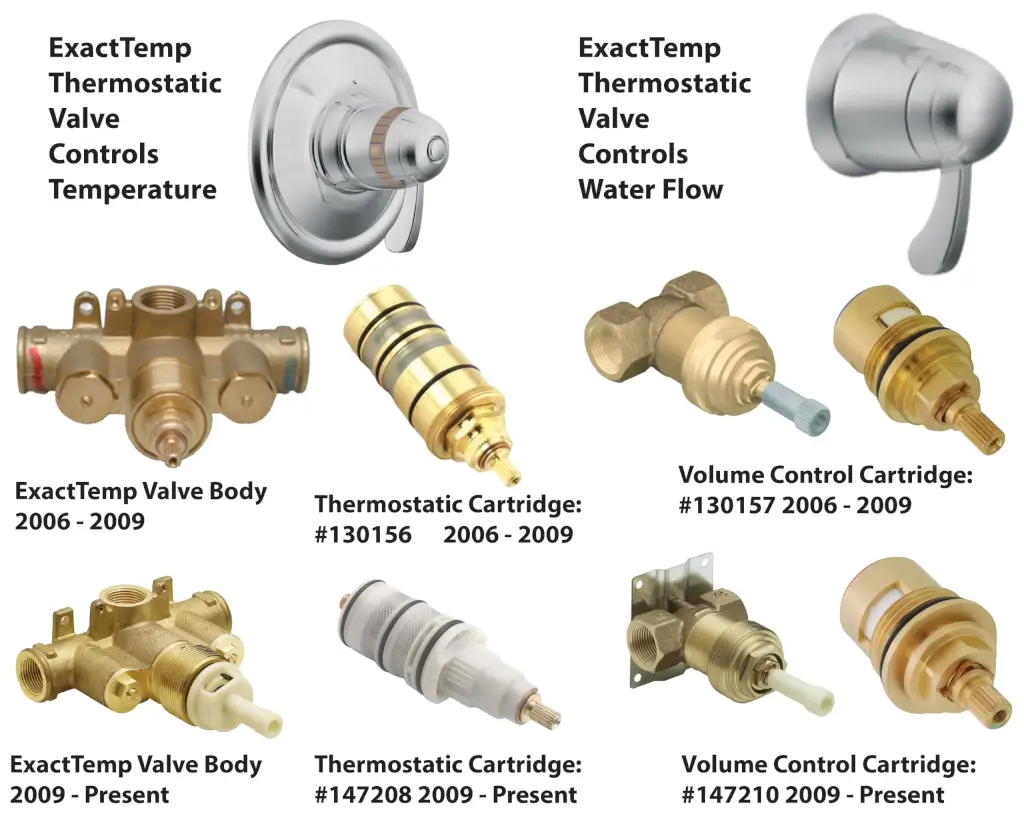
How the thermostatic cartridge works
The cartridge contains a wax-filled chamber that expands as it heats and contracts when it cools. This expansion/contraction moves a spool that throttles the hot- and cold-water ports — automatically, with no electronics involved. In many ways, it’s no different than the traditional thermostats used in your car.
Issues with the ExactTemp Faucet
Mineral buildup and debris can clog the internal thermostatic element, causing erratic temperatures, loss of hot water, or a valve that won’t respond properly to adjustments. I’ve also seen plugged filter screens and worn check stops reduce flow or create temperature swings. Another common issue is loss of calibration, where the handle no longer matches the actual output temperature, or the valve won’t reach full hot or cold. When these valves start acting up, cleaning sometimes buys you time, but more often than not, the fix is to replace the thermostatic cartridge—because once that element degrades, the valve simply can’t regulate temperature as it was designed to.
5. Moen M-CORE Shower Valve System (2020–Present)
The Moen M-CORE shower valve is Moen’s modern replacement for the older Moentrol and Posi-Temp designs. In many ways, it’s similar 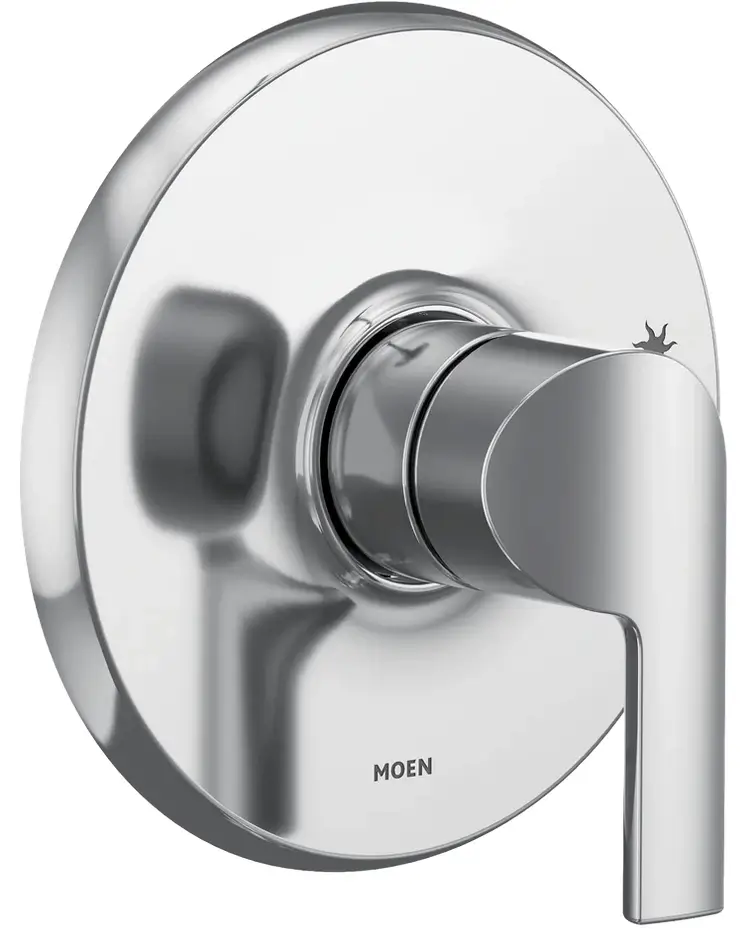 to Delta’s Multi-Choice shower valve, a single valve body that can accept different cartridges with different features.
Instead of a one-size-fits-all valve, the M-CORE system comes in different “series” (2, 3, and 4), each offering a different level of control—from basic temperature-only operation to full temperature and independent volume control. Internally, it still uses a pressure-balancing system (not thermostatic), but Moen redesigned the layout so the rough-in valve, cartridge, and trim are more serviceable and adaptable. In real-world use, the handle operation depends on the series: a 2-Series rotates for temperature only, while a 3-Series adds push/pull volume control, and the 4-Series separates temperature and flow into two coordinated controls.
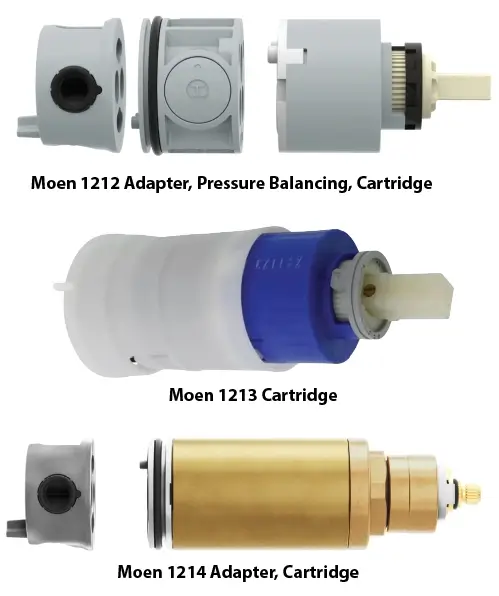
The M-CORE uses a family of dedicated cartridges 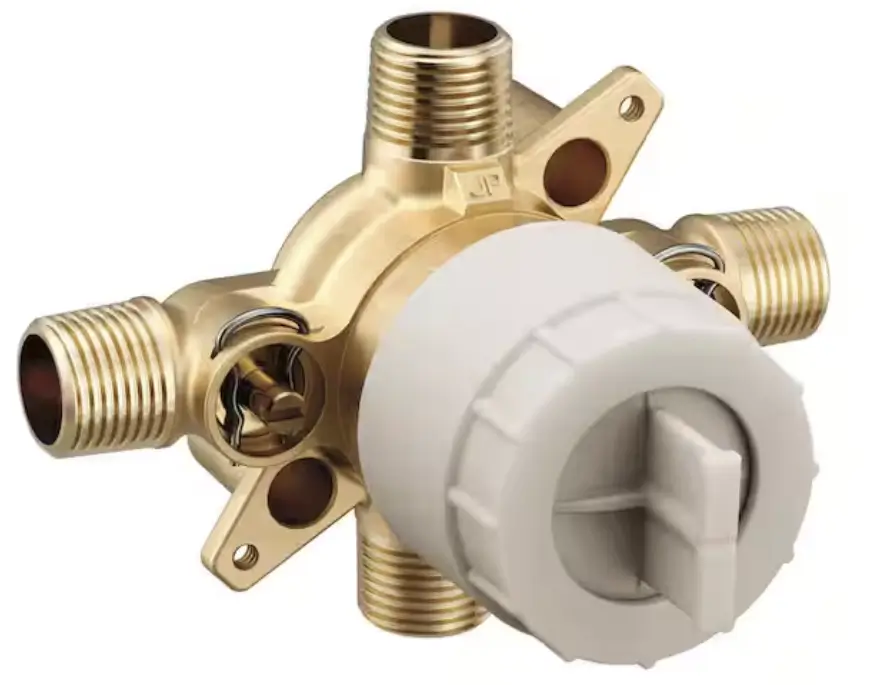 rather than one universal design. The most common are the 1212 cartridge (2-Series), 1213 cartridge (3-Series), and 1214 cartridge (4-Series), all of which use a pressure-balancing “puck” and built-in check valves to regulate hot and cold flow. These cartridges control both mixing and flow, depending on the model, which is a departure from older Moen valves, where the cartridge did everything in a single format.
As for what goes wrong, I see the same patterns over and over: the cartridge is the weak link. Debris or mineral buildup can cause sticking, uneven temperature, or reduced flow, and installation issues—like misalignment, missing seals, or insufficient lubrication—can lead to leaks right out of the gate. I’ve also seen complaints about stiff operation or incorrect hot/cold orientation when the cartridge is installed upside down, and occasional seepage behind the trim if the seals aren’t perfect. Bottom line: when an M-CORE valve acts up, you almost always end up back at the cartridge and its seals.
©, 2026 Rick Muscoplat