
Crankshaft Sensor vs. Camshaft Sensor: The Difference
Understanding the Difference: Crankshaft Sensor versus Camshaft Sensor
The crankshaft sensor and camshaft sensor are critical components that help manage the engine’s timing and firing sequence. Though they work in tandem and sound somewhat alike, their roles, locations, and functions differ significantly. Understanding the differences between a crankshaft sensor versus a camshaft sensor is sential for diagnosing engine issues and ensuring proper engine maintenance.
A camshaft sensor is typically used to time the ignition
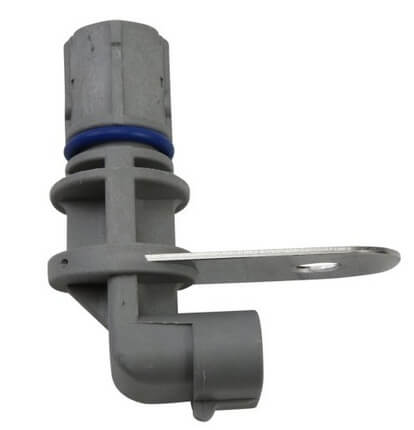
A camshaft sensor bolts to the cylinder head on an overhead cam eninge
DIYers often get confused over the difference between a crankshaft sensor versus a camshaft sensor. They each control a different part of the fuel/spark cycle.
To ease the confusion, think of a camshaft sensor as if it’s an oil-style distributor that runs off a gear on the camshaft to fire the spark plugs. A camshaft sensor no longer gears to the camshaft, but it does monitor the position and rotation speed of the camshaft. The ECM uses data from the camshaft sensor, along with data from the crankshaft sensor to time spark plug firing. For details on how a camshaft sensor works, see this post.
A crankshaft sensor typically provides timing data for the fuel injection
There was no need for a crankshaft sensor in carbureted cars because the fuel was pulled into the cylinder during the intake stroke. When car makers switch to throttle body, port and direct injection, they needed a way to trigger the fuel injectors at the right time during the intake or compression stroke.
In a throttle body and port fuel injection system, the fuel injectors operate
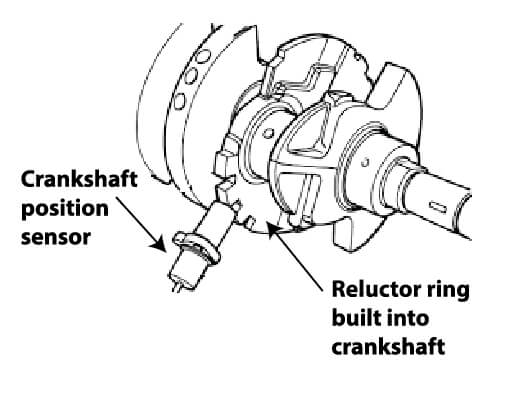
This image shows a crankshaft sensor mounted on the side of the long block to monitor a reluctor ring built into the crankshaft
during the intake stroke. In order to time the injectors, the computer must know the exact location of the pistons and it learns that from the crankshaft sensor. Direct injection engines, on the other hand, operate the injectors during the compression stroke. For more details on how a crankshaft sensor works, see this post.
Location Of The Crankshaft sensor
Typically, the crankshaft sensor is located near the harmonic balancer, although some engines mount the sensor on the side of the long block. It usually operates using one of two methods: magnetic or Hall effect. A magnetic sensor generates a voltage signal as the teeth of a reluctor wheel attached to the crankshaft pass by it, while a Hall effect sensor produces a digital signal in response to changes in a magnetic field caused by the crankshaft’s rotation.
The crankshaft sensor sends this data to the ECU, which uses it to determine the exact position of the crankshaft at any given moment. This information is vital for controlling the timing of the ignition system, fuel injection, and other engine functions. Without accurate data from the crankshaft sensor, the engine would struggle to operate efficiently, leading to issues like misfires, poor fuel economy, and increased emissions.
Location The Camshaft Sensor
The camshaft sensor is usually on the top of an overhead cam engine near the camshaft. Like the crankshaft sensor, it can operate using either magnetic or Hall effect principles. The sensor detects the position of the camshaft by monitoring the rotation of a toothed or slotted wheel attached to it.
The data from the camshaft sensor helps the ECU synchronize the operation of the engine’s valves with the crankshaft’s position. This synchronization is vital for ensuring that the intake and exhaust valves open and close at the right time, optimizing engine performance and fuel efficiency.
What’s the difference between a camshaft sensor versus a crankshaft sensor?
• The camshaft sensor controls ignition timing
• The crankshaft sensor controls fuel injection timing
What happens if the camshaft sensor fails?
No start due to no camshaft sensor signal
Engine stalls due to weak or erratic signal
Misfire due to weak or erratic signal
Poor performance/lack of power or poor fuel mileage due to weak or erratic signal
Shifting problems
Check engine light
What happens if the crankshaft sensor fails?
No start due to no fuel
Engine stalls due to no fuel
Misfire due to no fuel or erratic fuel injection
Poor performance/lack of power or poor fuel mileage due erratic fuel injection
Shifting problems
Check engine light
©, 2018 Rick Muscoplat
Posted on by Rick Muscoplat