
Do Pour-In Fuel Injector Cleaners Really Work?
Fuel System Cleaners: Do They Deliver Real Results?
Quick Summary
• A pour-in fuel injector cleaner only works when the carbon buildup is light to moderate.
• It will not fix a clogged or failing injector.
• Products that contain PEA (polyether amine) or Polyisobutylene Amine (PIBA) are the most effective ingredients in modern fuel system cleaners. If the label doesn’t list either of those ingredients, the product won’t be as effective.
• Professional cleaning is required when injector deposits are heavy or spray patterns are severely distorted.
•Filling your tank with Top Tier gas is the most efficient way to keep the fuel system clean
Article
As someone who has diagnosed thousands of fuel-related drivability issues, I’m constantly asked whether a fuel injector cleaner actually works. The honest answer: a pour-in fuel injector cleaner works under the right conditions, but it isn’t a miracle in a bottle. To understand when these products help—and when they don’t—you need to know what causes injector problems and what’s actually inside the best fuel system cleaners.
How Fuel Injectors Get Dirty — And Why a Cleaner May or May Not Help
Fuel injectors are precision parts that meter fuel through microscopic openings. Over time, carbon, varnish, and polymerized fuel deposits accumulate on the injector tip. When that happens, the spray pattern becomes distorted, atomization suffers, and the engine starts to run rich or lean. I’ve seen these deposits cause:
• Rough idle
• Hesitation
• Poor fuel economy
• Misfires
• Sluggish acceleration
Engines that do lots of short-trip driving are especially at risk. The combustion chambers never fully heat up, leading to more residue and more opportunity for buildup. That’s where a fuel injector cleaner might help.
How a Pour-In Fuel Injector Cleaner Works
A pour-in fuel injector cleaner dissolves carbon and varnish as fuel passes through the injectors. But its effectiveness depends on the chemistry. The best fuel system cleaners use:
PEA (Polyether Amine) — The gold standard. It withstands high temperatures and chemically breaks down carbon, restoring the injector’s spray pattern.
PIBA or PIB (Polyisobutylene Amine / Polyisobutylene) — Less powerful than PEA but still effective for mild deposits.
Products I personally trust because they contain high PEA levels include:
• Chevron Techron
• Red Line SI-1
• Gumout Regane
These three consistently outperform older formulas. For example, Seafoam contains little or no PEA, which is why I don’t think it’s as effective as modern fuel system cleaners. If you’re judging whether a pour-in fuel injector cleaner works, PEA content is the biggest deciding factor in my opinion.
Which cleaners have the most active ingredients? Click here for a list
When a Fuel Injector Cleaner Works — and When It Won’t
MotorTrend magazine did a laboratory test of fuel injector cleaners in 2011 and concluded that they don’t work. See the article here. They didn’t disclose the brands or concentrations of PEA or PIBA, so I can’t draw any conclusions from those tests. But, from personal experience, I can say that the products I’ve listed in this article can make a small difference.
In my opinion, a fuel injector cleaner can restore performance in the following situations:
Light to moderate carbon buildup
Preventive maintenance every few thousand miles
Short-trip driving which creates more deposits than highway driving
A pour-in fuel injector cleaner will NOT fix:
Severely clogged injectors
Internally damaged injectors
Injectors with electrical failures
Spray patterns distorted by heavy carbon
In those cases, no chemical you pour into the tank will help.
What Professional Fuel-Injection Cleaning Really Is
A lot of people confuse a pour-in fuel injector cleaner with a professional cleaning, but they are completely different.
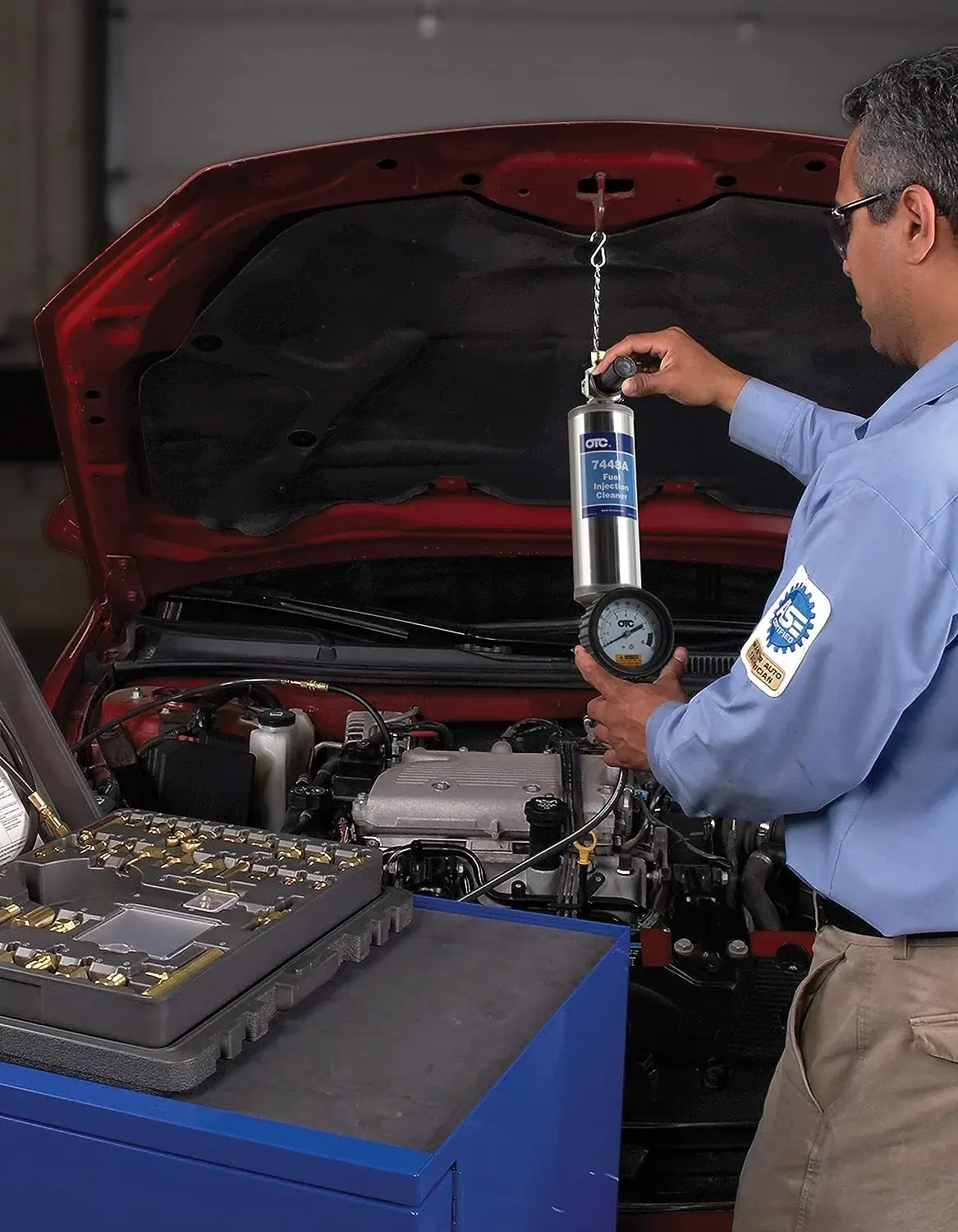
This image shows how a professional fuel injector cleaning is done using the OTC Tools (7448A) Fuel Injection Cleaner Canister
In a shop, I connect a pressurized canister filled with a high-strength detergent that you cannot buy in stores. Professional-grade chemicals are so strong that they would damage fuel-tank plastics and rubber, which is why they cannot be sold as pour-in products.
The fuel pump is disabled, and the engine runs exclusively on the cleaner until the canister is empty. This exposes the injectors to a much higher concentration of detergent than any bottle added to the tank delivers.
Professional cleaning is the right choice when injector deposits are heavy or when a spray-pattern test shows uneven atomization.
Should You Add a Pour-In Fuel Injector Cleaner as Routine Maintenance?
If you use Top Tier fuel, you’re already getting PEA-based detergents. But if you:
• Make frequent short trips
• Drive a GDI (gasoline direct injection) engine
• Use lower-quality gasoline
• Notice mild drivability issues
…then adding a pour-in fuel injector cleaner every 3,000–5,000 miles can help keep the system clean.
©, 2023 Rick Muscoplat
Posted on by Rick Muscoplat