
Engine Overheating Causes You’re Probably Missing
The Real Causes of Engine Overheating Explained
Quick Summary
When an engine overheats, the root cause almost always falls into one of four categories:
1) Coolant level or flow problems
2) Airflow issues
3) Heat transfer failures
4) System pressure loss.
The pattern of engine overheating—whether it happens at idle, under load, or both—is the fastest way to narrow it down.
• If the engine overheats at idle, I immediately suspect low coolant levels or airflow problems, such as inoperative cooling fans or a restricted radiator (clogged fins).
• If the engine overheats while driving under load, I focus on coolant flow, combustion temperature, and restrictions in the radiator or cooling system. The most commonly missed causes include partially clogged radiators, failing water pumps with eroded impellers, trapped air pockets, and early-stage head gasket failures.
Professional diagnosis isn’t guesswork—it’s a structured process of verifying airflow, flow rate, temperature drop, and pressure integrity.
Why Engine Overheating Happens in the First Place
Every time an engine runs, it creates massive heat from combustion. The cooling system’s job is to absorb that heat and release it through the radiator. When something interrupts that process, the engine overheats.
From years of diagnosing engine overheating, I can tell you it always comes down to one of these failures:
• Heat isn’t being carried away from the engine (coolant flow issue)
• Heat isn’t being released (airflow or radiator issue)
• Too much heat is being created (engine or combustion issue)
• Cooling system pressure is too low, lowering the boiling point
Use a professional diagnostic strategy to pinpoint the root cause of engine overheating
Engine Overheats only at idle (No Load) but stops overheating when driving—this symptom points to an airflow and heat-rejection problem. Check fan operation and the condition of the radiator fins FIRST.
• Cooling Fan Problems: At idle, the radiator depends entirely on the fan to move air through the fins. If the fan isn’t pulling enough air, the engine overheats quickly. Check for a failed electric fan motor, bad fan relay or speed controller, weak radiator fan clutch (on mechanical fans), or a faulty engine coolant temperature sensor that’s reading too low to activate the radiator fan.
Restricted Radiator Airflow: More common than you think. DIYers and even professional technicians often skip this step, replacing expensive parts only to come back to it later. Bent fins, bugs, and dirt packing the radiator fins are common causes of engine overheating at idle, but not while driving. Remember, cooling is all about airflow efficiency. Anything that reduces airflow will cause the engine to overheat. I’ve fixed many engine overheating complaints just by cleaning the radiator stack.

Low Coolant or Air Pockets: Overheating due to low coolant will be more noticeable at idle than while driving. That’s because the engine runs at a lower RPM, causing the water pump to circulate less coolant. Low coolant also causes air pockets, further reducing cooling. Air disrupts heat transfer, causing the engine to overheat even without a load.
Engine Overheats While Driving Under Load — This is where things get more serious. If the engine overheats under load, the cooling system is failing when heat production is at its highest. Here are the most common causes.
Weak or Failing Water Pump: A water pump can look fine, but fail to move enough coolant when the engine is under load. This is one of the most overlooked causes of engine overheating.
• Corroded or eroded impeller blades
• Loose impeller on the shaft
• Reduced flow at higher RPM
[caption id="attachment_353128" align="alignleft" width="700"]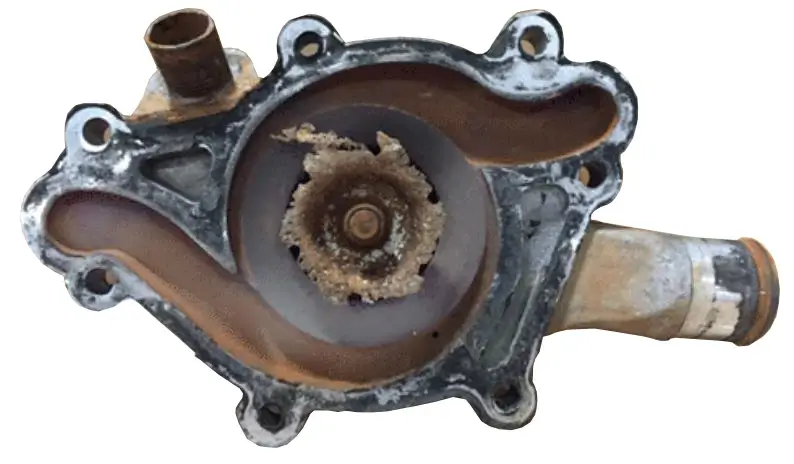 Notice the fully eroded impeller in this water pump. It can’t possibly move enough coolant to prevent engine overheating
Partially Internally Clogged Radiator: This is a big one—and often missed because at low load, it works well enough, but under load, it can’t dissipate enough heat, so the engine overheats. Always check for clogged areas in the radiator.
Using an infra-red non-contact thermometer and the engine running, scan the entire surface of the radiator. Cooler areas indicate clogs that reduce total cooling.
Thermostat Issues — Doesn’t fully open: Not all thermostat failures are obvious. A thermostat that doesn’t fully 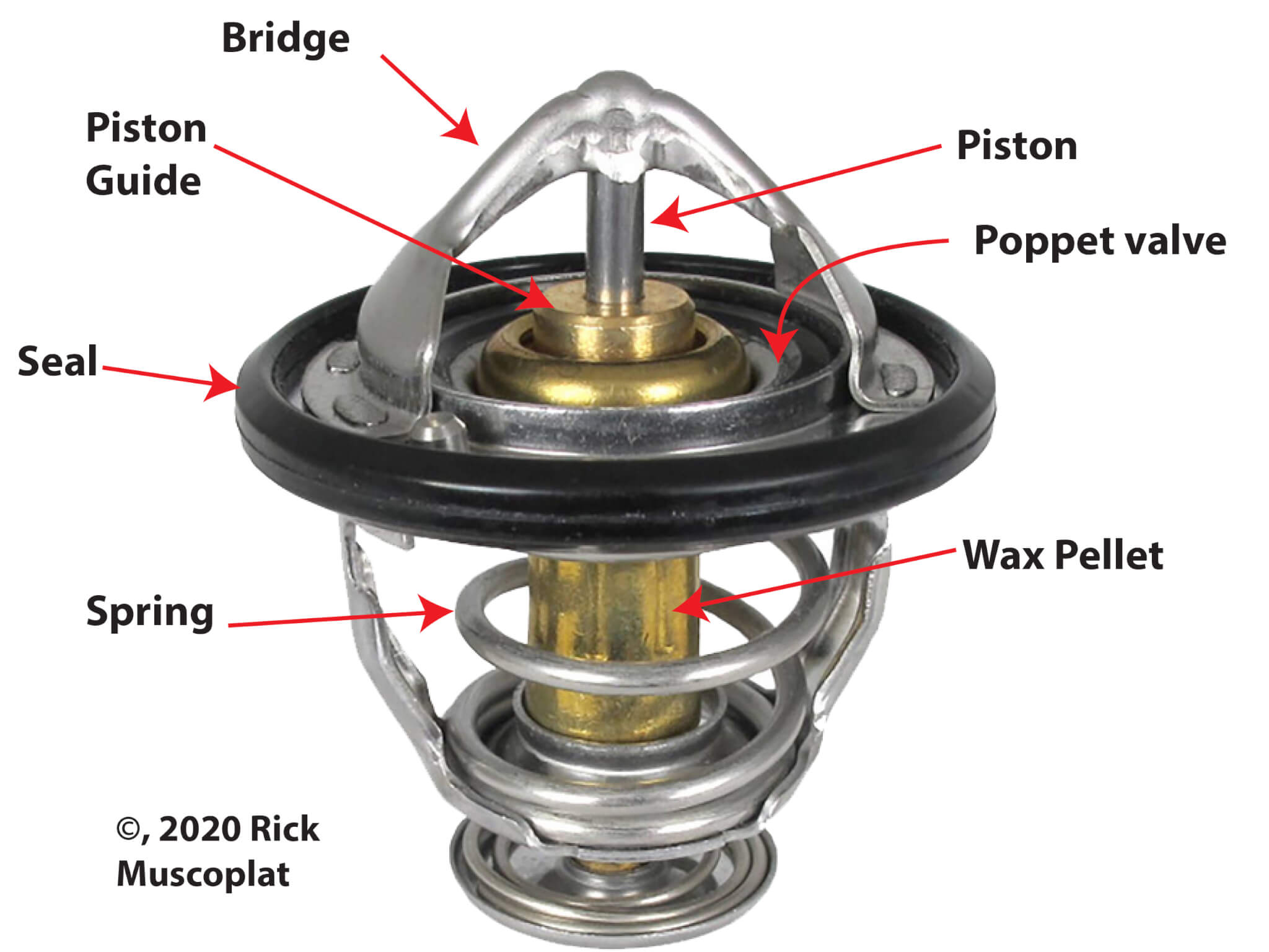 open can cause engine overheating at idle, especially in summer when the AC is running. There’s simply too little coolant flow to remove the heat generated by the added engine load and heat load from the AC condenser. But a partially closed thermostat can also cause the engine to overheat when driving because it restricts coolant flow.
Combustion-Related Heat (Head Gasket Early Failure)
This is where many people get fooled. A small head gasket leak can:
• Inject combustion gases into the coolant
• Increase system pressure
• Create localized hot spots
The result? Intermittent engine overheating, especially under load. These cause engine overheating during sustained driving.
Exhaust-related Engine Overheating
Anything that restricts engine breathing, reduces combustion efficiency, and can cause overheating. Under normal conditions, exhaust gases leave the engine quickly and efficiently. But when the catalytic converter or muffler becomes restricted, exhaust flow slows down.
Heat Gets Trapped in the Engine: When exhaust can’t escape:
• Hot gases stay in the combustion chamber longer
• Cylinder temperatures rise dramatically
• Exhaust valves and cylinder heads absorb extra heat
This alone can cause engine overheating, especially under load.
Combustion Efficiency Drops (More Heat, Less Power): Restricted exhaust flow disrupts the engine’s ability to:
• Pull in fresh air/fuel
• Push out spent gases, leading to
• Incomplete combustion
• Higher combustion temperatures
• Increased thermal load
So even though power drops, heat actually increases—a key reason the engine overheats.
Exhaust Manifold and Head Temperatures Spike: With an exhaust restriction:
• Exhaust manifold temperatures skyrocket
• Heat transfers into the cylinder head and the cooling system
In severe cases:
• Exhaust manifolds glow red
• Oxygen sensors overheat
• Nearby components get heat-soaked
This added heat load pushes the cooling system beyond its capacity → engine overheating.
Why does engine overheating due to a restricted exhaust worsen when the engine is under load?
Here’s why:
• More throttle = more exhaust volume
• Restriction becomes more severe
• Backpressure increases exponentially
So under load:
• Heat skyrockets
• Coolant temperature rises quickly
• The engine overheats fast
An exhaust restriction rarely causes overheating at idle:
• Exhaust volume is low
• Backpressure is less severe
• Heat production is minimal
The Most Commonly Missed Causes of Engine Overheating
1. Radiator Flow Restriction (Internal) — Not plugged completely—just enough to reduce efficiency.
2. Air Trapped in the System — Modern cooling systems are extremely sensitive to air pockets.
3. Failing Water Pump Impeller — Especially plastic impellers that erode or slip.
4. Collapsing Lower Radiator Hose — Under load, suction increases and a weak hose collapses, restricting flow.
5. Cooling System Pressure Loss — A bad cap lowers boiling point, leading to engine overheating without obvious leaks.
How I Diagnose Engine Overheating (Professional Strategy)
I never guess. I follow a structured diagnostic path every time.
Step 1: Confirm the Condition — Does the engine overheat at idle, under load, or both?
Step 2: Check Coolant Level and Condition — Look for contamination. Check for oil, rust, or debris
Step 3: Verify Airflow — Confirm fan operation. Inspect the radiator and condenser for blockage
Step 4: Measure Temperature Across the Radiator — This is critical.
Large temperature drop = working radiator
Uneven temps = restriction
Step 5: Check Coolant Flow — Observe flow in radiator (if accessible). Use an infrared thermometer to track flow patterns
Step 6: Pressure Test the System — Identify leaks. Confirm the system holds pressure
Step 7: Test for Combustion Exhaust Gas Intrusion — Block tester (chemical test)
Watch for bubbles in the coolant. This step often confirms hidden causes of engine overheating.
Step 8: Evaluate Under Load — Road test while monitoring live data. Watch the temperature climb under load
Final Thoughts: Why Most Engine Overheating Diagnoses Go Wrong
Most people replace parts instead of diagnosing the system. That’s why engine overheating problems keep coming back. If you understand this one principle, you’ll solve it correctly:
The condition under which the engine overheats tells you where to look.
Idle overheating = airflow problem
Load overheating = flow or heat generation problem
When you approach engine overheating this way, you stop guessing—and start fixing.
Fix: Use a garden hose and nozzle to clean the bugs and debris off the radiator fins
Bugs, dirt, and rd debris can clog the fins on your radiator and reduce cooling. Bent radiator fins also reduce cooling.
5) Water Pump Failure
The water pump circulates coolant throughout the engine and radiator. If the water pump fails, the coolant can’t flow effectively, leading to overheating.
Water pump failure can result from a broken or worn impeller or a worn-out bearing and seal.
If you notice coolant leaking from the water pump or hear unusual noises from the engine area, it could be a sign of a failing water pump.
Fix: Replace the water pump
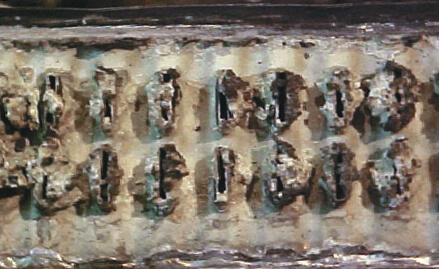
6) Clogged Cooling System
Not changing your coolant on time causes cooling system components to rust and clog the radiator passages. A clogged radiator is also a common reason for car overheating. A clogged cooling system can result in uneven cooling and
Radiator corrosion prevents good coolant flow and heat dissipation, causing car overheating[/caption]
overheating. Flushing the cooling system periodically and using the correct type of coolant can help maintain proper flow and prevent clogs.
Fix: Try flushing the radiator to see if that helps. If not, replace the radiator.
7) Clogged muffler or melted catalytic converter
A clogged muffler or melted catalytic converter can cause overheating because the hot exhaust has nowhere to go. Engine overheating is a common symptom of a clogged catalytic converter.
Fix: Conduct an exhaust backpressure test by removing the upstream oxygen sensor and connecting a vacuum gauge to the port. If the pressure is above 1.5 psi, that indicates a clogged muffler or converter. Disconnect each to find the culprit.
8) Excessive Engine Load And AC Load
Overloading your vehicle or driving in extremely hot conditions can put extra strain on the engine, causing it to overheat. Towing heavy loads, driving up steep inclines, or excessive idling in hot weather can increase the engine temperature beyond its cooling capacity. This is especially true if you’re running your car’s AC at the same time. The hot air entering the radiator from the condenser puts an extra load onto the cooling system. To avoid overheating in such situations, it’s essential to monitor the engine temperature and reduce the load or allow the engine to cool down if necessary.
9) Leaking Head Gasket
A head gasket seals the engine block and cylinder head, preventing coolant and oil from mixing and maintaining proper engine compression. A blown head gasket can cause the piston to pump hot exhaust into the cooling system causing rapid overheating. Or, it can suck coolant into the engine and burn it, causing a low coolant level. This is a severe issue that requires immediate attention, as it can result in significant engine damage. Common signs of a blown head gasket include white smoke from the exhaust, coolant loss, and oil that appears milky.
©, 2019 Rick Muscoplat
Posted on by Rick Muscoplat