
Horn Honking By Itself: Most Common Causes
Why Your Car Horn Honks by Itself — And How I Fix It as a Pro
Quick Summary
If you’re facing a situation where your car horn honks on its own, honks in the middle of the night, or won’t stop honking, there are only four possible causes:
• A faulty horn switch in your steering wheel
• A faulty clockspring located under the steering wheel
• A bad horn relay
• A short to ground in the horn wiring harness ahead of the horn relay
First things first: Stop the horn from blowing:
1) Locate and remove the horn relay.
2) If you can’t locate the relay, locate the horn fuse and remove it.
Then diagnose the problem.
Article
There are few things more embarrassing than your car horn honking by itself in a parking lot, or worse, in the middle of the night. After years of diagnosing electrical issues, I can confidently tell you there are only four common causes of a horn honking on its own. Let me walk you through them one by one — along with the fixes that have worked in my
Understanding Horn Wiring Designs
A car horn draws between 6 and 8 amps. To avoid running heavy-gauge wires up through the steering column and to the steering wheel, carmakers instead run small-gauge wires to the horn switch. Pushing the horn button completes the circuit to ground, which then activates a higher-amp relay to switch power to the horn. On late model cars, pressing the horn button completes the circuit to ground, which signals the body control module to activate the horn relay.
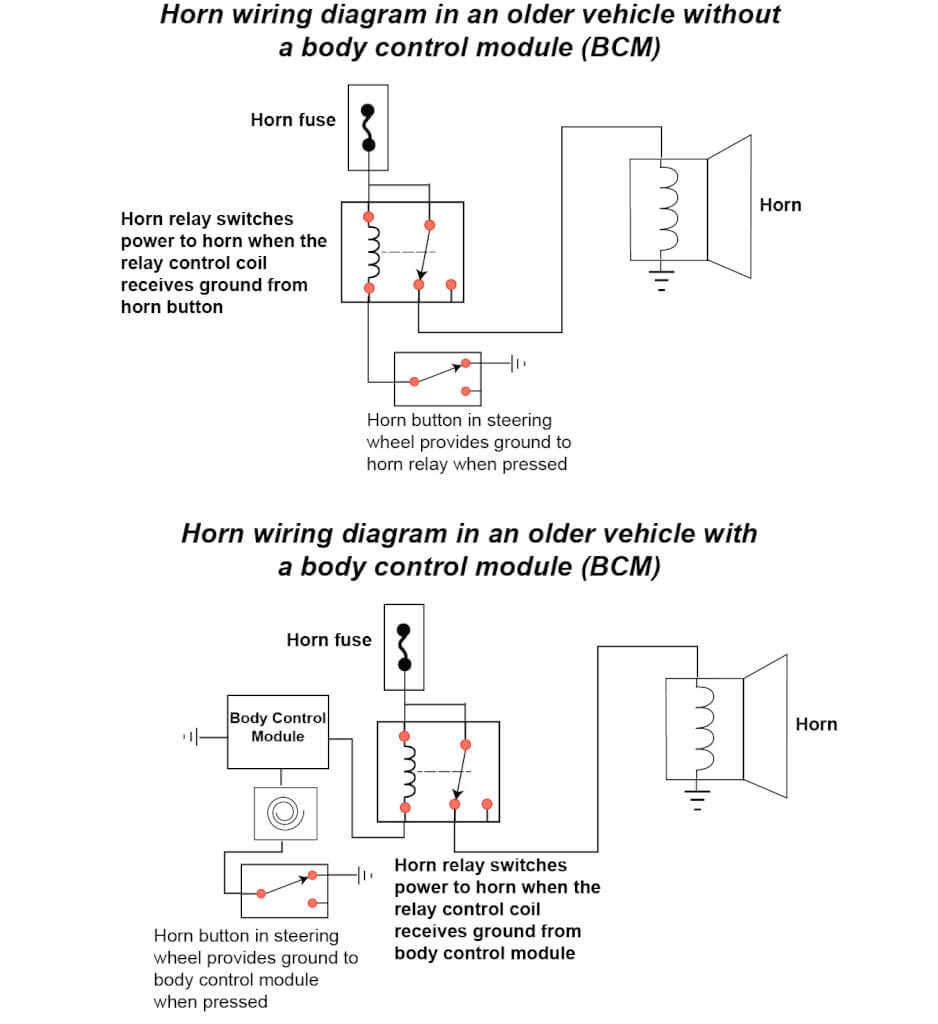
Click on the image to download a PDF wiring diagram.

In most cases, you can replace just the horn button without having to replace the entire steering pad.
Most Common Causes of a Car Horn Honking by Itself
• A faulty horn switch can cause the horn to blow by itself — The horn switch under the airbag is extremely simple — two metal contacts separated by a thin piece of foam. Over time, that foam deteriorates. Then vibration, temperature, or even just turning the steering wheel can make the contacts touch. Boom — the horn honks on its own.
To test the horn switch, you’ll need a wiring diagram and a multimeter. Locate the correct wires at the base of the steering column and set your meter to the ohms setting. Touch the two probes to the horn wiring. It should be an open circuit, reading ~ or 0L on your meter. If you see an ohm reading instead, you have a bad horn switch or shorted wires.
• A faulty clockspring (spiral cable) can cause the horn to honk by itself— The clockspring is a flexible electrical circuit board printed on a thin mylar plastic. It carries the electrical circuits for all the steering wheel controls, such as the radio, cruise control, cell phone, and ADAS features, as well as the horn and airbag circuits. It winds and unwinds like a window shade when you turn the steering wheel. Over time, the mylar ribbon cable can degrade, causing circuit traces to break off the plastic, fall apart, create an open condition, or short out other circuits.

Notice the multi-circuit ribbon cable inside the clockspring.
Diagnosing a clockspring can be a bit more difficult, so your best bet is to eliminate all other possibilities first.
• A pitted/sticking horn relay can cause the horn to honk by itself— Over time,

Pitting on the horn relay contacts can cause false horn activation
Metal particles can migrate from one relay contact to another, causing the relay contacts to stick together and keep the horn honking, or to separate by too little, causing them to reconnect as heat causes the contacts to expand and touch.
To diagnose a bad horn relay, either swap it out to see if the problem goes away, or wait until the horn blows, then rap on the relay with the handle of a screwdriver. If the honking stops, the relay contacts were stuck. Replace the relay.
• A short to ground in the horn wiring harness— The horn switch completes the ground portion of the circuit to the control coil of the horn relay. If any portion of the horn wiring harness is chafed or rubbed through, it will complete the ground path, causing the relay to power the horn.
If you’ve eliminated the horn switch and the horn relay as possibilities, check the condition of the wiring from the relay to the horn, or from the horn switch to the body control module.
Final Advice From the Shop Floor
A car horn honking by itself always has a root cause — and it’s almost always electrical. When a horn honks on its own, especially if the horn honks in the middle of the night, start with the most likely and least costly fix: replace the horn relay. If the horn won’t stop honking while driving, pull over safely and disconnect the relay or battery to regain control.
Fixing this isn’t guesswork — it’s methodical diagnosis.
©, 2024 Rick Muscoplat
Posted on by Rick Muscoplat