
How a car battery works: Understanding the chemical process
How a car battery works to make power
A car battery provides the electrical power necessary to start the engine and power various electronic accessories. Understanding how a car battery works requires a look into its design, chemistry, and the role it plays in the overall vehicle system.
Typical car battery construction
A typical car battery is a lead-acid battery consisting of six cells connected in series. Each cell produces approximately 2.1 volts, combining to provide a total voltage of around 12.6 volts when fully charged. The primary components of each cell include two lead plates (one coated with lead dioxide (PbO2), the positive plate, and the other made of pure lead (Pb), the negative plate) and an electrolyte solution, which is a mixture of sulfuric acid and water.
The lead plates are immersed in an electrolyte (a solution that supplies water and acid for an electrochemical reaction). When these two dissimilar materials are immersed in an electrolyte, they create a voltage potential.
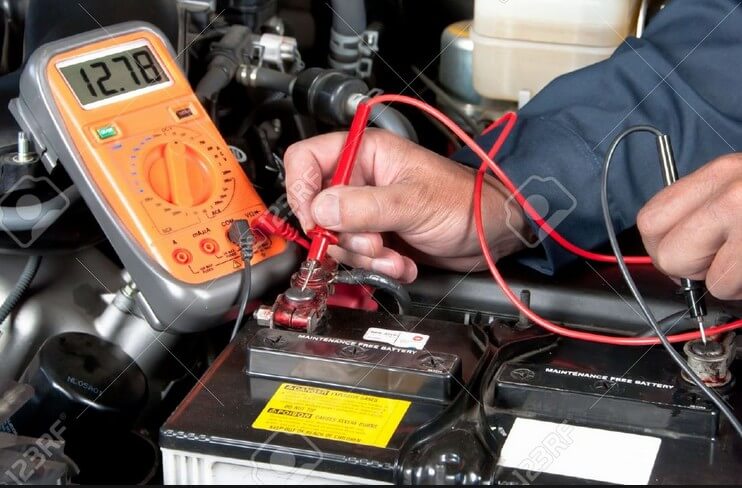
Check battery voltage with a multimeter
How a car battery works to creat electricity during the discharge cycle
The chemical reaction and electrical generation begin once you complete the electrical circuit and seek to draw power from the battery. The positive electrode (plate) is coated with lead dioxide (PbO2)—lead Pb and oxygen dioxide (O2). The PbO2 combines with the hydrogen H+ and sulfate (SO4) ions (from the sulfuric acid) to form lead sulfate (PbSO4) and water (H2O) on the surface of the positive plate.
Meanwhile, on the negative plate, Lead (Pb) from the negative active material reacts with the sulfate ions (SO42) from the sulfuric acid electrolyte to form lead sulfate (PbSO4) on the negative plate.
As you continue to discharge the battery, you’re using up the sulfuric acid and turning more of the electrolyte into water. That’s why a discharged battery freezes in winter—because the electrolyte has turned into water.
During the discharge process, the coating on both plates is slowly converted into lead sulfate (PbSO4), which is nonconductive, and the electrolyte (sulfuric acid) becomes weaker. That’s why the voltage drops: because there’s no longer a voltage potential between the two plates. Since the plates become less electrically conductive, internal conductivity drops. At a certain point, the battery can no longer produce electricity.
How fast does car battery discharge happen?
Let’s say you’re starting your engine and drawing 150-amps from the battery, but the engine isn’t in good shape. The starter motor cranks the engine, but either the fuel isn’t vaporizing properly of there’s an ignition issue preventing the engine from firing up.
If you continue to crank the engine at such a high load, you’ll discharge your battery much faster than if you were to leave the lights on for a long period. Here’s why: For the battery to produce electricity, the plate material with the sulfuric acid electrolyte must combine, and for that to happen, the acid must circulate into the pores of the plate coating, and the water produced must also flow. Most of this reaction takes place on the surface of the plate. Once that voltage potential is used up, the acid would normally penetrate deeper into the plate coating. But on rapid discharge, the acid can’t penetrate into the coating that fast. So, continued cranking quickly depletes your battery’s ability to create power.
How a car battery works when it’s getting recharged?
When you apply power to the battery, the chemical process reverses itself. The sulfate (PbSO4) in both plates splits into lead (Pb) and sulfate (SO4), and the water splits into hydrogen (H) and oxygen (O). The sulfate in the plates then combines with the hydrogen to form sulfuric acid (H2SO4). Meanwhile, the oxygen combines with the lead of the positive plate to form lead dioxide (PbO2).
As the battery reaches its “full” state, continued charging produces gassing —Hydrogen (H2) gas at the negative plate and oxygen (O2) at the positive. In effect, you’re driving off the water by continuing to charge the battery at a rate higher than it can accept. In older, non-maintenance-free batteries, the hydrogen and oxygen vented out of the caps and were lost. That’s why you had to continually check the water level and add distilled water to return it to a proper electrolyte level. In a maintenance-free battery, the plate materials are slightly different, and the venting is limited to reduce outgassing and the need for water replacement.
An automatic battery charger avoids this problem by tapering the charge level as the battery reaches full capacity.
Why do car batteries die
• Plate Shedding Shorts Out the Battery— Car batteries don’t last forever, even when they’re properly maintained. Over time, the lead coating on the grids begins to soften and “shed.” Softening and shedding happen faster in a battery that’s abused through multiple deep discharge cycles caused by extended cranking, leaving your lights on, or driving with a failing charging system that doesn’t recharge or overcharge the battery.
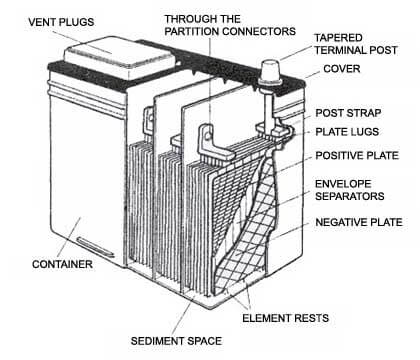
This cut-away view shows the cells of a car battery and the positive and negative plates.
As the lead coating sheds, it falls to the bottom of the battery and accumulates in a sediment trap cavity below the plates. The sediment trap is designed to accumulate this material without contacting the plates. But, as the shredded material fills the sediment trap, it can eventually reach the point where it comes in contact with the positive and negative plates,
That causes a short between the contacted positive and negative plates. You’ll notice this kind of failure if you drive your car and it starts and runs just fine, and the next time you go to start it, it’s completely dead.
According to a 2010 BCI Failure Mode Study (BCI=Battery Council International — the battery trade association), shorted batteries account for 18% of all battery failures.
• Battery Sulfation Kills Car Batteries— Car battery plate sulfation occurs when you leave a battery in a discharged or partially discharged state for long periods. How can a typical driver destroy a battery due to sulfation? Easy. Here’s an example. You start your car on a cold day. You then turn on the electric rear window defroster, crank up the heat, and turn the blower to its highest setting. Then, you turn on the headlights, wipers, and heated seats.
Here’s how much power you’re drawing:
Wipers 7.5-amps
Headlights 18-amps
Parking lights 8-amps
Brake lights 11-amps
Blower motor 18-amps
Rear window defogger 28-amps
Heated seats 5-amps (each)
Ignition system 8-amps
So, in addition to drawing at least 100 amps to start the engine, you’re also drawing slightly over 103 amps to run your accessories. Then you drive to the store or to work, and you’re in stop-and-go traffic, or you drive just a short distance. Your car is most likely equipped with at least a 130-amp alternator. However, alternators can only output roughly 30% of their maximum value at idle speeds. So, while you’re at a stoplight or crawling in traffic, you’re pulling more power out of your battery than you’re putting back into it. An alternator must run at nearly 2,000 engine RPM to output its full charge. Repeating this start/drain cycle every day for a week during cold weather can easily run your battery dry and cause the plates to sulfate.
In other words, sulfation occurs when your battery is discharged and stays in that condition for a while. The sulfation is the formation of hard lead sulfate crystals that fill the pores of the paste coating on the plates. The lead sulfate crystals act as an insulator that prevents electrical generation. It cannot be reversed once the sulfation occurs and is serious enough.
How to avoid car battery sulfation
If you drive in the conditions described above, it comes down to this: either drive the vehicle longer and at higher speeds, or connect a charger when you arrive home, OR prepare yourself to buy a new battery every one to two years. It’s really that simple.
Other ways to prolong the life of your car battery
• Clean the battery posts and terminals— You can’t always see battery terminal/post corrosion, and any amount of corrosion can dramatically affect your battery’s recharging rate. Worse yet, corrosion stresses your car’s alternator, causing it to run hotter and fail earlier.
• Protect your car battery against overheating— Most car owners think cold weather kills their batteries. Nope. Your battery may drop dead in cold weather, but it was actually damaged during summer. Keep in mind that a car battery is a chemical reaction and that kind of reaction happens faster as conditions heat up. Underhood temperatures accelerate battery deterioration. Heat is such a factor that many car makers install battery insulators right at the factory. You may think they’re designed to keep the battery warm in winter. Not true. They’re installed to keep your battery COOLER and protect it from underhood heat. If you replace the battery, may sure you move the battery insulator over to the new battery.
• Secure your car battery to prevent vibration— The battery hold-down mechanism is there for a reason. It’s to prevent the battery from vibrating. You may think that the battery is heavy enough to not jiggle while driving. You’d be wrong. It does move if not secured. If you skip the battery hold-down, you’ll kill the battery. It’s that simple.
©, 2016 Rick Muscoplat
Posted on by Rick Muscoplat