
How many cold cranking amps does your car need?
Learn how many cold cranking amps your battery need to start your cold engine
Understanding the importance of Cold Cranking Amps (CCA) is essential for maintaining your vehicle’s reliability, especially in cold weather conditions. CCAs measure a battery’s ability to start an engine in cold temperatures, making them a critical specification for any car battery. This article explores what CCAs are, why they matter, and how to determine the appropriate CCA rating for your vehicle.
What Are Cold Cranking Amps?
Cold Cranking Amps (CCA) refer to the amount of current a battery can deliver at 0°F (-18°C) for 30 seconds while maintaining a voltage of at least 7.2 volts for a 12-volt battery. Essentially, CCAs indicate the battery’s ability to start an engine in cold climates when the engine oil is thick, and the chemical reactions within the battery are slower. A higher CCA rating means the battery can provide more power to the starter motor under these challenging conditions.
The number of cold cranking amps your battery needs to start your particular car is dependent on several things like the displacement size of your engine, the lowest outdoor temperature in your area, and the motor oil viscosity you use. In other words, the larger the engine and the colder the temperatures, the more cold cranking amps you want to spin the engine fast enough to fire up.
The bigger the engine, the more cold cranking amps it needs
When you crank a V-8 engine, you’re moving more metal, which takes more power than cranking a 4-cylinder engine. However, the carmaker factors that into the specifications for the size of battery your vehicle needs. So, the most reliable source of information on the battery specifications for your vehicle is your vehicle’s owner’s manual.
As a general rule, you need 1 Cold Cranking Amp for every cubic inch of engine displacement (2 CCA for diesel engines).
One litre = 61 cubic inches.
For example, a 2276 CC engine is rounded to 2.3L, equivalent to 140 cubic inches.
How are Cold-cranking amps measured?
CCA is tested with the battery chilled to 0°F (-17.8°C). Then, the battery is put under load for 30 seconds, and its CCA is the number of amps the battery can deliver at that temperature without dropping below 7.2 volts.
Why cold weather changes battery output
A battery creates power through a chemical reaction, and that reaction slows down in cold weather. The colder it gets, the more it slows down. That means it creates less and less power as the temperature drops.
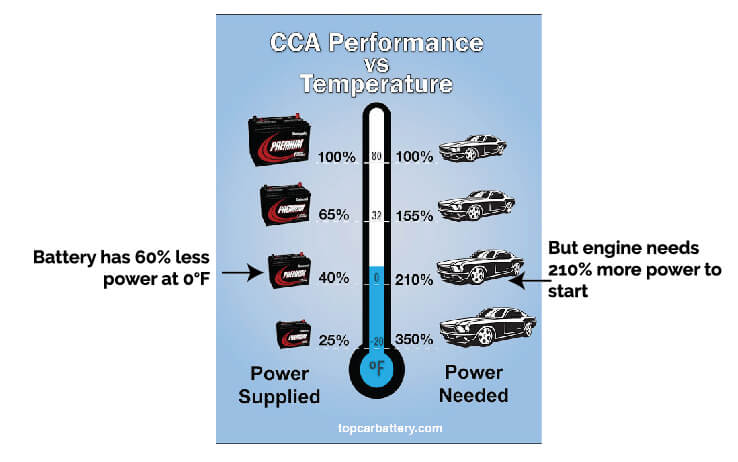
This chart compares the amps available at various cold temperatures versus the number of amps needed to start your engine at those various temperatures.
Unfortunately, your engine needs more power as temperatures drop due to turning resistance from your motor oil. so it provides far more resistance to moving parts. Here’s a chart showing available battery power versus how much power is required to start a cold engine.
Should you buy a battery with more cold cranking amps than the carmaker recommends
Your battery tray and battery hold-down brackets are made to fit a certain size battery. Let’s say your car requires a Group 35 battery, and the carmaker recommends a battery with 600 cold-cranking amps. But you shopped around and found a Group 35 battery with 800 cold-cranking amps. Should you get it?
No. here’s why:
To get more CCA in the same-size battery, the battery manufacturer can use either thicker grids or more (thinner) grids. Each design has advantages and disadvantages. For example, if you buy a battery with a higher CCA rating that is recommended by the car maker and the battery achieves that higher CCA rating by using thinner grids with a higher paste density, that design will be far more sensitive to high temperatures, and it’s high temperatures that kill car batteries.
In this case, you’ll be trading off winter performance for shorter battery life. Thicker grids, on the other hand, allow less room for battery electrolyte. So, the battery may have high initial CCA but quickly lose its ability to output high amps because of lower levels of electrolyte.
Stick with the CCA rating of the car maker
© 2016 Rick Muscoplat
Posted on by Rick Muscoplat