
How Much Does a Lift Kit Cost—Understanding the options
Learn how much a lift kit costs: the types of lift kits, parts costs and labor costs
Lift kits are incredibly popular among off-road enthusiasts and those looking to give their vehicles a more aggressive appearance. However, before you decide to lift your ride, it’s essential to understand the costs associated with this modification. In this article, we’ll dive into the various factors that influence how much a lift kit costs in terms of hardware and labor prices.
Understanding the 3 types of lift kits and how each relates to cost
A Leveling Kit is not technically a lift kit— But it does raise the vehicle’s front end by 2″-3″ to provide a more aggressive stance and reduce or eliminate the truck’s positive rake. A leveling kit provides more room to install bigger tires/wheels on the front end, but it doesn’t provide additional frame-to-ground clearance.
Body Lift Kit— A body lift kit raises the body off the frame by 2″ to as much as 5″ to get you more tire-to-fender clearance. It doesn’t change the factory rake or provide additional frame-to-ground clearance. In addition to the added tire clearance, a body lift kit helps avoid body damage from rocks and trees when off-roading.
Suspension Lift Kit—A suspension lift kit is the gold standard of lift kits. It provides more tire-to-fender clearance and more frame-to-ground clearance, something the other two types can’t provide. A suspension lift kit is mandatory if you plan to go off-roading and want to reduce the chances of ground contact with the engine, transmission, and steering systems.
Leveling Kit Costs
Technically speaking, a leveling kit is only designed to reduce

This image shows what a positive rake looks like on a light-duty truck. The bed of the truck sits higher than the front end. Carmakers designed the truck so the vehicle sits level when the bed is fully loaded
or remove the truck’s positive rake by raising the vehicle’s front end to close to the height of the unloaded bed. The whole purpose of a leveling kit is to remove the positive rake (nose down) attitude from the factory. Owners install a leveling kit to change their truck’s appearance and raise the front end so they can install larger tires.
A leveling kit raises the front end using strut extension spacers, the least expensive method, or by installing taller and beefier struts and springs.

This image shows the added space you get at the front of the truck when you add a leveling kit
Pros and Cons of a leveling kit:
PROS:
• Reduces or remove the positive rake, giving you a more aggressive look
• Adds tire-to-fender clearance, allowing you to install larger tires/wheels.
• DIY installable and the least costly way to gain front-end clearance
CONS:
• Gains body-to-ground clearance but no frame-to-ground lift
• May result in too much nose-up when you load the bed
Leveling kit parts cost
Front leveling spacers range in price from as little as $50/pair to around

ReadyLift #66-2120 2″ leveling kit for the F150 (2021-2024)
$250/pair. The downside to leveling spacers is that they don’t compensate for the added weight of larger tires. If you install a leveling kit and larger tires but don’t modify the struts, you may wind up with tire-to-fender contact and a rough ride.
To provide a smoother ride and eliminate any tire contact, many truck owners choose a leveling kit that achieves the same front-end lift using new struts. Those leveling kits range in price from as low as $350 to as much as $1,500 for pneumatically adjustable struts.

Larger beefier struts with lift spacers from Roughcountry.com
Some companies also make spacer kits for the rear wheels. However, from a strictly technical point-of-view, installing the same size front and rear spacers is no longer a leveling kit but a lift kit. It won’t eliminate the positive rake.

This is a 2″ spacer kit for rear leaf springs. You get spacer blocks, longer U-bolts and new bolts
Leveling kit installation Cost
You can install a leveling kit yourself or pay a shop to do it for you. The installation involves removing the two front struts and adding a spacer on top of the strut mount. Then, the strut is re-installed, and the vehicle is aligned.
Professional installation for a leveling kit usually costs around $600, including the alignment.
If you’d like to learn more about leveling kits, see my post here
Body Lift Kit Costs
A body lift kit works by replacing the thin body-to-frame bushings with thicker spacers. Installing a body lift kit is not a DIY project because you need a tall lift to do the job.
The job involves disconnecting all the body-to-frame bolts, steering linkage, master cylinder, and all body-to-engine/transmission electrical connectors. Only then can the technician lift the body off the frame. With the body raised off the frame, the technician swaps in the kit’s taller spacers.
Next, the technician installs bumper relocation brackets so the bumper matches the raised body. In some cases, the technician may have to alter the brake line routing to the master cylinder. Then the technician lowers the body onto the spacers, installs longer body bolts, and reconnects the steering and all electrical connectors.

This image shows how a body lift kit is installed. The body is disconnected from the frame lifted up and the factory grommets are replaced with lift blocks
Body Lift Parts Cost
A body lift kit costs as little as $125 to as much as $1,000, depending on the complexity of the bumper relocation and possible steering linkage modifications.
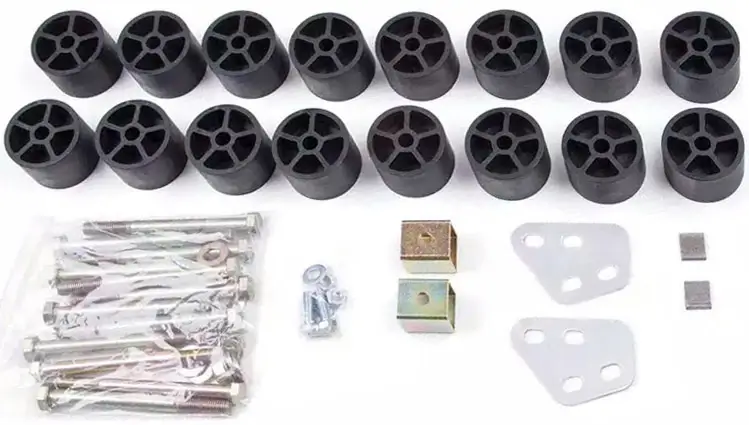
Body Lift Kit Components:
• Frame-to-Body spacers, • Longer frame-to-body bolts, • Bumper repositioning brackets and bolts
Professional installation costs for a Body Lift Kit
The labor costs vary depending on whether the exiting body spacer bolts are rusted, how much work is involved in disconnecting the steering, brake, and electrical systems from the body to the frame, and how difficult the bumper relocation process is.
At the low end, plan on paying at least 3 hours of shop labor to as much as a full 8 hours, roughly $600 to as much as $1,600 for a body lift installation.
Pros and Cons of a Body Lift kit:
PROS:
• A body lift kit costs less than a suspension lift kit
• Adds tire-to-fender clearance, allowing you to install larger tires/wheels.
CONS:
• Gains body-to-ground clearance but no frame-to-ground lift
• Not DIY friendly. Must be professionally installed.
If you’d like to learn more about body lift kits, see my post here
Suspension Lift Kit Costs
The engine, transmission/transfer case, steering, and differential are all mounted on a truck’s frame. If you plan to do any off-roading, it’s essential to increase the frame-to-ground clearance to avoid damaging those very expensive components. This is where a suspension lift kit comes into play.
A suspension lift kit contains the necessary components to elevate the frame while maintaining the functionality of the drivetrain, steering, and braking systems. By raising the frame, you create more space between the ground and the underside of your truck, allowing you to navigate over rocks, logs, and other obstacles without causing damage.
A Suspension Lift Kit typically includes new, longer shock absorbers, springs, and other components that lift the frame and maintain proper suspension geometry. A properly designed suspension lift kit ensures that your truck can still handle well and provide a comfortable ride, even with the increased height.

Here you see all the components needed to provide a 6 inch lift on a 2023 Ford F-150. This kit is made by roughcountry.com

Suspension Lift Kit Parts Cost
The price of a suspension lift kit can vary greatly depending on several factors, such as the make and model of your vehicle, the desired lift height, and the brand and quality of the components.
• 3″ to 4″ Suspension Lift Kits—Expect to pay between $1,000 and $3,000 for a high-quality 3″-4″ lift kit.
• 6-inch Lift Kits: 6″ lift kits can cost anywhere from $2,000 to $5,000 or more. These kits often require additional components and modifications, such as new drive shafts, brake lines, and steering components.
If you’d like to learn more about suspension lift kits, see my post here.
Suspension Lift Kit Installation Costs
While you can technically install a lift kit in your garage, I don’t recommend it. A suspension lift kit changes your truck’s center of geometry and center of gravity, and any mistake made during installation can result in steering/suspension binding or failure, which can result in an accident or death.
Installation costs can range from as little as $1,000 for a small 2″ – 3″ lift to up to $5,000 for a 6″- 10″ lift. Large lifts often require drilling and even welding modifications, which substantially raises installation costs.
Pros and Cons of a Suspension Lift Kit
PROS:
• Provides added ground clearance between the frame and the ground to prevent ground contact with the engine, transmission, steering, and differentials.
• When designed properly, it will provide a more comfortable ride and provide more stability in turns than a body lift kit.
CONS:
• The most expensive of all lift options and the most complicated to install. May require drilling and frame modifications, depending on the lift height and the kit brand.
• Reduces gas mileage by 20% or more and reduces towing capacity
• Puts more stress on suspension components like ball joints, control arm bushings, struts, and tires.
• Changes the vehicle’s steering geometry, resulting in different handling characteristics and accelerated suspension and tire wear.
• Results in a reverse rake when the bed is loaded, causing a nose-up condition with less steering control. If you haul heavy loads, you’ll need to add additional equipment to raise the bed when loaded.
• Requires a complete ADAS re-calibration and, in some cases, may render ADAS completely ineffective.
In Summary
Lifting your ride can be an exciting way to improve its appearance and off-road capabilities, but it’s crucial to understand the costs involved. Lift kit prices can range from a few hundred dollars for a basic body lift kit to several thousand dollars for a comprehensive suspension lift. When budgeting for your lift kit, consider the type of kit, your vehicle’s make and model, the desired lift height, and the brand and quality of the components.
Don’t forget to factor in installation costs, which can add significantly to the overall expense. By understanding these costs and carefully researching your options, you can make an informed decision and enjoy the benefits of a lifted vehicle without breaking the bank.
A note about lift kit parts costs
The parts prices shown here are the prices shown on the manufacturer’s website. If the shop provides the parts, they will add a markup to the parts prices, so your price will often be 66%-100% more than the parts prices shown here.
Bringing your own parts
If you buy a lift kit online and expect the shop to install your parts, don’t be surprised if the shop raises its installation rates to compensate for the lost profit on the parts. Shops make their living on parts profit and labor profit, just like every other retail service business. You wouldn’t buy a steak at the grocery store and expect a steak house to charge you only for the time cook it, and the same applies here.
Also, be aware that the shop won’t give you a parts or labor warranty if you bring in your own parts. And, if the parts you provide don’t fit your truck, you may be charged extra for the wait time while you scrounge up the correct parts.
In other words, unless you’re 100% positive that you’ve ordered the correct parts, let the shop source the parts.
©, 2024 Rick Muscoplat
Posted on by Rick Muscoplat