
How to Choose the Right Brake Pads and Rotors
Brake Pads vs. Rotors: What Matters Most
Quick Summary
Choosing the right brake pad types and a quality brake rotor matters far more than chasing the lowest price or the most aggressive marketing claims. The friction material, the backing plate design, and rotor metallurgy all work together to determine stopping power, noise, dust, and longevity. Get one piece wrong, and even the best pads or rotors won’t perform the way they should.
Article
What to Know About Brake Pads and Rotors Before You Buy
Whether you’re doing your own brake job or paying a shop, everyone wants the same outcome: strong braking, quiet operation, and long service life. The problem is that most people are only told what to buy—not why. Once you understand how different brake pad types interact with a brake rotor, choosing the right combination for your vehicle becomes much easier.
I’ll walk you through how brake pads are built, how rotors differ, and which combinations actually make sense for real-world driving.
Understanding the Three Main Brake Pad Types
When people ask me which brake pads are “best,” my answer always starts with this: best for what kind of driving? There are three primary brake pad types, and each behaves differently once it’s clamped against a brake rotor.
Non-Asbestos Organic (NAO) pads are the softest of the three. They’re quiet, generate minimal dust, and are easy on a brake rotor. The downside is reduced stopping power and shorter life, especially under repeated hard braking. You’ll still see NAO pads on some economy cars, but most manufacturers have 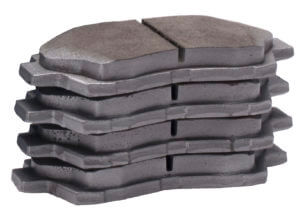 moved on.
Semi-metallic pads are the workhorses. They deliver excellent stopping power and hold up well under heat, which is why they’re common on trucks, SUVs, and performance applications. The tradeoff is increased rotor wear, more noise, and heavier brake dust. If maximum braking matters more than refinement, this brake pad type still has a place.
Ceramic pads are now the most common OE replacement choice, and for good reason. They provide stronger braking than NAO pads, are quieter than semi-metallics, and are easier on a brake rotor. For most daily-driven vehicles, ceramic pads strike the best balance between performance, cleanliness, and longevity.
For detailed information on the different types of brake pads, see this post.
• NAO pads are softer and easier on rotors but don’t brake as well as semi-metallic pads
• Semi-metallic pads provide the best braking but are very abrasive to rotors. They make more noise and give off a lot of dust
• Ceramic pads provide more braking power than NAO and are easier on rotors than semi-metallic brake pads.
Why the Backing Plate Matters More Than Most People Think
Most brake pad failures I see aren’t caused by worn friction material—they’re caused by rusted backing plates. The backing plate is the foundation of the pad, and if it fails, the pad fails with it.
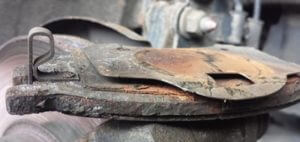
Corroded brake pad backing plate and corroded shim
Low-quality pads often use untreated steel backing plates and rely on glue to hold the friction material in place. Once rust forms, the bond weakens, the pad swells, and you end up with dragging brakes or uneven wear—no matter how good the friction compound is.
Higher-quality pads use galvanized or coated steel and mechanically attach the friction material. That extra cost pays off in longer pad life, quieter operation, and better interaction with the brake rotor over time.
Studies show that many low-end pad manufacturers use low-grade steel, which becomes a huge problem once it starts to rust. No matter how good the friction material is, a rusting backing plate always shortens the life of the pads. Higher-end pads are made from galvanized steel and use a mechanical system to retain the friction material instead of glue. For in-depth information on brake pad backing plates, see this post.
Brake Rotor Quality: The Part No One Wants to Talk About
Here’s an uncomfortable truth: there are no federal standards for replacement brake rotors. That’s why the market is flooded with cheap castings that look fine out of the box but don’t perform like the original brake rotor on your vehicle.
A low-quality brake rotor often has inconsistent metallurgy and poor machining. That leads to hot spots, uneven pad transfer, vibration, and shorter service life. In contrast, OE-quality rotors use higher-grade iron and tighter machining tolerances, which result in smoother braking and longer pad life.
When people complain that their “rotors warped,” what they’re usually dealing with is uneven friction material transfer caused by poor rotor quality or improper bedding—not actual warping.
For in-depth information on what to look for in a brake rotor, see this post and this post.

See the difference between economy brake rotors and OE quality brake rotors
How Brake Pads and Rotors Work as a System
Brake pads don’t stop the car—the interaction between the pad and the brake rotor does. A high-end pad on a cheap rotor performs poorly, and a premium rotor paired with low-quality pads won’t last.
That’s why I always recommend choosing brake pads and rotors from the same quality tier. OE-equivalent ceramic pads paired with OE-quality rotors will outperform mismatched “premium” parts every time.
What You Actually Need for a Complete Brake Job
A proper brake job involves more than pads and a brake rotor. Hardware kits, shims, caliper slide lubrication, and correct torque procedures all matter. Skipping those steps is how noise, uneven wear, and premature failures happen—regardless of brake pad types or rotor brand.
See this post for details.
©, 2020 Rick Muscoplat
Posted on by Rick Muscoplat