
How to Fix a P0101 Code Without Guessing
Step-by-Step Guide to Fix a P0101 Code
Quick Summary
A P0101 code is defined as: MAf Circuit Range/Performance. Most DIYers automatically replace the MAF sensor and are disappointed when the code returns. This common mistake arises from a misunderstanding: the Mass Air Flow sensor is usually functioning properly, but another component in the engine isn’t matching the airflow data it reports. In my experience, the real cause is often unmetered air, carbon buildup in the throttle body, or an airflow restriction, not a failed sensor. Learning to correctly diagnose the root cause is the fastest way to fix a P0101 code without wasting money on unnecessary parts.
Article
Learn How to Diagnose a P0101 Code Like a Pro
As an automotive diagnostician, I’ve addressed thousands of airflow-related drivability complaints, and the P0101 code is one of the most misunderstood trouble codes. The official definition of the P0101 code is “Mass Airflow (MAF) Circuit Range/Performance Problem.” In plain English, the engine computer sees airflow readings that don’t match what it expects based on throttle position, engine speed, load, and other sensor inputs.
That mismatch doesn’t automatically mean the MAF sensor is bad. In fact, most of the time, the MAF is accurately reporting airflow—and the problem lies elsewhere. Understanding that distinction is key to diagnosing and fixing a P0101 code correctly the first time.
What a P0101 Code Means Inside the Engine Computer
The engine computer constantly cross-checks airflow data from the MAF against throttle position sensor data, manifold pressure (if equipped), RPM, and oxygen sensor feedback. When those values fall outside the programmed range, the computer flags a P0101 code.
What’s important to understand is that the computer isn’t accusing the MAF of lying—it’s saying the airflow math doesn’t add up. That’s why blindly replacing the MAF is one of the most common and costly mistakes people make when trying to fix a P0101code.
The Most Common Real-World Causes of a P0101 Code
1) One of the most overlooked causes of a P0101 code is a dirty throttle body. Carbon buildup around the throttle plate restricts airflow at idle and low throttle openings. When airflow is mechanically limited, but the MAF still reads correctly, the computer sees a performance mismatch and sets the code.
2) Another extremely common issue is MAF contamination. Oil vapors, dust, and residue from oiled air filters can coat the sensing element and skew readings. In many cases, careful cleaning with a proper MAF cleaner is all it takes to resolve a P0101 code.
3) Unmetered air is another big player. A cracked intake boot, a loose duct clamp, or a vacuum leak allows air to enter the engine downstream of the MAF. That air isn’t measured, so fuel delivery doesn’t match actual airflow, triggering a P0101 code even though the sensor is working perfectly.
4) Exhaust restrictions can also confuse airflow calculations. A partially clogged catalytic converter affects engine breathing efficiency, which can cause airflow readings to fall outside expected ranges. While less common, this is still something I consider when diagnosing a stubborn P0101 code.
Other causes of a P0101 code
• Fuse blown to MAF — The MAF requires power and a reference voltage
• Wiring harness issues — A constant or intermittent open fault in the wiring to the MAF can cause a MAF-related trouble code
• MAF sensor disconnected
• PWR GND open to MAF sensor
• A closed [throttle indication throttle position (TP) sensor system]
• Damaged MAF sensor
• Damaged PCM
How I Diagnose a P0101 Code Step by Step
When diagnosing a P0101 code, I always start with fundamentals. I verify that the air filter is clean and properly seated, the intake duct is intact, and there are no obvious vacuum leaks. Next, I inspect the throttle body for carbon buildup because it’s one of the fastest and cheapest things to rule out.
From there, I look at live scan data. At idle and during light acceleration, I compare MAF airflow readings to engine displacement and RPM. If the numbers don’t make sense, I inspect for unmetered air or airflow restriction before touching the sensor.
Only after verifying airflow integrity do I move into electrical testing. I confirm that the MAF has proper power, ground, and signal integrity. This methodical approach prevents unnecessary replacement of parts and consistently leads me to the true cause of the P0101 code.
How to Fix a P0101 Code the Right Way
To fix a P0101code correctly, the repair must address the root cause—not the symptom. Cleaning a contaminated throttle body or MAF often resolves the issue immediately.
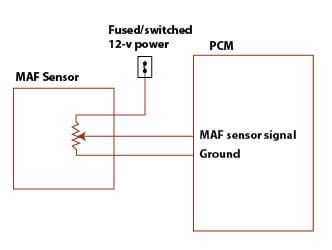
Repairing intake leaks restores accurate airflow measurement. Fixing wiring faults stabilizes the MAF signal.
Once repairs are complete, I clear the code and verify proper airflow readings during a road test. When airflow data aligns with engine load and throttle input, the P0101 code stays gone—and so do the drivability complaints.
Is a P0101 Code Serious?
A P0101 code usually won’t leave you stranded, but it does affect fuel economy, throttle response, and overall engine efficiency. Left unresolved, it can contribute to catalytic converter damage over time. That’s why I always recommend addressing it promptly and correctly rather than ignoring it or guessing.
The Biggest Mistake DIYers Make With a P0101 Code
The most common mistake I see is assuming the MAF sensor is bad simply because the code mentions it. In reality, the MAF is often telling the truth. Air leaks and airflow restrictions are far more common than sensor failure. Checking those first is the smartest way to fix a P0101code without wasting money.
© 2012 Rick Muscoplat
Posted on by Rick Muscoplat