
P0103 Code Causes, Diagnosis, and How to Fix It Right
Best Methods to Fix a P0103 Code Permanently
Quick Summary
A P0103 is defined as: Mass Air Flow MAF Circuit High. The code sets when the engine computer receives a Mass Air Flow (MAF) signal that’s higher than expected, not when the engine is actually ingesting too much air. In most cases, the root cause is electrical, not airflow-related. A contaminated MAF, a shortened signal wire, or an incorrect reference voltage are the usual culprits. The good news is that diagnosing and fixing a P0103 code is very straightforward if you understand how the MAF sensor works and what “high input” actually means to the PCM.
Article
Understanding the P0103 Code: Why the Computer Is Complaining
The P0103 code is often misunderstood, and I see that confusion leads to unnecessary replacement of parts all the time. The Mass Air Flow sensor measures the air mass entering the engine, enabling the PCM to calculate the fuel injection amount. It does this by evaluating air density, which depends on temperature and pressure. When the signal voltage or frequency from the MAF exceeds the programmed maximum, the PCM sets the P0103 code.
What Actually Causes a P0103 Code in the Real World
When I diagnose a P0103 code, I rarely start by blaming the sensor itself. Most failures I see fall into a few predictable categories.
1) A contaminated or partially blocked MAF sensor screen can distort airflow across the sensing element, causing an artificially high signal. This is especially common on vehicles with oiled aftermarket air filters.
2) Electrical problems are even more common. A short between the MAF signal wire and the power supply (often labeled VPWR) will instantly drive the signal high and set a P0103 code. Chafed wiring near the air intake duct or battery is a frequent offender.
3) Internal MAF sensor failure can also cause a stuck-high output, although this is less common than wiring faults. In rare cases, a damaged PCM can misinterpret a normal signal as an excessive one, but I treat PCM failure as a last-resort diagnosis, not a starting point.
How I Diagnose a P0103 Code Step by Step
When diagnosing a P0103 code, I start with the basics because they catch most failures quickly.
1) I first verify that the MAF is receiving proper battery voltage on its power supply circuit and that the ground circuit has minimal voltage drop. A missing ground or excessive resistance will skew the signal upward.
2) If power and ground check out, I turn the key to RUN and backprobe the MAF signal wire. On analog systems, I look for a smooth, reasonable voltage that increases with throttle input. On digital systems, I check frequency output with a scope and compare it to known-good values from service data.
3) If the signal is already maxed out with the engine idling, I know the issue is electrical. That’s when I start isolating the wiring harness to determine whether the fault is inside the sensor or in the circuit between the sensor and the PCM.
How to Fix a P0103 Code Without Guessing
To fix a P0103 code correctly, you must repair the root cause—not just replace parts and hope for the best.
If contamination is the issue, carefully cleaning the MAF sensor with a dedicated MAF cleaner often resolves the problem. Never touch the sensing element or use brake cleaner, which can permanently damage the sensor.
When wiring damage is present, repairing the circuit and restoring proper insulation will immediately fix a P0103 code. If the signal wire is shorted to voltage, replacing the sensor won’t help until the wiring fault is corrected.
If testing confirms an internally failed MAF sensor, replacement is justified. After repairs, clearing the code and verifying normal MAF readings under varying load conditions help ensure the P0103 code does not recur.
Why Ignoring a P0103 Code Is a Bad Idea
Driving with an unresolved P0103 code often forces the PCM into a default airflow calculation strategy. That can lead to rich or lean fuel mixtures, poor throttle response, reduced fuel economy, and long-term catalytic converter damage.
From my experience, fixing a P0103 code early prevents much more expensive repairs later.
How MAF Sensors Work—and Why It Matters for Diagnosis
Before you can properly fix a P0103 code, you have to understand that not all MAF sensors operate the same way. Over the years, I’ve worked with both analog and digital designs, and the testing approach varies depending on the domain.
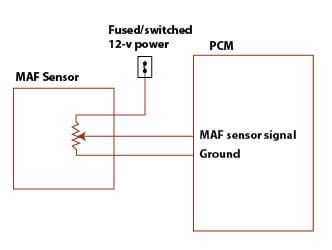
Some vehicles use a digital MAF sensor, which typically has three wires: a 12-volt power supply, a ground, and a signal wire that returns a pulsed on/off signal to the PCM. As airflow increases, the signal frequency increases. On these systems, the only accurate way to verify signal integrity is with an automotive oscilloscope.
Other vehicles use an analog MAF sensor, which produces a variable voltage signal that rises with airflow. These sensors often use four or five wires and can be tested safely with a high-impedance digital multimeter or a computer-safe test light.
© 2012 Rick Muscoplat
Posted on by Rick Muscoplat