
P0107 Code Explained: MAP and BARO Low Voltage Problems
What Causes the P0107 Code
Quick Summary
The P0107 code indicates the engine computer is detecting an abnormally low signal from the pressure-sensing system—specifically, a Manifold Absolute Pressure sensor low-voltage input and, in some designs, a related Barometric Pressure sensor voltage input issue. In plain terms, the PCM believes engine load or atmospheric pressure is much lower than it actually is. The most common causes are wiring faults, poor grounds, sensor contamination, or vacuum-related problems—not a bad computer. Accurate diagnosis relies on live data, electrical checks, and vacuum verification. Fix the root cause and normal fueling, timing, and drivability return.
Article
What the P0107 Code Means
When I diagnose a P0107 code, I’m looking at a condition where the powe
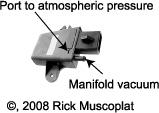
rtrain control module (PCM) detects a signal voltage that’s too low. That’s why the definition centers on the Manifold Absolute Pressure sensor low voltage input and, depending on vehicle design, a faulty Barometric Pressure sensor voltage input. The PCM uses these pressure readings to calculate engine load. If the voltage drops below the expected range, the PCM assumes extreme vacuum or an implausible atmospheric condition—and it can’t accurately manage fuel or spark.
On many vehicles, the barometric reading is captured from the MAP sensor at key-on engine-off; on others, there’s a dedicated BARO sensor. Either way, a persistently low signal triggers the P0107 code because the PCM no longer trusts the pressure data.
Why Low-Pressure Signals Cause Drivability Problems
A Manifold Absolute Pressure sensor with a low-voltage input signal to the PCM indicates that the engine is under a very light load at all times. A skewed Barometric Pressure sensor voltage input compounds the error by misreporting altitude. When either input is incorrect, the PCM learns from the mixture and adjusts timing. The result can be poor acceleration, hesitation, stalling, or hard starting—especially during cold starts or rapid throttle changes.
Accurate pressure inputs are foundational. When the PCM detects abnormally low pressure, it underfuels and mismanages ignition timing.
Common Symptoms of a P0107 Code
Vehicles with a P0107 code often exhibit weak acceleration, a rough idle, or stalling at stoplights. I also see extended crank times and hesitation off the line. Fuel economy may suffer, and the engine can feel “flat” under load. Because this is a low-voltage fault, the check engine light typically stays on rather than flickering.
In some cases, symptoms worsen after rain or engine washing—an important clue that moisture intrusion is affecting the Manifold Absolute Pressure sensor low-voltage input or the Barometric Pressure sensor voltage input.
The Most Common Causes of the P0107 Code
Despite common assumptions, sensors aren’t always the problem. In real-world diagnostics, wiring and grounds are the most frequent causes of a P0107 code. A short to ground on the signal wire or a poor sensor ground can force a Manifold Absolute Pressure sensor low voltage input reading, even when the engine load is normal.
Vacuum issues matter as well. A restricted MAP vacuum port, oil sludge in the sensor, or a collapsed hose can produce a falsely low signal. Connector corrosion—especially on vehicles where the sensor sits low in the engine bay—can also drop voltage and distort the Barometric Pressure sensor voltage input.
Less commonly, the MAP or BARO sensor fails internally and outputs a stuck-low voltage. PCM failures are rare and should be considered only after every circuit test passes.
How the MAP and BARO Circuits Work
Understanding the circuits makes the P0107 code easier to diagnose. The PCM supplies a 5-volt reference and ground to the MAP sensor. The sensor outputs a variable voltage proportional to pressure. High vacuum corresponds to lower voltage; low vacuum corresponds to higher voltage. When the signal drops below the minimum threshold, the PCM flags a Manifold Absolute Pressure sensor low-voltage input fault.
The Barometric Pressure sensor’s voltage input operates on the same principle but measures atmospheric pressure. The PCM continuously compares MAP and BARO values. If MAP voltage is implausibly low compared to BARO—or BARO itself is too low—the P0107 code sets.
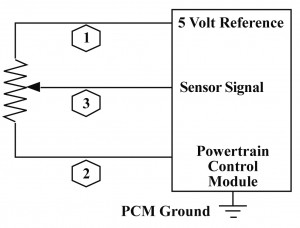 The sensor receives a reference voltage from the computer and the ground.
Depending on the type of MAP sensor, it can alter the returning voltage or generate a digital square wave back to the computer.
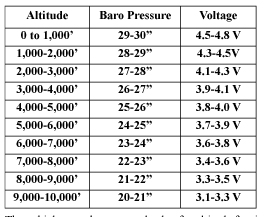
You can test a MAP sensor for correct barometric pressure readings with a digital multimeter. This is a typical voltage chart for a GM sensor, based on the altitude at your testing location.
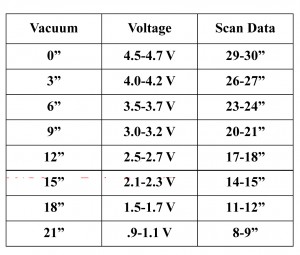
You can also test the MAP while it is running. Connect a vacuum gauge to the intake manifold and compare the gauge reading to the voltage output from the MAP sensor.
How I Diagnose a P0107 Code
I always begin with a scan tool. With key on, engine off, MAP and BARO readings should be nearly identical. If MAP is stuck very low, that’s an immediate red flag for a Manifold Absolute Pressure sensor low-voltage input. Then I start the engine. At idle, MAP should drop due to vacuum—but not to zero. If it’s pegged low, I suspect wiring, grounding, or a blocked port.
Next, I inspect the vacuum hose and sensor port for oil or debris. After that, I move to electrical checks: 5-volt reference, ground integrity, and signal voltage. If the signal wire shows near-zero volts, I look for a short to ground. Unplugging the sensor is a key test—if the signal returns to normal, the sensor is at fault; if it stays low, the wiring or PCM input is the issue. This approach prevents misdiagnosing a Barometric Pressure sensor voltage input problem as a bad sensor.
How to Fix the P0107 Code
Fixing a P0107 code depends on the results of testing. Many repairs involve cleaning or replacing a contaminated MAP sensor, repairing damaged wiring, restoring a solid ground, or replacing cracked or restricted vacuum hoses. Correcting these issues usually resolves both the Manifold Absolute Pressure sensor low voltage input and the Barometric Pressure sensor voltage input faults immediately.
If testing proves the sensor has failed, replacement is straightforward. After repairs, I clear the code and confirm MAP and BARO readings respond correctly at idle, during acceleration, and at cruise.
Why You Shouldn’t Ignore a P0107 Code
Ignoring a P0107 code allows the engine to operate with incorrect load calculations. Over time, that can lead to drivability complaints, increased emissions, and catalytic converter stress. Addressing issues with the low-voltage input of the Manifold Absolute Pressure sensor and the voltage input of the Barometric Pressure sensor early prevents more expensive problems later.
© 2012 Rick Muscoplat
Posted on by Rick Muscoplat