
How to Safely Jump Start a Car
The Right Way to Jump Start a Car: Safety Tips for Success
Jump-starting a car is a relatively simple process that almost anyone can do with the right tools and precautions. This guide will walk you through the steps needed to safely and effectively jump-start a car, as well as provide tips on avoiding common mistakes and keeping your battery in good condition.
Take your time to connect the cables properly: connecting them the wrong way can do a lot of damage
There’s always some risk to your car’s electronics when jump-starting a car. That’s because the instant you connect the last jumper cable, you create a spark and voltage spike in both vehicles. Computers don’t do well with sparks or voltage spikes. Connecting the jumper cables to the wrong terminals can cause the main fuses to blow, but it can also fry expensive computers in your car. So take your time and double-check each connection. Here are some connection tips to help you avoid that kind of damage.
Determine battery polarity— Some carmakers identify the positive battery cable with a red cover or red cable insulation. However, if your car doesn’t have color coding, use a rag to wipe off the top of the battery and look for the “+” and “—” markings. Don’t guess!
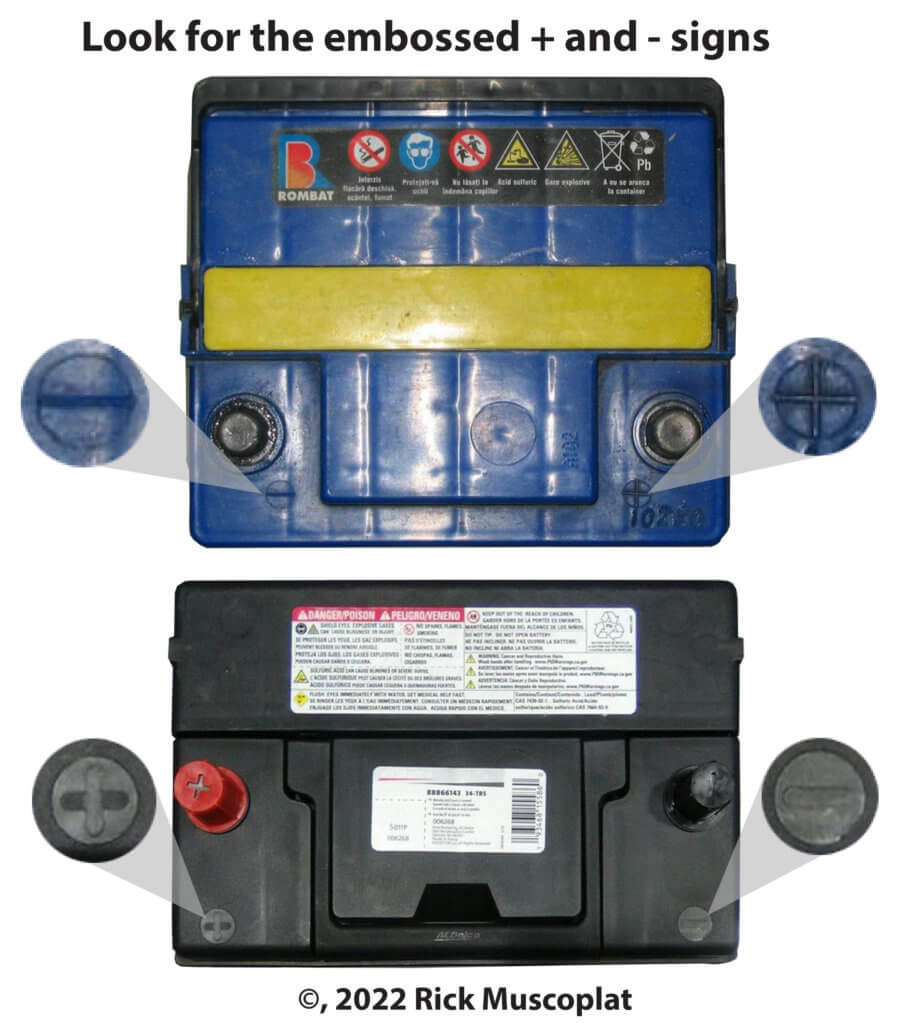
All car batteries have markings showing the positive “+” and Negative “—” terminals. Connecting the correct terminal is critical when trying to jump start a car.
Reduce the risk of computer damage by turn off all electrical accessories in the dead vehicle before connecting the jumper cables
The surge spark generated when you make the final connection is an arc caused by the power flow from the donor car to the dead battery. If you leave any accessory on in the dead vehicle, like headlights, you create even more power demand when connecting cables.
Worse yet, the arc produces very high voltages that can damage sensitive computers. So, turn them off.
Turn off headlights, blower motor, wipers, rear defroster, seat heaters, and even your radio in the dead vehicle! Turn the IGNITION in both vehicles to OFF. Seriously, why risk damaging a $500 factory radio during a jump start?
How to connect jumper cables
1) Connect a red jumper cable to the positive battery terminal or jump-starting stud on the dead vehicle.
2) Connect the opposite end of the red cable to the positive terminal or jump-starting stud on the running (donor) vehicle.
3) Connect a black jumper cable to the negative post on the donor vehicle
4) Connect the opposite end of the black jumper cable to a clean engine bracket on the dead vehicle.
Painted bolt heads don’t make very good contact, so clamp to an engine component bracket instead. Wiggle the clamp to ensure good contact.
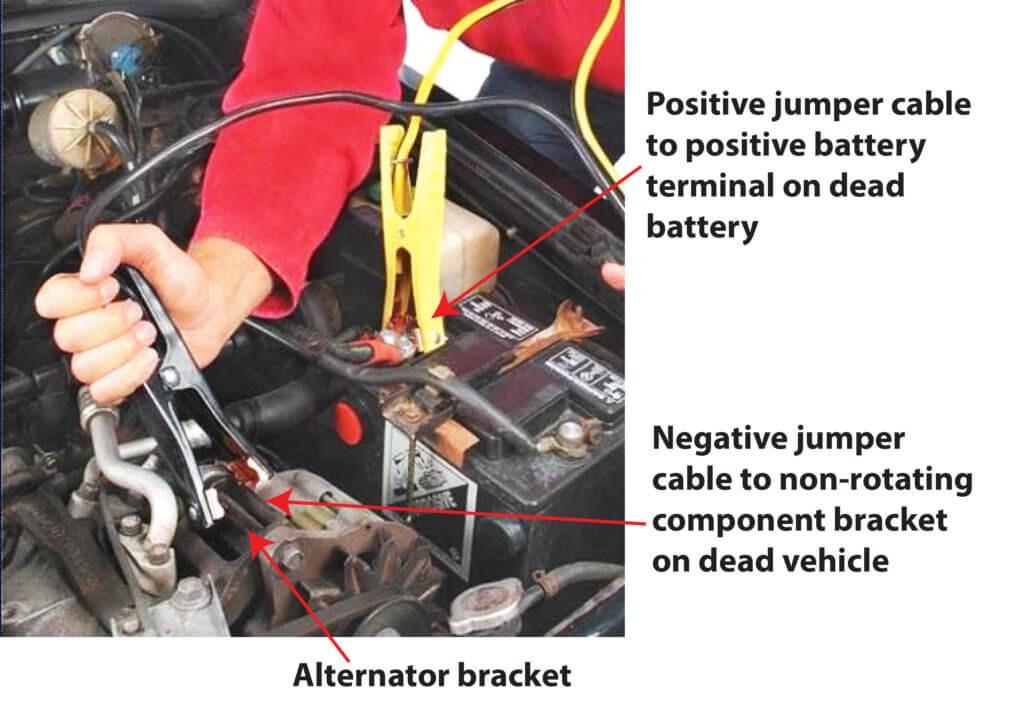
Make sure you connect the jumper cables to the correct terminals to jump start a car. Connecting the wrong terminal can damage costly vehicle electronics. Slow down and double check that you’re connecting the proper terminal.
Leave the cables connected for at least 5 minutes before trying to start the dead vehicle
Allow the dead battery some time to recharge before trying to start the engine.
Start the donor vehicle and raise the idle to 1,500 RPM. Maintain that idle for at least 5-minutes. That will run the donor alternator at a high enough speed to charge the dead battery while preventing the donor alternator from overheating. Then try starting the dead vehicle.
Don’t ruin a good jump by ignoring the flooded engine
If you’ve tried to start your vehicle multiple times in winter and run the battery down, be aware that you’ve most likely flooded the engine. If your engine cranks strongly but won’t fire up, depress the gas pedal all the way to the floor and hold it there while cranking. That puts the computer into “clear flood” mode, and the ECM shuts off the fuel injectors. The full throttle with no added fuel can help evaporate the excess fuel in the cylinders. After cranking for a few seconds with full throttle, release it and see if you get any signs of life from the engine.
Other jump-starting tips
After starting, the engine may run rough— When the battery voltage drops to below 9.6-volts, the ECM loses its adaptive memory; those changes to the factory programming that compensate for engine wear. Don’t panic. Your ECM will relearn that data over a period of time, usually over the next 10 cold starts.
Tip to get your to idle or accelerate after properly jump start— As mentioned above, the computer loses its memory when the battery voltage dips below 9.6 volts. On a late-model vehicle, that may mean the electronic throttle body no longer recognizes its “home” position. In that case, you may have to perform a throttle body relearn procedure. Unfortunately, the procedure is different for every year, make, model, and engine. I’ve posted some of the relearn procedures on this site. Just search for the term “relearn” to see if yours is included. Search the internet for the procedure for your car.
©, 2019 Rick Muscoplat
Posted on by Rick Muscoplat