
Is a power steering flush necessary?
Should you flush your power steering fluid?
If you check your owner’s maintenance guide, you probably won’t find a recommendation to flush your power steering fluid. But if you search the Internet, you’ll find lots of recommendations to do it, from once a year to once every 12,000 miles. Where are these recommendations coming from?
The recommendation to flush power steering fluid is coming from the shops, not the carmakers
If the carmakers aren’t recommending it, then why are the shops pushing it so hard? Simple. It’s a wallet-flushing service designed to flush money out of your wallet and into theirs.
But is there ever a reason to do a power steering fluid change?
Power steering fluids come in several varieties, from ordinary red transmission fluid to clear hydraulic fluid. Whatever the type, they all have anti-corrosion additives and pH balancing additives that can wear out over time. In addition, power steering fluid is subjected to high heat and high pressures, up to 2,000-psi, when the wheel it turned into full lock position.
Over time and with high heat, those additives can break down, causing expensive wear to the pump and steering gear.
If you want to be on the safe side, change power steering fluid once every 100K miles
For most owners, that’s once in the life of the vehicle. If the shop recommends it more often than that, ask them to show you where that recommendation is listed in the owner’s manual. Changing power steering fluid once a year or every 12,000 miles is just insane and a complete waste of money.
Are there any symptoms that would indicate you need to flush the power steering fluid?
The searches on the Internet show “symptoms you need a power steering flush.” They’re all bullshit.
Power steering fluid, even worn out fluid, will not produce any symptoms unless you’ve contaminated it with other fluids.
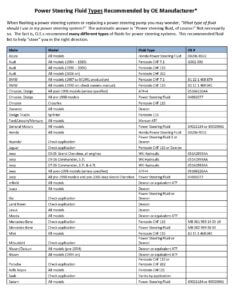
You can change your power steering fluid yourself
First, you’ll need about two quarts of new power steering fluid. Click on the PDF listed here and find the correct fluid for your car. Not all power steering fluids are the same and using the wrong fluid can cause costly damage. Avoid “universal” power steering fluids unless they specifically note that they meet the specifications listed in your owner’s manual.
Next, you’ll need a turkey baster that you’re willing to toss when you’re done. You’ll be removing the return line to the power steering pump and most are held in place with a spring hose clamp. But some return lines connect using a hex fitting. In that case you’ll need an open end wrench.
You’ll also need to plug the return port to the power steering pump. Find these plugs at your local hardware store.

Finally, you’ll need an old container to catch and cap the old fluid. You’ll take that to recycling when you’re done.
Remove all fluid from the power steering reservoir
Use a turkey baster to suck the old fluid out and squirt 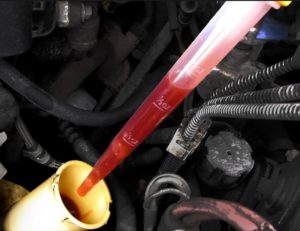 it into your catch can.
Disconnect the return line from the power steering gear
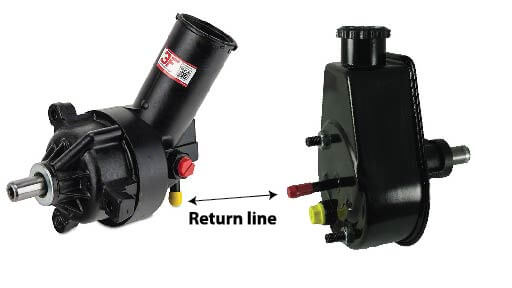
If the return hose has a spring clamp, simply compress the ears with a pliers and move it back. The twist the hos off the pump fitting. Plug the fitting with either a cap or plug. If your return line has a hex fitting, remove it with an open end wrench.
Route the return line into your catch bottle.
Remove the fuse or relay to cut power to your fuel pump
You’ll be cranking the engine to pump fresh fluid into the steering gear to force out the old fluid. DON’T run your engine to do this—a running engine can suck the reservoir dry quickly and that can damage your pump.
Fill the reservoir with fresh power steering fluid
Since you’ll be using up almost all the fluid, you can fill the reservoir to the brim. Then, crank the engine. Refill the reservoir and repeat until the fluid coming out of the return hose looks clean. Then, turn the steering wheel fully to one side and repeat the flush procedure. When the fluid looks clean, turn the wheel to the opposite side.
Reattach the return hose to the pump
Then, fill the reservoir to the proper level. Reinstall the fuse or fuel pump relay and start the engine. The power steering pump may whine and accumulate bubbles. That’s normal. SLOWLY turn the steering wheel to one side, but don’t hold it at full left or right. Then, turn to the opposite side. That will bleed air out of the system.
©, 2017 Rick Muscoplat
Posted on by Rick Muscoplat