
P0120 Code: What It Means and How to Fix It Fast
P0120 Code: Diagnosis and Repair Guide
Quick Summary
A P0120 code is defined as: Throttle/Pedal Position Sensor ‘A’ Circuit. It means the engine computer is having trouble trusting the data from one of the throttle position sensors (TPS). The throttle position sensors tell the computer exactly how far the throttle plate is open. When that signal becomes inaccurate, inconsistent, or out of range, the computer sets the P0120 code and may put the vehicle into reduced-power or limp mode.
The most common causes of a P0120 code are a failing throttle position sensor, damaged wiring at the throttle body, carbon buildup restricting throttle movement, or a faulty electronic throttle body. The good news is that many of these problems are relatively easy to diagnose with a scan tool and a multimeter. Fixing the problem quickly restores proper throttle response and prevents more serious driveability issues.
Article
P0120 Code: What It Means, What Causes It, and How I Diagnose It
After decades of diagnosing engine management problems, I can tell you that the P0120 code is one of the more common trouble codes technicians encounter. The P0120 code indicates a problem with the throttle position sensor circuit, which the computer uses to monitor throttle movement.
Understanding how the throttle system works makes diagnosing the P0120 code much easier.
Modern vehicles use an electronic throttle control instead of a mechanical cable connecting the accelerator pedal to the throttle plate. The engine computer electronically controls the throttle opening based on driver input from the accelerator pedal position sensors.
Each throttle position sensor produces a voltage signal that changes as the throttle opens or closes. The engine control module constantly compares those signals to make sure they agree with each other.
If the computer detects a voltage that doesn’t make sense or falls outside the expected range, it sets a P0120 code and turns on the check engine light.
Put simply, the P0120 code means the engine computer believes the signal from the throttle position sensor “A” is unreliable.
A Quick Look at An Electronic Throttle Body
All throttle-by-wire throttle systems have the same basic parts:
1) a throttle body with a throttle plate that opens and closes to control the amount of air entering the engine,
2) A motor and gears to move the plate, and
3) Two or more throttle position sensors (TPS). When the throttle body sensors fail, you often see a P0120 code, along with other possible codes listed below.
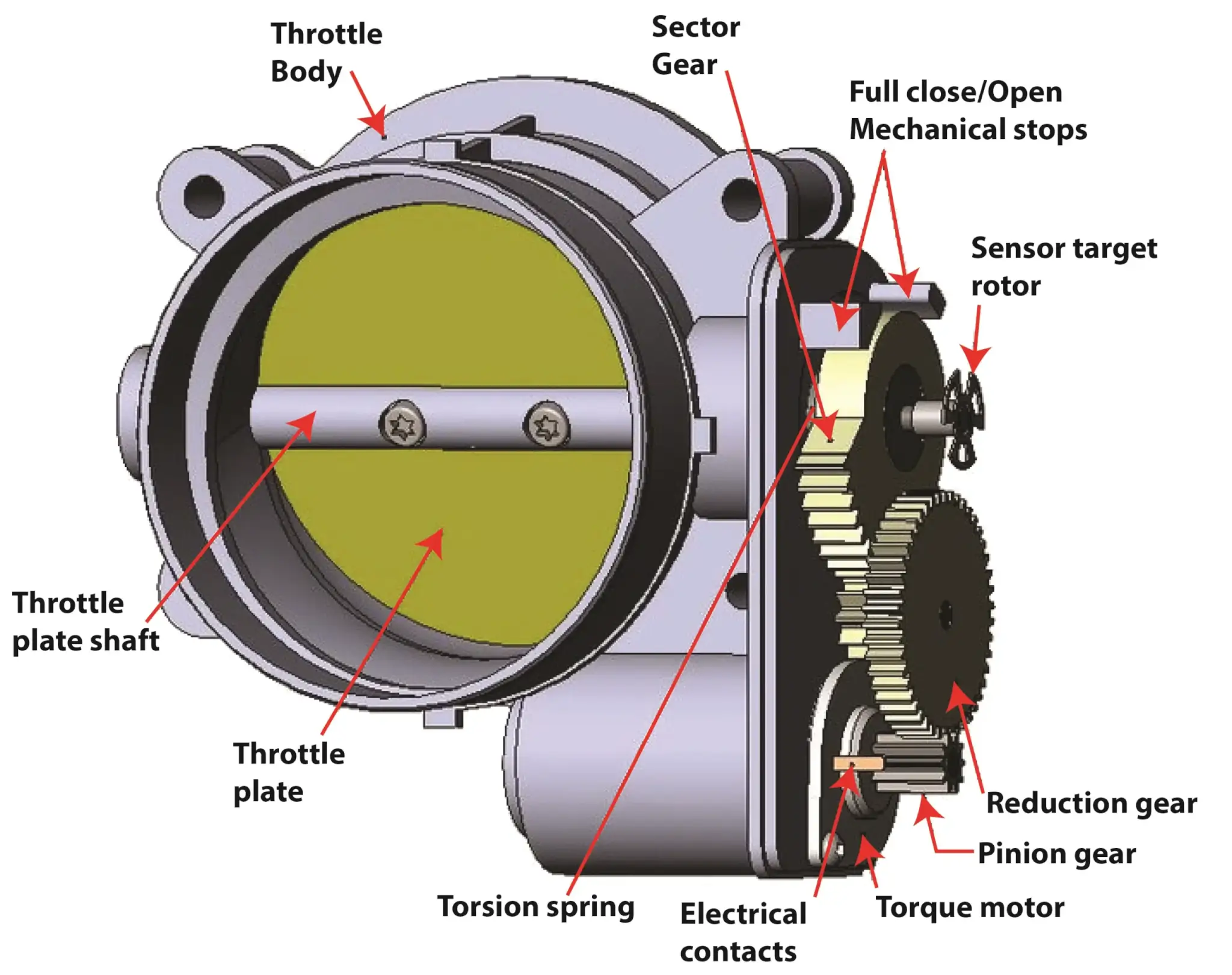
This image shows the parts of an electronic throttle body
The Most Common Causes of a P0120 Code
In my experience, there are a handful of issues that trigger a P0120 code, and most can be confirmed with basic diagnostic tools.
Here are the most likely causes:
• Wiring problems— Damaged, corroded, or loose wiring at the throttle body connector is a leading cause of the P0120 code. The sensor signal or reference voltage may drop out intermittently.
• Failed throttle position sensor (TPS)— Over time, internal wear or contamination can cause dead spots in the sensor, leading to incorrect voltage output.
• Carbon buildup— Excess carbon around the throttle plate can restrict movement or prevent full closure, confusing the ECM and triggering the P0120 code.
• Faulty throttle actuator motor— A weak or sticking motor can prevent the plate from moving correctly, resulting in sensor mismatches.
• ECM issues— Although rare, internal ECM faults or poor ground connections can cause false throttle position readings.
Symptoms You’ll Notice With a P0120 Code
When the ECM detects a P0120 code, it usually activates the check engine light and may trigger “limp mode” to protect the engine. Here’s what you might experience:
• Sudden loss of throttle response or reduced power.
• The throttle is sticking or surging unexpectedly.
• Rough idle or stalling after startup.
• Poor acceleration or jerky throttle input.
If your car suddenly won’t rev past a certain RPM, it’s a strong indicator that the P0120 code has forced the vehicle into reduced-power mode.
How I Diagnose and Fix a P0120 Code
When diagnosing a P0120 code, I always start with a visual inspection. I check the throttle body connector, wiring harness, and nearby vacuum lines for damage or corrosion.
Next, I connect a scan tool and monitor live data from both throttle position sensors. In a healthy system, the two voltage signals will rise and fall smoothly in opposite directions as the throttle is opened.
If I see dropouts, flat spots, or readings that don’t add up to 5 volts combined, I know I’m dealing with a sensor or wiring issue.
Here’s my step-by-step process:
1)Inspect and clean the throttle body to remove carbon buildup.
2) Test the 5-volt reference signal and ground integrity with a multimeter.
3) Backprobe the TPS signal wires and check for smooth voltage sweep between 0.5V (closed) and 4.5V (wide open).
4) Wiggle the wiring harness to check for intermittent faults.
If everything checks out, replace the throttle body assembly or TPS as required.
Clearing the P0120 code after repairs and retesting ensures the fix is verified and the ECM sees proper correlation between the throttle plate command and feedback signals.
Preventing Future Throttle Body Trouble Codes
You can prevent another P0120 code by keeping the throttle body clean and inspecting electrical connectors during regular maintenance. Modern vehicles are sensitive to voltage fluctuations, so that a clean connection can make all the difference.
Also, make sure your battery and charging system are healthy — low voltage can cause erratic throttle readings that mimic a bad sensor.
My Expert Take on the P0120 Code
When a P0120 code appears, it’s not something to ignore. The car’s computer relies heavily on accurate throttle position feedback for fuel management and safety systems.
While a simple cleaning or wiring repair often solves the issue, continued driving with this fault can lead to more serious problems — including unsafe throttle behavior.
In my shop, I’ve found that about 70% of P0120 code repairs come down to simple cleaning or connector issues. The rest usually require throttle body replacement. Either way, diagnosing it early saves money and prevents driveability headaches later.
Most common electronic throttle body trouble codes
P0120-P0124 are for sensor A.
P0220-P0224 are for sensor B.
P0225-P0229 are for sensor C.
The codes in the three sets cover circuit malfunctions, such as high or low inputs. These codes indicate an issue with the throttle body position sensors, wiring harness, or connectors.
Use the live data on a scan tool or a multimeter to check for proper operation of the throttle position sensors.
The most common electronic throttle body trouble code is P2119 Throttle Actuator Control Throttle Body Range/Performance. This ECM sets this code when the commanded throttle plate angle does not match the actual throttle position angle reported by the throttle position sensors. This is called a plausibility code, meaning the computer can’t make sense of the incoming data.
The most common causes of P2119
P2119 can be caused by either mechanical or electrical problems. For example, a change in throttle angle should immediately alter the signal sent from the mass airflow sensor or manifold air pressure sensor. If it doesn’t, a P2119 can be set.
Carbon buildup in the throttle body or a dirty MAF sensor can cause this. Check those two items first when diagnosing a P2119
Are there other trouble codes?
Check for codes in other modules for loss of communication. Resolve those trouble codes before addressing the throttle body-related trouble codes.
Diagnose P2119
The scan tool compares live data with the commanded and actual throttle angle values. On most vehicles, these two data PIDs should match. Next, check for proper reference voltages to all throttle position sensors. The reference voltages should all be the same and match specs in the shop manual.
If those values are correct, look at the signal voltages of sensors A and B. For most vehicles, when you add up the two signal voltages, they should equal the reference voltage.
©, 2023 Rick Muscoplat
Posted on by Rick Muscoplat