
P0410 Code Explained: How to Diagnose and Fix It
P0410 Code: What It Means, Common Causes, Diagnosis, and How to Fix It
Quick Summary
A P0410 code means your vehicle has detected a malfunction with the Secondary Air Injection System.
The secondary air injection system primarily operates during a cold engine start to reduce exhaust emissions.
Common P0410 causes include:
• A failed secondary air injection pump
• Bad switching or diverter valve
• Defective check valve
• Vacuum leak
• Electrical problem
• Or a blocked air passage
A vehicle with a P0410 trouble code will often drive normally, making the problem easy to ignore.
The best time to diagnose P0410 is during a true cold start, because that is when the system is normally commanded on.
Don’t automatically replace the air injection pump. Test the pump, valves, power, ground, airflow, and related components first.
In many cases, the repair isn’t especially complicated—but guessing at parts can make it expensive.
I’ve diagnosed enough emission-system faults to know that a trouble code can sound much worse than the actual problem. P0410 is a good example.
When I see this code, I don’t immediately assume the car needs an expensive repair. Instead, I look at what the engine computer was trying to accomplish, what response it expected, and which part of that process failed.
Once you understand that sequence, diagnosing a P0410 secondary air injection system malfunction becomes much easier.
Why Does a P0410 Code Set?
This is where I see people make an expensive diagnostic mistake.
They read “Secondary Air Injection System Malfunction” and immediately order a secondary air pump.
I don’t.
The ECM usually isn’t directly telling you, “The pump motor has failed.” It’s telling you that the system failed its functional test.
That can happen because the pump doesn’t run. But it can also happen because the pump runs and the air never reaches the exhaust.
For example, the pump may be operating perfectly while a switching valve is stuck closed. A check valve may be plugged. An air hose may be damaged.
Carbon deposits may block the passages into the exhaust. A relay may not supply power. A vacuum-operated valve may not receive vacuum.
From the ECM’s point of view, many of those failures look similar: the expected oxygen change didn’t happen.
That’s why diagnosis matters more than the code description alone.
Most Common Causes of a P0410 Code
Based on the way these systems operate, these are the areas I investigate first.
1. Failed Secondary Air Injection Pump — A bad secondary air injection pump is one of the best-known causes of a P0410 code.
Electric AIR pumps can fail because of:
• Internal motor failure
• Worn bearings
• Corrosion
• Water or condensation intrusion
• Electrical failure
• Excessive current draw
• Damage caused by hot exhaust gases or moisture reaching the pump
A dead pump obviously can’t provide the airflow the ECM expects. But before replacing one, I verify that the pump is actually receiving the correct power and ground. If it isn’t, replacing the pump won’t solve the underlying problem.
2. Bad Secondary Air Injection Switching or Diverter Valve — A failed secondary air injection valve is another common P0410 cause.
Depending on the vehicle, you may hear this component called a:
• Switching valve
• Diverter valve
• Combination valve
• Air injection valve
• Secondary air valve
The terminology changes, but the purpose is similar: control where and when secondary air enters the exhaust.
These valves operate in a hot, corrosive environment. Carbon and moisture don’t help.
If the valve sticks closed, the AIR pump can run normally while little or no fresh air actually reaches the exhaust.
That’s why I never condemn the pump merely because a P0410 code is present.
3. Failed or Carbon-Clogged Check Valve — The secondary air injection check valve is there for an important reason: exhaust gas should travel through the exhaust system, not backward toward the air pump.
A damaged or stuck check valve can disrupt airflow. Worse, a valve that allows exhaust backflow can expose upstream AIR-system components to heat, moisture, and corrosive exhaust gases. That can turn one failed component into several.
If I’m replacing a damaged AIR pump, I want to know why it failed, especially if I see evidence of water, corrosion, or exhaust contamination.
4. Blown Fuse or Bad AIR Pump Relay— Sometimes the mechanical components are fine, and the pump simply isn’t getting electricity.
A blown secondary air injection fuse or failed AIR pump relay can prevent the system from operating. The important question is why the fuse failed.
A blown fuse can be the original fault, but it can also indicate a seized pump or one drawing excessive current. Replacing the fuse without checking the circuit may result in another blown fuse.
5. Wiring or Connector Problems — Secondary air components are exposed to heat, vibration, moisture, road debris, and age.
I look for:
• Corroded terminals
• Loose connectors
• Broken wires
• Chafed insulation
• Poor grounds
• Heat-damaged wiring
• Water intrusion
Electrical faults are especially important when a pump or solenoid doesn’t receive the expected power or ground during activation.
6. Vacuum Leaks or Failed Vacuum Solenoids — Some secondary air injection systems use engine vacuum to operate their switching valves.
On these vehicles, a cracked vacuum hose, failed vacuum-control solenoid, leaking diaphragm, or disconnected line can prevent the valve from opening.
The pump may run, but airflow still won’t reach its intended destination.
7. Carbon-Clogged Secondary Air Passages — This is one of the P0410 causes that’s easiest to overlook.
Air injection passages in the cylinder head, exhaust manifold, tubes, or valves can accumulate enough carbon to restrict airflow.
In that situation, you can have:
• A working pump
• Correct electrical power
• A functioning relay
• An operating valve
…and still get a P0410 code because insufficient air reaches the exhaust.
If the obvious electrical and mechanical components test correctly, restricted air passages move higher on my diagnostic list.
What Does the Secondary Air Injection System Do?
To understand a P0410 fault, you first need to understand why the secondary air injection system exists.
When you start a cold engine, combustion isn’t as efficient as it will be after the engine warms up. The engine may run with a richer fuel mixture, and the catalytic converter may still be below its most effective operating temperature.
That creates a period when exhaust emissions can be relatively high.
The Secondary Air Injection system, sometimes called the SAI system, AIR system, smog pump system, or secondary air pump system, addresses that problem by introducing fresh air into the exhaust stream.
That fresh air contains oxygen.
The additional oxygen supports oxidation of unburned exhaust gases and helps the exhaust system and catalytic converter reach effective operating temperatures sooner.
The key thing to remember is that secondary air injection is generally a cold-start emissions strategy. It doesn’t normally need to run continuously.
And that explains one of the biggest challenges when diagnosing a P0410 code: if you wait until the engine is already warm, you may miss the system operating altogether.
How the Secondary Air Injection System Works
Although the exact design varies by manufacturer and model, a typical secondary air injection system can contain:
• A secondary air injection pump, also known as an AIR pump or smog pump
• Air hoses or pipes
• A switching, combination, or diverter valve
• One-way check valves
• Vacuum lines on vacuum-operated systems
• Vacuum-control solenoids
• Electrical relays and fuses
• Wiring and connectors
• Exhaust air-injection passages
• Engine control module commands
• Oxygen sensors used by the ECM to monitor the result
Most newer systems use an electric secondary air pump.
During a qualifying cold start, the ECM commands the AIR pump to turn on. At approximately the same time, it opens the appropriate switching or diverter valve so air from the pump can enter the exhaust system.
Fresh oxygen entering the exhaust should change what the upstream oxygen sensor or air/fuel-ratio monitoring system sees.
The ECM watches for that change.
If it commands secondary air injection but doesn’t detect the expected exhaust response, it may eventually store OBD-II code P0410 and illuminate the check engine light.
Is the P0410 Code Serious?
I generally don’t treat P0410 the same way I would treat an oil-pressure warning, severe misfire, or overheating engine.
A P0410 code is primarily an emissions-system fault, and many vehicles continue to drive normally with the code stored.
That doesn’t mean I recommend ignoring it.
A P0410 fault can:
• Keep the check engine light illuminated
• Cause the vehicle to fail an emissions inspection
• Increase cold-start emissions
• Hide a developing electrical or mechanical problem
• Lead to damage elsewhere in the AIR system if exhaust or moisture backflows through a failed valve
There is another practical issue: once the check engine light is already illuminated, you don’t have the same obvious visual warning if another emissions-related fault appears later.
So while P0410 often isn’t an emergency, it deserves a proper diagnosis.
How to Diagnose a P0410 Code Step by Step
The diagnostic principle I use is simple: test the system when it’s supposed to operate—during a cold start.
A warm engine can make a perfectly legitimate test look like a failure simply because the ECM isn’t requesting secondary air injection at that moment.
Step 1: Scan the Vehicle for All Trouble Codes — I begin with a complete scan rather than focusing only on P0410.
Related trouble codes can point toward:
• A particular AIR valve
• Pump control problems
• Oxygen-sensor issues
• Circuit faults
• Bank-specific airflow problems
I also review freeze-frame data when it’s available. Freeze-frame information gives me a snapshot of operating conditions when the fault was detected and can provide useful clues about coolant temperature, engine speed, and other conditions.
Step 2: Perform a Visual Inspection — Before reaching for complex test equipment, I inspect the system.
I’m checking for:
• Disconnected hoses
• Cracked or collapsed air tubing
• Damaged vacuum lines
• Burned wiring
• Loose electrical connectors
• Corrosion
• Water intrusion
• Blown fuses
• Damaged valves
• Signs of exhaust leakage
A five-minute visual inspection can sometimes save an hour of electrical testing.
Step 3: Check Whether the AIR Pump Runs on a Cold Start — With the engine genuinely cold, start it and listen for the secondary air injection pump.
Depending on its location, the pump may sound like a vacuum cleaner or electric blower while operating.
No sound doesn’t automatically prove the pump is bad.
The ECM may not be commanding it on, the relay may have failed, a fuse may be open, or there may be a wiring problem.
That’s why the next step is electrical testing.
Step 4: Check Power and Ground at the Secondary Air Pump — If the pump should be operating
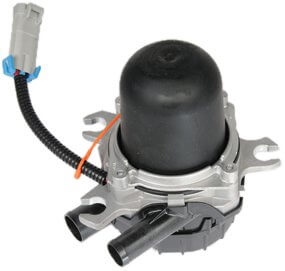
Electric Air Injection Reaction pump
but isn’t, I check its electrical supply.
If the pump receives proper power and ground during the commanded operating period but doesn’t run, the pump itself is the likely failure.
If power or ground is missing, I don’t replace the pump yet.
I move upstream through the circuit and inspect the:
• Fuse
• Relay
• Wiring
• Connectors
• Grounds
• Control circuit
A wiring diagram for the exact year, make, model, engine, and emissions package can be extremely helpful here.
Step 5: Test the Switching Valve or Solenoid — Next, I verify that the secondary air switching valve can actually open.
On an electrically controlled
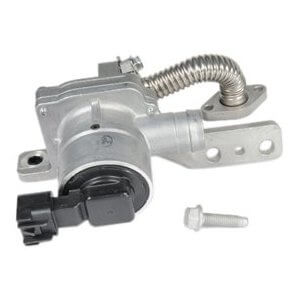
Secondary air one-way valve and solenoid
valve or solenoid, that means checking the appropriate electrical command and circuit operation.
On a vacuum-operated design, it can also mean confirming that vacuum reaches the valve and that the diaphragm responds properly.
A bi-directional scan tool can make this test much easier on supported vehicles because it may allow the technician to command secondary air components on and off.
If the component has the correct electrical or vacuum input but doesn’t respond, the component itself becomes suspect.
Step 6: Verify That Air Actually Reaches the Exhaust — This step separates diagnosis from parts swapping.
A running AIR pump doesn’t prove the system works.
I need to know whether the air gets through the hoses, valves, and passages and ultimately reaches the exhaust.
If the pump operates and the valve opens but airflow is weak or absent, I start looking for:
• Restricted hoses
• Carbon buildup
• Plugged check valves
• Blocked cylinder-head or exhaust-manifold air passages
This is especially important when every electrical test passes, but P0410 keeps returning.
Step 7: Watch Oxygen-Sensor or Air/Fuel Data — Remember what the ECM is trying to verify.
When fresh air enters the exhaust, the additional oxygen should produce a recognizable change in exhaust oxygen readings.
With a capable scan tool, watching live sensor data while commanding the AIR system can be extremely useful.
If the pump and valves activate but the expected sensor response never appears, airflow restrictions or another system-monitoring issue may require further investigation.
Step 8: Repair the Fault, Clear the Code, and Retest Cold — After repairing the confirmed problem, I clear the diagnostic trouble codes and retest the vehicle.
The important part is verification.
I want to confirm that:
1. The secondary air system activates when commanded.
2. The pump operates correctly.
3. The valve opens.
4. Air reaches the exhaust.
5. Sensor data responds appropriately.
6. The P0410 code does not return after the necessary drive cycle or system monitor runs.
Clearing a code isn’t a repair. The repair is complete when the system passes its test.
How Do You Fix a P0410 Code?
There isn’t one universal P0410 fix because P0410 describes a system malfunction rather than identifying one guaranteed failed component.
Depending on your diagnosis, the repair may involve:
• Replacing a failed secondary air injection pump
• Replacing a stuck switching or diverter valve
• Replacing a defective one-way check valve
• Repairing damaged vacuum hoses
• Replacing a failed vacuum solenoid
• Repairing wiring or corroded connectors
• Replacing a failed relay
• Correcting a fuse or circuit problem after identifying its cause
• Cleaning blocked secondary air passages where appropriate
• Repairing damaged air hoses or pipes
The rule I follow is simple:
Test first. Replace second.
That approach matters especially with a P0410 code because several different failures can produce the same diagnostic trouble code.
Can I Drive With a P0410 Code?
In many cases, a vehicle with a P0410 code will continue to run and drive normally because secondary air injection primarily affects cold-start emissions.
However, whether a particular vehicle is safe to continue driving depends on the actual failure and any other symptoms or codes present.
If P0410 is the only code, the engine runs normally, and there are no warning signs such as overheating, severe misfires, unusual smoke, major electrical problems, or other serious symptoms, the fault is often not an immediate drivability emergency.
But I would still diagnose it rather than leave it indefinitely.
Will P0410 Cause a Failed Emissions Test?
It can.
An illuminated check engine light, a stored emissions-related diagnostic trouble code, or incomplete OBD readiness monitors can cause inspection problems depending on the testing rules where the vehicle is registered.
There’s also a serious mistake to avoid here. Don’t clear the code immediately before an emissions inspection and assume the problem is solved.
Clearing diagnostic codes also resets OBD readiness monitors on many vehicles. Those monitors generally need to run again before the vehicle is ready for an OBD-based inspection.
Repair the underlying fault first.
Can a Bad Oxygen Sensor Cause P0410?
Sensor or monitoring problems can complicate diagnosis, but I wouldn’t replace an oxygen sensor solely because P0410 is present. The ECM uses exhaust feedback to determine whether secondary air injection had the expected effect. If that expected response is missing, the underlying cause could still be the pump, valve, airflow path, electrical circuit, or another problem.
Check the entire system and any accompanying diagnostic trouble codes before blaming the oxygen sensor.
Can a Vacuum Leak Cause a P0410 Code?
Yes—on secondary air systems that use vacuum-operated valves.
If a vacuum hose is cracked, disconnected, restricted, or leaking, the AIR pump may operate while the valve controlling airflow fails to open.
That’s another example of why hearing the pump run doesn’t prove the secondary air injection system is working correctly.
Can Carbon Buildup Cause a P0410 Code?
Yes.
Carbon-restricted secondary air passages are particularly frustrating because the electrical components can test normally.
The pump runs.
The relay works.
The valve opens.
But the ECM still doesn’t see the expected exhaust response because not enough air is making it through the restricted passages.
When a P0410 code keeps returning despite apparently functional components, blocked secondary air injection passages should be part of the investigation.
How Much Does It Cost to Fix a P0410 Code?
There isn’t a reliable single price for a P0410 repair.
The cost depends on what actually failed and how difficult the component is to access.
A damaged hose, fuse, relay, or electrical connection may be relatively inexpensive. A secondary air pump or valve assembly can cost substantially more, and cleaning badly restricted air passages may involve significant labor on some engines.
That’s another reason I discourage replacing the AIR pump based solely on the trouble code.
A good diagnosis can be much cheaper than a wrong repair.
Common P0410 Diagnostic Mistakes
The biggest mistake I see with P0410 is treating the code as a component diagnosis.
It isn’t.
Avoid these common traps:
• Replacing the AIR pump without testing power and ground
• Ignoring a failed check or switching valve
• Testing only after the engine is warm
• Replacing a blown fuse without determining why it blew
• Assuming pump noise proves air is reaching the exhaust
• Ignoring carbon-clogged passages
• Clearing the code without verifying the repair
• Replacing oxygen sensors without confirming they’re responsible
• Failing to inspect for water or exhaust contamination when replacing a damaged pump
The most expensive diagnostic strategy is often the simplest-looking one: keep replacing parts until the light stays off.
P0410 Diagnosis: The Logic I Use
Whenever I’m working through a P0410 secondary air injection code, I reduce the diagnosis to a sequence of questions:
Did the ECM command the system on?
If yes:
Did the AIR pump receive power and ground?
If yes:
Did the pump run and produce airflow?
If yes:
Did the switching valve open?
If yes:
Did that air actually reach the exhaust?
If yes:
Did the ECM see the expected change in exhaust sensor data?
Working through the system in that order is far more reliable than guessing which component “usually” fails.
P0410 Code FAQ
What does code P0410 mean?
P0410 means the vehicle detected a Secondary Air Injection System Malfunction. The ECM commanded the emissions system to operate but did not detect the expected result.
What is the most common cause of a P0410 code?
Common causes include a failed secondary air injection pump, a stuck switching or diverter valve, a defective check valve, electrical failure, a vacuum-control problem, or carbon-restricted air passages. The most likely cause varies by vehicle.
How do I fix code P0410?
Start by scanning for related codes and testing the secondary air system during a cold start. Verify AIR-pump operation, power and ground, valve operation, airflow to the exhaust, and the corresponding sensor response. Repair the component or circuit that fails testing.
Will P0410 clear itself?
The check engine light may turn off after enough successful monitoring cycles on some vehicles if the problem no longer occurs, but an intermittent or permanent underlying fault can cause the code to return. Don’t assume the system is repaired simply because the warning light temporarily disappears.
Does P0410 mean I need a new air pump?
No. This is one of the most important things to understand about the P0410 code. A bad pump can cause P0410, but so can a stuck valve, blocked passage, vacuum leak, failed relay, wiring problem, check-valve failure, or another issue that prevents the expected airflow response.
Is P0410 an engine problem?
P0410 is primarily associated with the secondary air injection emissions system, not an internal mechanical engine failure. However, you still need to diagnose the specific cause.
Can I fix P0410 myself?
An experienced DIYer can diagnose some P0410 problems with an OBD-II scan tool, a digital multimeter, wiring information, and a solid understanding of electrical testing.
More complicated cases—particularly systems with carbon-blocked cylinder-head passages or difficult electrical faults—may require professional diagnostic equipment and experience.
Final Thoughts on the P0410 Code
When I diagnose a P0410 code, I don’t start by asking, “Which part should I replace?” I ask, “Where did the secondary air injection process stop working?”
That change in thinking makes the diagnosis much easier.
During a cold start, the ECM wants the AIR system to supply fresh air to the exhaust. The pump has to run. The control valve has to open. The passages have to flow. And the engine computer has to detect the expected change in exhaust oxygen.
Find the point where that chain breaks, and you’ve found the direction of the repair.
The P0410 code can look intimidating on a scan tool, but systematic testing usually turns it into a straightforward question of power, control, airflow, or feedback.
And that’s how I approach it: diagnose the system, confirm the failed component, make the repair, and verify that the secondary air injection monitor works correctly afterward.
©, 2023 Rick Muscoplat
Posted on by Rick Muscoplat