
P0420 Code Causes and Fixes
How to Properly Diagnose a P0420 Code
Quick Summary
The P0420 code indicates that your vehicle’s catalytic converter is not reducing exhaust emissions as efficiently as the engine computer expects. In most cases, the code means the catalytic converter has failed and must be replaced. However, in some cases, the cause can be due to an exhaust leak that’s skewing the results from the oxygen sensors.
Many owners consult the Internet and believe that replacing the oxygen sensors will solve the problem, but that rarely works. If the oxygen sensors aren’t working properly, you’d see oxygen sensor trouble codes, not a catalytic converter trouble code.
Article
P0420 Code: Catalyst Efficiency Below Threshold Explained by a Pro
When a P0420 code appears on a scan tool, it’s telling you one specific thing: the catalytic converter on Bank 1 is failing to clean the exhaust. Bank 1 refers to the side of the engine containing cylinder 1.
The ECM constantly monitors emissions performance. The ECM compares signals from the upstream oxygen sensor (before the catalytic converter) with those from the downstream oxygen sensor (after the converter). If those two signals look too similar, the computer concludes the converter isn’t storing and burning oxygen properly—and that’s when the P0420 code sets.
NOTE: Codes P0420 and P0430 are similar. I wrote a much more detailed explanation of how an emission system works and what causes these codes. Read this post and then refer to this more detailed post.
How the Catalytic Converter Is Monitored
To understand why the P0420 code appears, you need to understand how the system works. The upstream oxygen sensor rapidly switches between rich and lean as the engine runs. A healthy catalytic converter smooths out those fluctuations.
The downstream oxygen sensor should show a relatively steady signal. When the downstream sensor starts mimicking the upstream sensor, the PCM interprets that as reduced catalyst efficiency. After a sufficient number of failed tests across multiple drive cycles, the P0420 code is stored, and the check engine light illuminates.
The Most Common Causes of a P0420 Code
Failing Catalytic Converter — Yes, catalytic converter failure is the most common cause. However, catalytic converters generally don’t fail on their own. They fail because of misfires, oil, coolant, or silicone contamination, or impact damage.
Misfires dump unburned fuel into the converter. That extra fuel raises the converter’s temperature above its threshold, causing permanent damage to the ceramic structure.
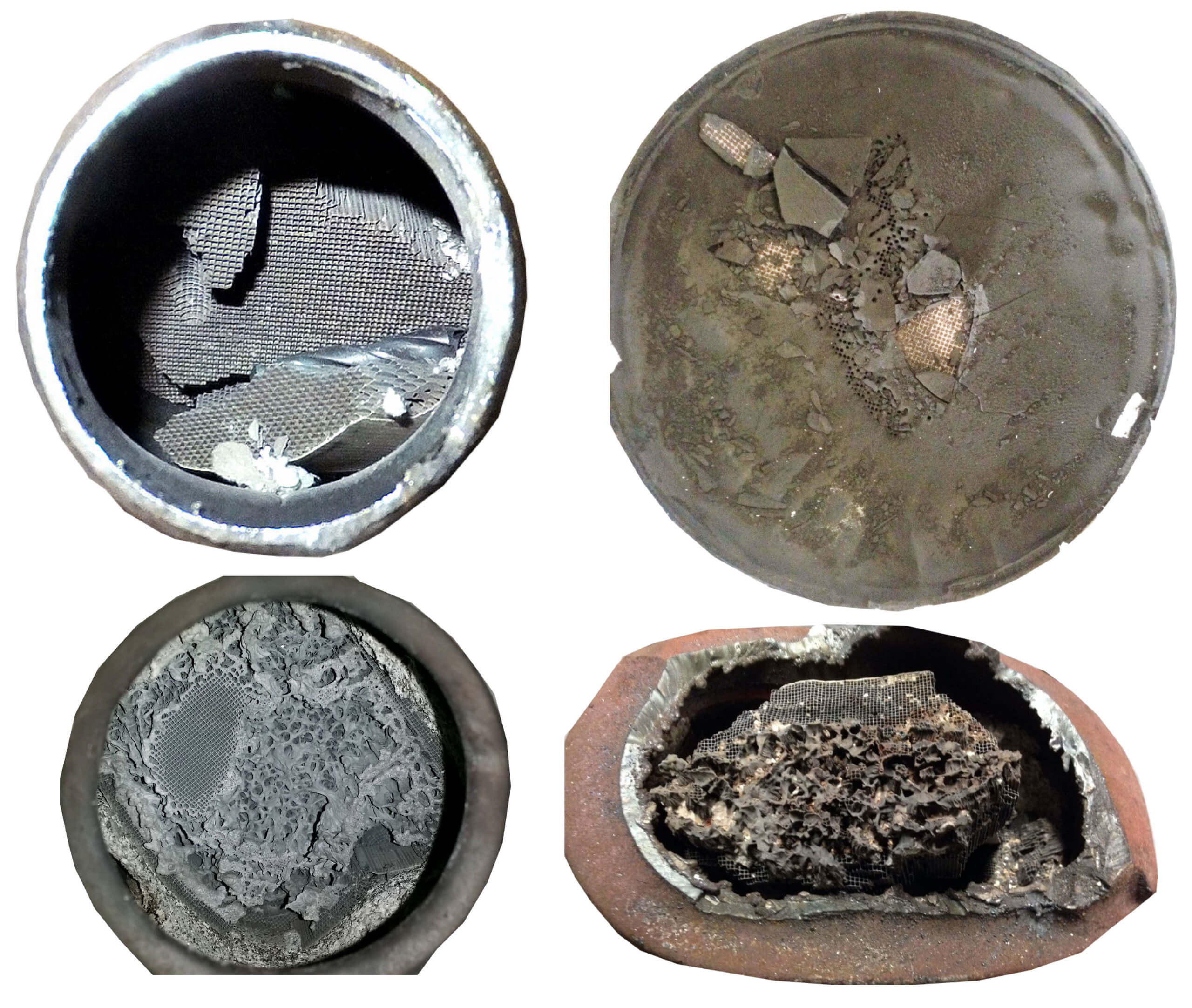
Inside view of a catalytic converter with a melted ceramic structure
Internal engine oil, silicone, or coolant leaks contaminate the converter, rendering it ineffective and clogging the small passages, reducing exhaust flow.
If you replace the catalytic converter but don’t address the underlying cause, you’ll keep replacing it.
Exhaust Leaks — Even a small exhaust leak upstream of the downstream oxygen sensor can pull fresh air into the exhaust stream. That extra oxygen skews sensor readings and can easily cause a P0420 code.
Faulty Oxygen Sensors — A faulty downstream oxygen sensor can falsely indicate poor converter efficiency. However, in most cases, a faulty downstream sensor would report one of these codes, rather than a P0420:
P0138 02 Sensor Circuit High Voltage (Bank I Sensor 2)
P0139 02 Sensor Circuit Slow Response (Bank 1 Sensor 2)
P0140 02 Sensor Circuit No Activity Detected (Bank 1 Sensor 2)
How I Diagnose a P0420 Code Correctly
The biggest mistake people make is replacing the catalytic converter first. That’s backwards. I always start by checking for other stored codes, especially misfire- or fuel-trim-related faults. If long-term fuel trims are excessively high, like 25% or more, the computer is flooding the engine with fuel, and most of that fuel is loading the catalytic converter and causing the P0420 or P0430. If you find a high LT fuel trim, find the root cause and fix it.
Next, I inspect the exhaust system for leaks and verify that the engine is running properly. Then I analyze live scan-tool data, comparing upstream and downstream oxygen sensor waveforms. If the downstream sensor is flatlined or erratic, I test the sensor and its wiring before condemning the converter.
Only after everything else checks out do I recommend replacing the catalytic converter for a confirmed P0420 code.
How to Fix a P0420 Code (Without Wasting Money)
Repair Engine Problems First — If the engine isn’t running correctly, any new catalytic converter will fail again. Fix misfires, oil consumption, vacuum leaks, or rich fuel conditions before clearing the P0420 code.
Fix Exhaust Leaks — Repairing an exhaust leak is often the cheapest and fastest fix for a P0420 code, and it’s frequently overlooked.
Replace Faulty Oxygen Sensors — If testing confirms a bad downstream oxygen sensor, replacement can restore correct readings and eliminate the P0420 code.
Replace the Catalytic Converter (When Proven Bad) — When replacement is necessary, use a quality OEM or CARB-compliant converter. Low-cost units often don’t meet efficiency thresholds and can trigger the P0420 code.
Can You Drive With a P0420 Code?
In most cases, yes—but you shouldn’t ignore it. A vehicle with a P0420 code usually drives normally, but emissions will be higher, fuel economy may suffer, and prolonged driving with underlying engine problems can cause further damage.
Final Thoughts From the Shop Floor
The P0420 code is one of the most misunderstood trouble codes I see. It doesn’t automatically mean “replace the catalytic converter.” It means the system detected low efficiency—and your job is to figure out why. With proper diagnosis, many P0420 code repairs are far less expensive than people expect.
© 2012 Rick Muscoplat
Posted on by Rick Muscoplat