
Power Window Issues: How to Diagnose and Fix Them Fast
How to Diagnose Power Window Issues Step-by-Step
Quick Summary
When I diagnose power window issues, I always start simple—verify the problem, listen for motor noise, and check switch operation. If the motor runs, I suspect a bad regulator. If it doesn’t, I move into electrical testing—checking power, ground, and control signals. Modern systems often involve modules, so a scan tool may be required. The key is to stop guessing and isolate whether the fault is mechanical, electrical, or control-related before replacing parts.
Why Power Window Issues Aren’t Always What They Seem
Power window issues can fool even experienced technicians if they jump to conclusions. I’ve had customers come in convinced they needed a new motor—only to find the driver had accidentally activated the window lockout switch.
That’s why I always start with verification. I operate the window from both the master switch and the individual door switch. Right away, I’m asking:
• Does the window move?
• Do I hear the motor?
• Is the problem intermittent or constant?
Those answers determine everything that follows.
Understanding How Modern Power Windows Work
Back when I started, power windows were simple—just a switch and a motor. Today, many vehicles use body control modules (BCM) or dedicated window control modules.
That means the switch you’re pressing may not directly power the motor. Instead, it sends a signal to a module, which then commands the motor. This is why diagnosing power window issues today requires more than a test light—you often need a scan tool that can read data and command outputs.
Understanding How Modern Power Windows Work — Then and Now
Back when I started, power windows were simple. The system included 4 components:
• Self-resetting circuit breaker (usually not a fuse)
• Master switch (driver’s side) and individual door switches
• Wiring harness
• Motor and window regulators
Power and ground ran to the master switch, which controlled power to each window motor and the other door switches. If there was power and ground at the master switch, but the other windows didn’t work or worked in only one direction, the problem was always caused by a wiring issue, a bad door switch, or a faulty motor/motor connector.
Modules changed everything
Today, many vehicles use body control modules (BCM) or dedicated window control modules. The switches act as signals to the BCM, requesting a window movement. In simpler terms, the window switches in modern vehicles don’t actually supply power to the window motors; that is handled by the module.
That’s why diagnosing power window issues today requires more than a test light—you often need a scan tool that can read data and command outputs.
The First Diagnostic Clue: Listen to the Window
One of the quickest ways I narrow down power window issues is by listening.
If I hear the motor running but the glass doesn’t move, I know I’m dealing with a mechanical issue with the window regulator. Most modern regulators use cables, which can snap or jump off track. You may even hear a crunching or crackling noise inside the door—that’s a dead giveaway.
If I hear nothing at all, I know I’m dealing with an electrical or control problem.
A Simple Diagnostic Trick: Watch the Dome Light
Here’s a trick I’ve used for decades: I watch the interior dome light as I operate the window.
• If the light dims when I press the switch, but the window struggles to move or moves slowly, that tells me the motor is drawing current.
• That usually points to a mechanical problem, like a binding regulator or worn motor.
If there’s no dimming, I’m thinking electrical—no power or no ground.
Diagnose car power window issues by symptom
#1 The power window goes down but not up, or it goes up but not down
In older vehicles without modules, the switch supplies power and ground to the window motor, then reverses polarity to move the window in the opposite direction. The polarity toggle occurs in the master switch at the driver’s door.
A window movement in one direction but not the other, is almost always caused by corrosion in the switch in these older systems. So that’s where you start your diagnosis.
Grab a wiring diagram and test for toggle voltage at the master switch. If the master switch doesn’t toggle the voltage, replace the switch.
On newer vehicles with a BCM or window module, you diagnose power window issues using a scan tool to view live data. Navigate to the power window live data section and operate the window switch. The live data will tell you whether the module has received a window-up or window-down request.
If the live data isn’t showing the request, then the problem is in the wiring harness between the module and the switch, or the switch itself.
Here are the common causes of a window that only works in one direction:
1) Bad master switch— It’s almost always the driver’s master switch because it’s used most often and gets wet most often. The copper contacts inside the switch corrode and may allow the window to work in one direction but not the other.
2) Wiring harness/connector issue— This happens more often when a passenger or rear seat switch causes the window to only work in one direction. If it’s a passenger or rear-seat switch causing the one-way operation, but the master switch works properly, it’s either a bad passenger or rear-seat switch or a wiring harness/connector issue.
3) There’s a dead spot on the window motor— A dead spot on the motor armature can cause the window motor to not work. Sometimes you can spot a dead spot by banging on the door to jar the motor a bit. If a good smack makes it work, suspect a bad window motor.
#2 —You have to press the window switch multiple times to make the window go up or down
This is usually caused by a worn or corroded switch. However, 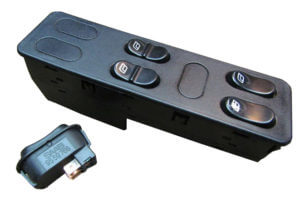 in some rare cases, it can be caused by a worn spot on the window motor armature. If you press the window switch multiple times and the car window won’t go up or down, smack the door panel hard with your fist. If the window motor operates after a good smack, that’s the sign of a bad motor or a problem with the wiring harness or connector inside the door. Time to remove the door panel and check out the wiring.
#3 — The Power window is slow to move up or down
A slow-moving window is often caused by dirt buildup in the window channels. The easiest way to diagnose that problem is to lubricate the channels. Use either silicone spray or Dry Teflon Lube. The advantage of dry Teflon lube is that the slippery particles don’t attract dust and dirt like wet silicone. However, the dry Teflon powder turns white after the solvent evaporates, and some people don’t like that look. Whichever you choose, aim the nozzle straw directly into the window channels and saturate the front and rear channels.
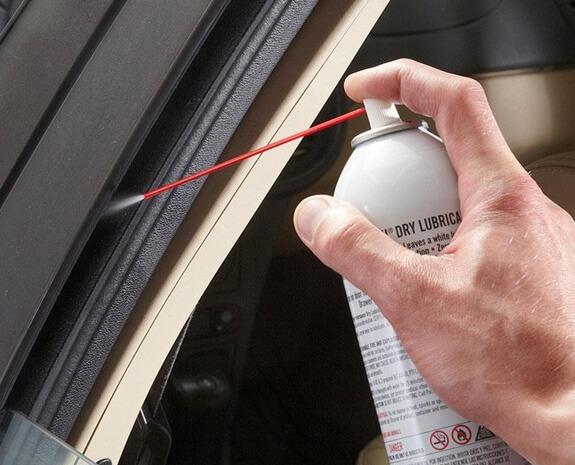
Lubricate glass channels with silicone or dry Teflon lube spray
If you use silicone spray, operate the window up and down right away to spread the silicone along the channel. If you used dry Teflon lube, wait a few minutes for the solvent to evaporate before operating the window. If the lube helps the window move faster, you’ve solved the problem. If not, the problem can be caused by a sticky or worn window tape, binding cable, or worn motor. That requires you to remove the door panel and check the window regulator operation.
#4 — The power window clicks when rolling up or down
Clicking is caused by debris in the window channels or failing moving parts in the window regulator. Don’t ignore this problem. It will not fix itself, and the clicking will get worse to the point where it can bind the glass and cause it to shatter.
Start by lubricating the window channels. If that doesn’t fix the problem, replace the window regulator
#5 — The power window won’t stay up or is crooked
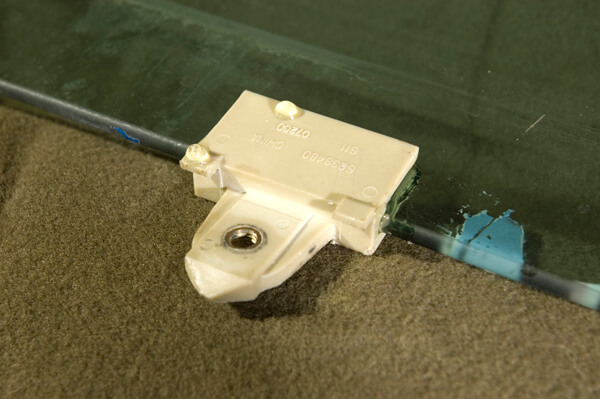
This is always a sign that you’ve got broken parts inside the door. 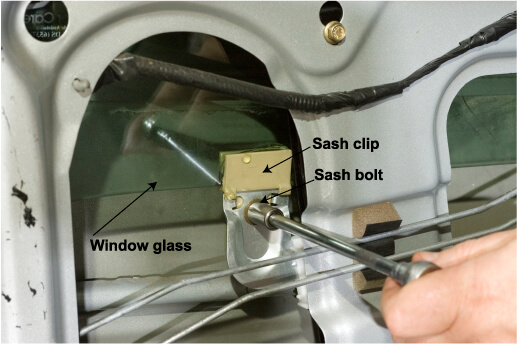 The glass window is connected to the window regulator by plastic sash clips. When a sash clip breaks, the window will cock and move up and down in a crooked fashion. You can remove and replace the sash clips, but that requires special glue.
This problem can also be caused by a broken window regulator. In that case, you’ll have to remove the old unit and install a new one.
 How to diagnose a power window issue
Start by checking for power and ground at the motor connector
Power window motors are pretty simple devices. They usually only have two wires. The switch provides power and ground to make the motor operate in one direction. If you see more than two wires, you’ve got a window motor that’s equipped with auto up/down and anti-pinch features. When you operate the switch in the opposite direction, it switches power and ground to the opposite wires. Here’s the bottom line: Testing right at the power window motor connector is the best way to diagnose the problem.
Get a voltmeter. Remove the door panel and vapor barrier. Disconnect the electrical connector to the power window motor. Set your meter and 20-volts DC and connect the red and black leads to the electrical connector. Turn the car key to the RUN position and operate the window switch. You should see either +12 volts or -12 volts on your meter. When you move the switch in the opposite direction, you should see -12 volts and +12 volts. If you get those readings, the switch and wiring are good, and the problem is with the motor or the mechanical system.
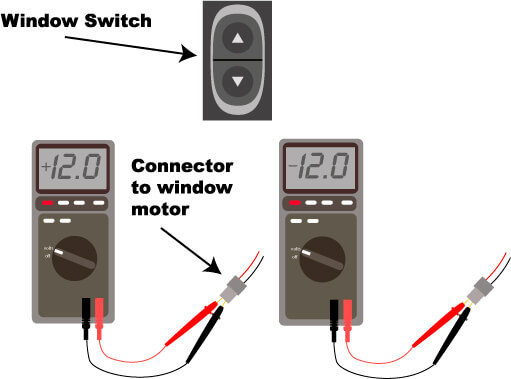
To narrow it down further, reconnect the electrical connector and operate the window motor. Look for any signs of binding or broken parts. If the motor doesn’t move at all, replace the entire window regulator. Trust me on this, it never pays to replace just the motor.
&©, 2019 Rick Muscoplat
Posted on by Rick Muscoplat