
Starter Clicks Once But Won’t Crank Engine
How to Diagnose a Starter That Clicks Once and Won’t Crank The Engine
Quick Summary
When your starter clicks once but won’t crank the engine, the most likely culprits are:
1) Dead battery
2) Worn-out starter motor or pitted electrical contacts inside the starter motor solenoid
3) Seized engine
A single click usually means the starter solenoid is energizing but failing to deliver full battery current to the starter motor. In most cases, this is diagnosable in under 30 minutes and repairable for a fraction of the cost of a new starter.
Why a Single Click Means Something Very Specific
A car that cranks normally sends full battery voltage through a chain of connections: battery, cables, ignition switch, starter relay, solenoid, and finally the starter motor itself. A single, sharp click — as opposed to rapid clicking or silence — tells you that the low-current control circuit is working (the key turns, the solenoid gets a signal, and its electromagnet activates) but that something downstream is preventing the high-current path from closing properly. That distinction matters, because it immediately rules out several possibilities, like a dead battery with zero charge or a completely failed ignition switch, and narrows the diagnosis toward the solenoid and its power connections.
How the Starter Solenoid Actually Works
The solenoid sits on top of the starter and functions as a heavy-duty relay. When you turn the key, an electromagnet inside the solenoid pulls in a metal plunger. Mounted on the edge of that plunger is a copper disk, and as the plunger travels inward, the disk bridges two copper contacts inside the solenoid housing. That connection is what allows several hundred amps of battery current to flow directly into the starter motor, spinning the engine over.
Because this connection handles such high current, every engagement produces a small amount of electrical arcing across the copper contacts. Over years of starts, that arcing pits and burns the copper surfaces. Eventually, the contacts can no longer make clean, low-resistance contact, and the solenoid clicks—the plunger moves—but not enough current reaches the motor to turn the engine.
Most Common Causes of a Single Click, No Crank
• Pitted solenoid contacts — the classic wear point; arcing over time degrades the copper disk and contact plate
• Sticking or worn plunger — the plunger no longer seats fully against the contacts, reducing current transfer
• Weak or marginal battery — The battery produces just enough power to energize the solenoid coil, not enough to spin the starter motor under load
• Corroded or loose battery terminals — Corrosion on the battery posts and terminals causes enough voltage drop to starve the starter of usable current
• Bad or corroded starter ground strap — an incomplete ground path limits current flow just as much as a bad positive connection
• Failing starter motor itself — worn brushes or an open field winding, separate from the solenoid
• Faulty starter relay (on vehicles where a separate relay controls the solenoid) — can cause a single click without properly holding the circuit closed
Diagnosing the Problem Step by Step
Work through these checks in order, starting with the simplest and cheapest to rule out:
1) Check battery voltage and terminal condition. A healthy resting voltage is around 12.6 volts. Clean any corrosion off the terminals and confirm they’re tight—a loose or corroded terminal is one of the most common reasons a solenoid clicks without cranking.
2) Test the battery under load. A battery can show adequate resting voltage and still collapse under the heavy draw a starter demands. A load tester or a shop battery check will confirm this quickly.
3) Inspect the ground connection. Follow the ground strap from the battery to the engine or chassis and confirm it’s clean and secure.
4) Listen carefully to the click. A single, solid click points to the solenoid contacts. Rapid, repeated clicking usually points to insufficient voltage reaching the solenoid, often from the battery or cables.
5) Tap (don’t hit) the starter with a tool while a helper cranks it. This is an old but genuinely useful diagnostic trick — a light tap can momentarily reseat worn contacts or brushes, and if the engine suddenly cranks, it strongly confirms a worn solenoid or motor brushes rather than a wiring issue.
6) Check voltage at the starter’s main power terminal while cranking. If full battery voltage is present there but the motor still won’t spin, the motor itself is likely at fault. If voltage drops significantly, the problem is upstream in the cables or connections.
The Repair: Contacts and Plunger vs. a Full Starter
Here’s where a lot of car owners overspend. 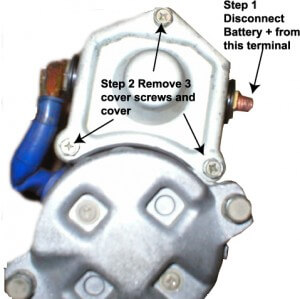 If the diagnosis points to the solenoid, you don’t automatically need a new starter. Solenoid rebuild kits with a replacement plunger and contact set are inexpensive and widely available for most starter models.
You can buy replacement contacts ($10/set) and a replacement plunger ($16.95) at nationsautoelectric.com. Go to their site, look up the starter model for your vehicle, then order the contacts and plunger.
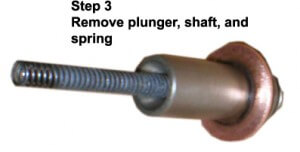
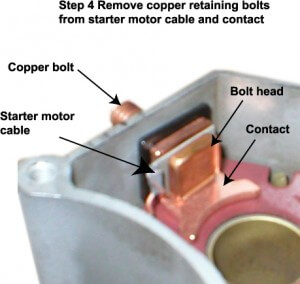
1) Disconnect the negative battery cable before starting any work
2) Raise the vehicle safely on jack stands if access requires it
3) Remove the solenoid’s cover plate, watching for the plunger, which will want to pop out under spring tension
4) Replace the pitted contacts and worn plunger rather than attempting to file the contacts smooth — filing removes protective plating and wears through again quickly
Reinstall the spring, plunger, and cover, then reconnect the battery and test
This repair typically costs a fraction of a full starter replacement and, when the contacts and plunger are genuinely the cause, reliably restores normal cranking.
When You Actually Need a New Starter
If the motor itself shows worn brushes, an open winding, or a damaged armature, no amount of solenoid work will fix it. Likewise, if voltage checks show good power reaching the starter but it still won’t spin under load, motor replacement — not a contact kit — is the correct fix.
© 2012 Rick Muscoplat
Posted on by Rick Muscoplat