
Water Heater Pressure Relief Valve Leaking? What to Check First
Leaking Water Heater Release Valve: Common Causes and How to Stop the Leak
Quick summary
A leaking water heater release valve can be caused by four things:
1) Excessive water pressure — Usually due to a failed pressure-reducing valve (PRV) in your home
2) Excessive water temperature — Usually due to hot water “stacking” or a failed gas valve/emperature sensor.
3) Failed expansion tank — When the internal bladder fails, the tank fills with water and the expanding water has nowhere to go
4) Mineral buildup on the seat of the Temperature and Pressure Release Valve (T&P valve).
The right repair starts with identifying when the discharge occurs and the nature of the discharge. The distinction matters. Replacing a working relief valve won’t correct excessive pressure or overheating—and the new valve may leak again.
Understanding The Role of A Water Heater Release Valve
The official name for a “water heater release valve” is a 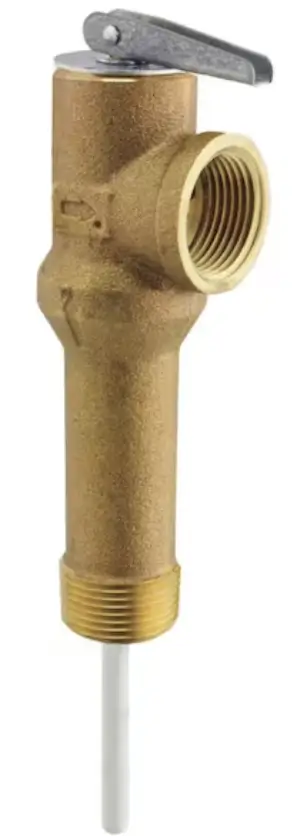 Temperature and Pressure Relief valve, abbreviated T&P valve or TPR valve.
The T&P valve is a safety feature designed to prevent a dangerous water heater rupture if the temperature or pressure exceeds its rating. It typically has a small test lever and a discharge pipe that directs released water away from the tank.
Many residential valves are designed to open and vent high pressure at around 150 psi or overheated water at 210°F, but exact specifications depend on the water heater’s make and model. These are emergency relief thresholds, not normal operating targets.
The T&P valve is usually on the side of the tank (in many gas-fired units) or on top of the tank in many electric water heaters.
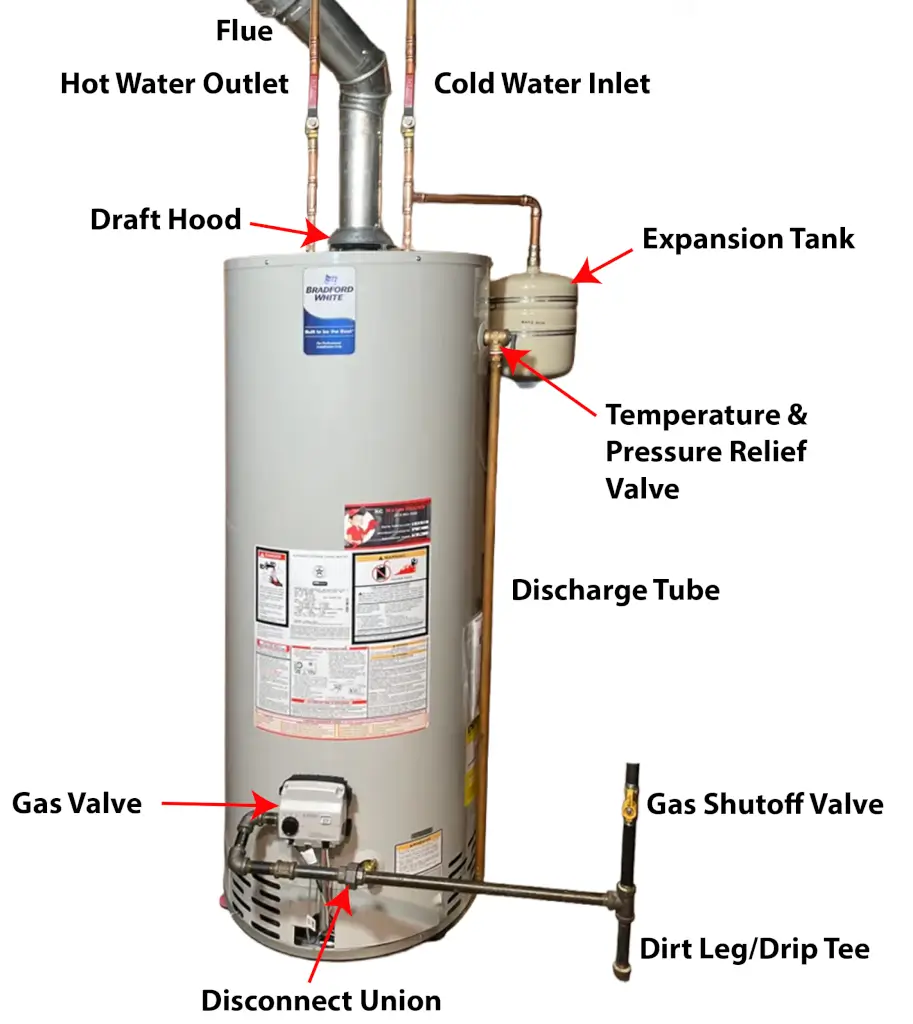
Understanding the role of a pressure-reducing valve in your home
A PRV (pressure-reducing valve) is installed on a home’s incoming water service when the municipal water pressure is higher than the plumbing system should routinely handle. Its job is simple: take high, fluctuating street pressure and reduce it to a safer, more consistent pressure inside the house.
Why a home needs a PRV
Municipal water pressure can vary considerably depending on elevation, demand, pumping stations, and the water utility’s distribution system. A neighborhood might need relatively high main pressure to reliably serve every property, but you don’t necessarily want that same
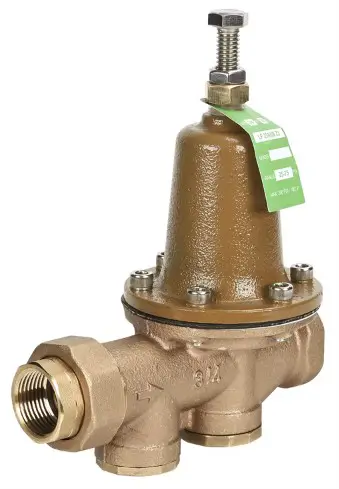
Pressure reducing valve
pressure inside a house. In the U.S., most plumbing codes require household water pressure to be at or below 80 PSI. Here’s why:
High pressure causes premature failure of many household appliances and components like:
• Faucets, toilet fill valves, and solenoid valves
• Washing machines and dishwashers
• Ice makers
• Water-heater components
• Flexible supply connectors
• Pipe joints and fittings
• Other pressure-sensitive plumbing components
It can also reduce water waste and complaints such as banging pipes and excessively aggressive fixture flow.
How a PRV works
A PRV contains a pressure-adjusting screw, spring, diaphragm, valve seat, and moving valve mechanism.
The adjustment screw changes spring compression on the diaphragm, which works against the downstream water pressure acting on the diaphragm. When downstream pressure falls because somebody opens a fixture, the valve opens farther and allows more water through.
As downstream pressure rises, the diaphragm pushes against the spring, and the valve moves toward the closed position.
So, rather than simply restricting the pipe to a fixed opening, the PRV constantly responds to conditions on the house side of the valve. That’s why it’s called a pressure-reducing valve rather than merely a flow restrictor.
Here’s where PRVs become especially important with water heaters
Depending on the PRV design and installation, a PRV can effectively create a closed plumbing system. That’s important because water expands when heated.
Imagine the house pressure is regulated to 60 PSI. Nobody is using water, and the water heater begins heating a tank of cold water. As that water heats, it expands by up to 2 gallons in a 50-gallon water heater.
In an open system, one with no check valve between the home and the utility’s water supply, the expanding water pushes backward toward the municipal system. However, in a closed system, it can’t, causing pressure inside the home to rise substantially.
That’s why homes with closed systems commonly require a properly sized and charged thermal expansion tank or another approved means of controlling thermal expansion.
This also explains a service call I see people misdiagnose:
What happens when a PRV fails?
A PRV can fail in several ways, and the symptoms aren’t always the same.
1) If it fails to regulate pressure, high municipal pressure can pass into the house. You might measure 60 PSI one day and suddenly find 90, 100 PSI or more, depending on the incoming supply.
That can cause dripping faucets, noisy plumbing, running toilets, appliance-valve problems, premature fixture wear, and increased leakage. It can also aggravate water-heater and expansion-system problems.
2) If the PRV becomes restricted, you’ll see the opposite problem. Static pressure may look acceptable when nothing is running, but pressure and flow can drop dramatically when you open fixtures.
The Role of An Expansion Tank in Your Home
An expansion tank is a pressure-control device for a closed plumbing system, but it does not control the home’s normal incoming water pressure. Its job is to absorb the temporary increase in water volume that occurs when the water heater heats the water.
That distinction is important: the PRV controls normal incoming pressure; the expansion tank controls pressure increases caused by thermal expansion.
Here’s an example of how an expansion tank handles water expansion. Imagine the house is sitting at 60 PSI and nobody is using water. The water heater fires or the electric elements come on. As the water gets hotter, it expands—but it has nowhere to go.
Because the piping system is already full of water, that small volume increase can cause a significant pressure rise. That’s where the expansion tank comes in.
A typical potable-water expansion tank contains
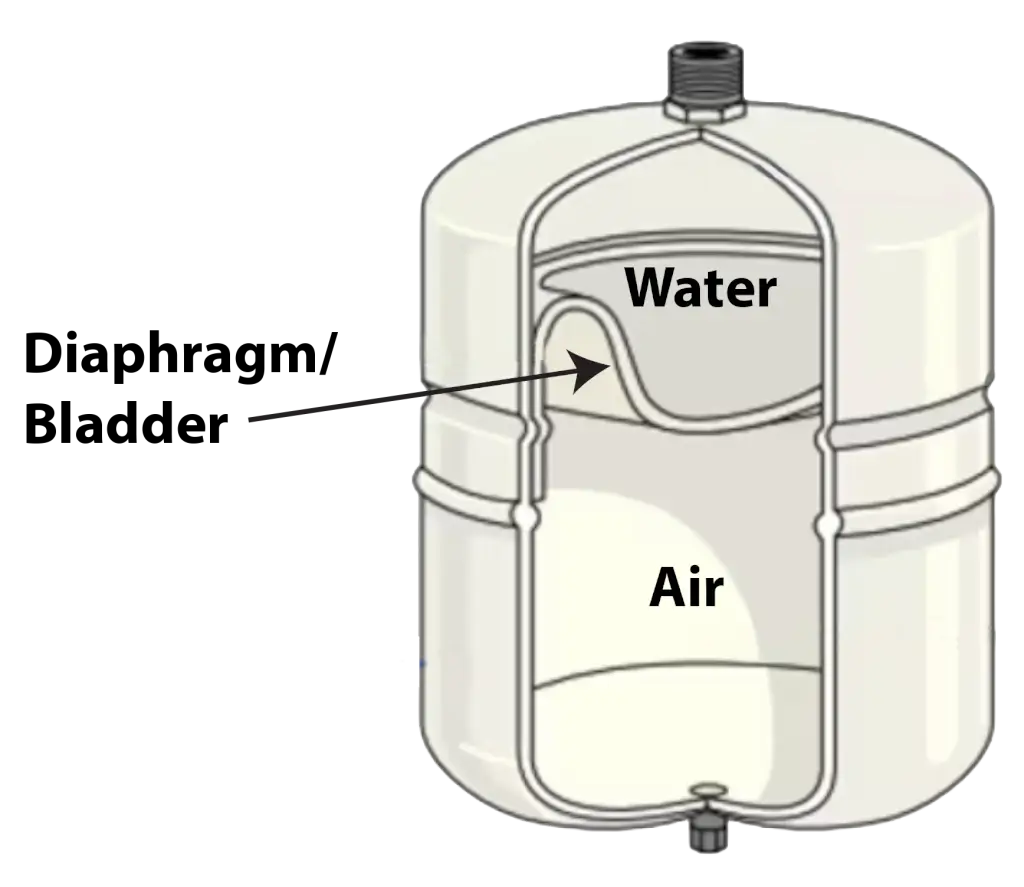
Cutaway view of a water heater expansion tank
two sections separated by a flexible diaphragm or bladder:
Water on one side → diaphragm → compressed air on the other side
Before putting the tank into service, the air side is precharged to a specified pressure. In a typical installation, the precharge matches the home’s static water pressure, per the tank manufacturer’s instructions.
Let’s say the home’s static pressure is 60 PSI. The expansion tank is properly sized and precharged for that system.
When the water heater starts heating, the expanding water pushes into the expansion tank. Instead of forcing the entire plumbing system to a much higher pressure, the additional water volume moves the diaphragm and compresses the air cushion.
When somebody opens a faucet and system pressure drops, the compressed air pushes that water back out of the expansion tank. Think of the expansion tank as a shock absorber for thermal expansion.
What an expansion tank does NOT do
This is where people sometimes misunderstand its purpose.
If municipal pressure is 100 PSI, an expansion tank isn’t supposed to reduce that to 60 PSI.
That’s the PRV’s job.
Likewise, if your house stays at 90 PSI because the PRV has failed, installing a larger expansion tank isn’t the fix.
• PRV: Establishes normal household pressure.
Expansion tank: Absorbs temporary pressure increases caused by heated water expanding in a closed system.
• T&P valve: Provides emergency temperature and pressure relief at the water heater.
What happens when the expansion tank fails
One common failure is a ruptured diaphragm or bladder.
When that happens, the air cushion can be lost, and the tank can become waterlogged. Now there isn’t enough compressible air volume available to accept the expanding water.
• The water heater heats.
• The water expands.
• System pressure rises.
The rising pressure causes the T&P valve to open and vent the high-pressure water.
The T&P valve often gets blamed because that’s where the water is visible, but the T&P may simply be responding to abnormal pressure.
Another common problem: incorrect precharge
Its air precharge must match the system pressure. For example, if you have a house regulated to approximately 60 PSI, you can’t simply install an expansion tank straight out of the box without checking its precharge pressure.
To learn more about expansion tanks and how they work, see this article. Water Heater Expansion Tank: Do You Need One and Why?
What the symptoms tell you about the cause of the leak
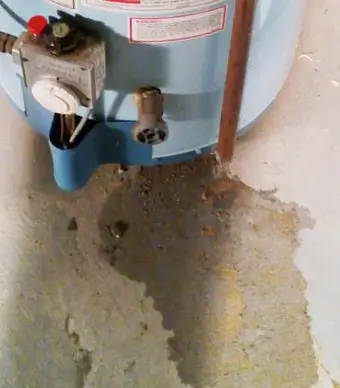
A small puddle beside a water heater is easy
Leaking water heater relief valve
to spot. It’s located directly under the relief valve discharge tube. Or, it may form a puddle in the emergency drain pan under your water heater (if yours is equipped with a drain pan).
Suspect a failed pressure-reducing valve, failed expansion tank, or mineral deposits on the seat of the T&P valve
Causes of a small puddle
1) Failing PRV — A PRV keeps water pressure below 80 psi. If it fails and pressure rises, the T&P valve opens and vents water until pressure falls below the T&P valve’s pressure rating.
2) Failing or improperly pressurized expansion tank — When an expansion tank becomes waterlogged, it no longer absorbs the expanding water. With nowhere to go, the expanding water raises pressure in the water heater, causing the T&P valve to open and release the excess pressure.
3) Stacking — Stacking occurs when you repeatedly draw off small amounts of hot water. Each draw lets in cold water near the bottom of the tank, causing the thermostat to initiate a new heating cycle. Heating continues until the water around the thermostat reaches the set temperature. The hottest water rises to the top of the tank.
If you then draw off subsequent small draws of water, the process repeats, creating layers of superheated water at the top of the tank. The superheated water can sometimes exceed the T&P valve’s 210°F limit, causing it to open and vent hot water onto the floor.
Causes of a large puddle of extremely hot and steamy water
A large burst of very hot water, along with steam, represents a serious, life-threatening condition. It means the water heater’s temperature-regulating safety devices have failed and the heater is continuing to heat water well beyond the set temperature.
As the temperature and internal pressure rises, the T&P opens, venting a large amount of superheated water.
Suspect a failed water heater thermostat, failed thermal shutdown sensor/switch, or failed gas valve.
Causes of an occasional drip from the discharge tube
An occasional drip or very small puddle is far less serious and usually caused by mineral buildup on the relief valve seat.
Here’s how I would work through the problem, from the first visible drip to the repair that addresses its cause.
How to diagnose the problem
1) Lift the level of the T&P valve to vent some water. Let it snap back to the closed position. Repeat several times. If the dripping stops, that proves mineral buildup on the seat caused the leak. Watch for puddles over the next few weeks. If the puddles return, proceed with the next steps.
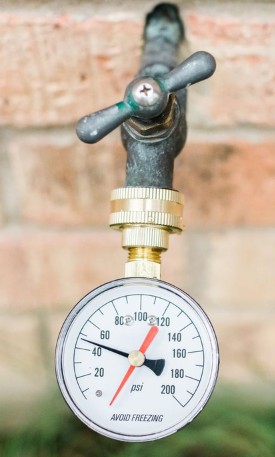
2) Check household water pressure — Connect a water
Water pressure gauge on an outdoor spigot
pressure gauge to an outdoor spigot and record the pressure reading.
If the pressure is above 80 psi. the problem is a misadjusted or failing PRV. Adjust or replace the PRV accordingly.
3) Next, check for a waterlogged expansion tank (if equipped) — Remove the cap from the air valve and depress the stem. If water comes out, the tank has failed and must be replaced
4) Check and adjust the pre-charge air pressure on the expansion tank — Connect a water pressure gauge to an outdoor spigot and measure static water pressure. If the pressure at the spigot is above 80 psi., that indicates a Then, using a low-pressure gauge, measure the air charge in the expansion tank. See this article for the exact procedure. Water Heater Expansion Tank: Do You Need One and Why?
5) Replace the T&P valve — If the PRV is working properly, expansion tank precharge pressure is correct, and the unit isn’t water-logged, and opening the T&P doesn’t stop the dripping, it’s time to replace the T&P valve.
Replace a Defective Water Pressure Relief Valve
Note the specifications on the data plate on your current T&P valve. 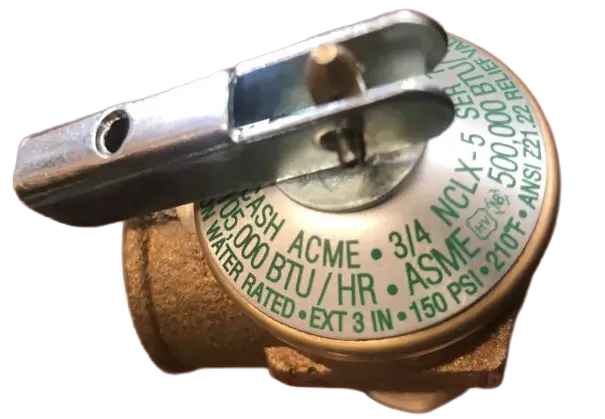 The replacement must meet the heater manufacturer’s requirements, including:
• Pressure and temperature ratings.
• Discharge capacity.
• Connection size.
• Probe length and installation configuration.
• Never install a higher-pressure valve simply to stop dripping.
How To Replace a T&P Valve
1) Turn the gas valve to the PILOT setting (gas water heater), or shut off the circuit breakers on an electric water heater.
2) Shut off the cold water inlet valve to the water heater.
3) Relieve water pressure in the home by opening a hot faucet on the lowest level.
4) Drain off approximately 3-5 gallons from the water heater by connecting a hose to the drain valve and opening the valve.
5) Disconnect the discharge tube from the current T&P valve.
6) Using a large slip-joint pliers or a pipe wrench, unscrew the current T&P valve.
7) Wrap 4-5 wraps of Teflon tape on the new valve and install the new valve with the opening pointing toward the floor.
8) Reinstall the discharge tube.
9) Open the cold water valve on the water heater and allow water to flow into the tank until you get a steady flow from the open faucet. Then shut off the faucet and check the T&P valve for leaks.
©, 2026 Rick Muscoplat
Posted on by Rick Muscoplat