
Water Heater Expansion Tank: Do You Need One and Why?
What Happens If You Don’t Have a Water Heater Expansion Tank?
Quick Summary
If your home has a closed plumbing system, you likely need a water heater expansion tank. This small tank gives expanding hot water somewhere to go, helping control pressure and protect your water heater, pipes, valves, faucets, and other plumbing components.
• A water heater expansion tank absorbs the extra water volume created by thermal expansion.
• If your home is equipped with a pressure-reducing valve (PRV), check valve, or backflow preventer, it commonly has a closed plumbing system.
• In a closed system, the expanding heated water cannot simply push backward toward the municipal water main.
• Excess pressure can shorten the life of your water heater and other plumbing components.
• The expansion tank is normally installed on the cold-water supply side of the water heater.
• The tank’s air pre-charge should be matched to the home’s static water pressure for proper operation.
• Expansion tanks must be properly sized and supported.
• Local plumbing codes and manufacturer requirements ultimately determine whether one is required for a particular installation.
So, do you need one? If your plumbing system is closed, an expansion tank or another approved method of controlling thermal expansion is typically necessary.
Let me explain why this little tank can make such a big difference.
What Is a Water Heater Expansion Tank?
I’ve found that the easiest way to understand a water heater expansion tank is to stop thinking about the tank itself and think about what happens to water when you heat it.
Water expands as its temperature rises — Every time the burner fires or the electric heating elements turn on, the temperature of the stored water increases.
• As that water heats, its volume increases.
• That extra volume has to go somewhere.
In the past, that extra water would push back against the city water supply, reducing the effectiveness of the utility’s pumping. To eliminate that pumping efficiency loss, utilities require homes to be fitted with a check valve, backflow prevention device, pressure-reducing valve, or similar component that prevents water from flowing backward. Once a check valve is installed, it’s called a closed system.
Now, with nowhere for the expanded water to go, the higher pressure acts against the water heater tank and all the pipes in the home. The result is:
• The walls of the water heater flex, causing cracks in the glass lining
• The pressure degrades the seals and cartridges in faucets, causing early failure and leaks.
• Toilet fill valve seals fail, causing the toilet to run constantly
• Washing machine hoses degrade faster and can burst, causing flooding.
• Washing machine solenoid inlet valves fail early, causing repeat service calls.
• Pipe fittings and connections leak
• The added pressure causes the water heater temperature pressure relief valve to pop open and spill water onto the floor.
That’s where a water heater expansion tank becomes important.
What Does a Water Heater Expansion Tank Do?
Think of the expansion tank as a pressure cushion for your plumbing system.
A potable-water expansion tank is an air chamber separated from the water by a flexible diaphragm or bladder.
When water heats and expands,
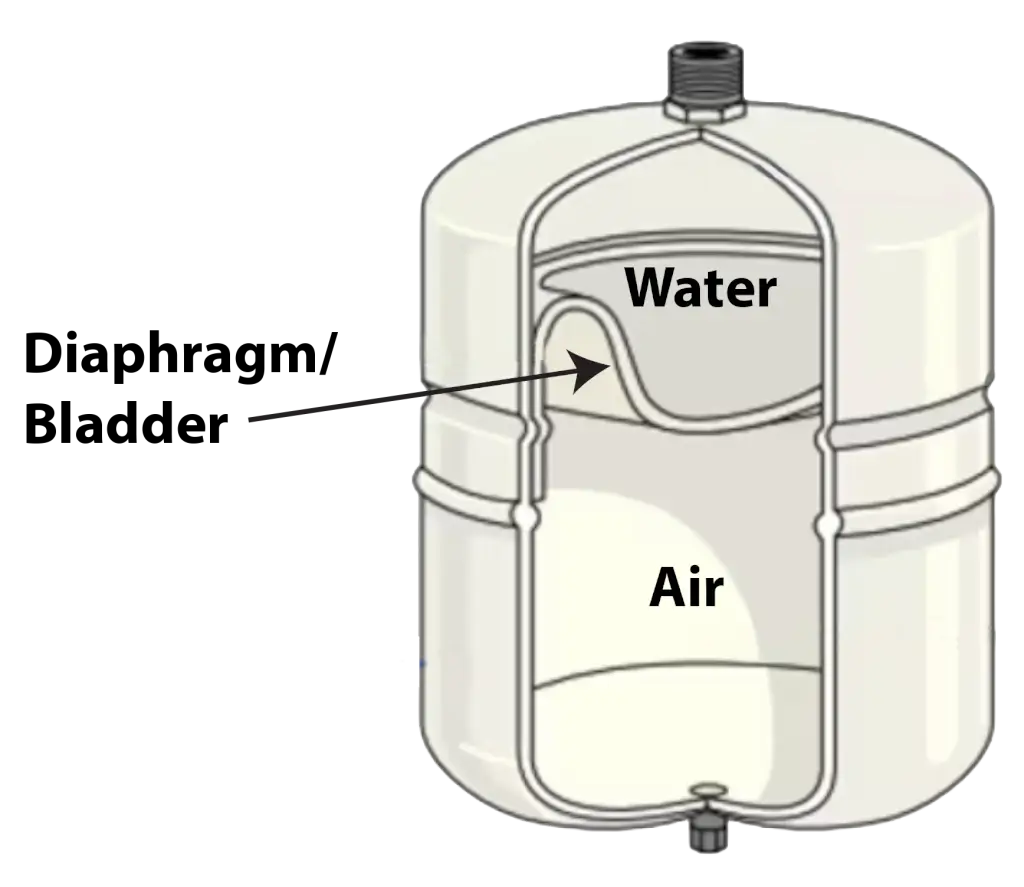
Cut away view of a water heater expansion tank
the additional volume can move into the expansion tank. The air side compresses, creating room for the expanded water without letting system pressure rise as much. When the water cools, or pressure conditions change, the system returns toward its normal state.
Without somewhere to accommodate that expansion, pressure can be transferred throughout the plumbing system.
That can affect more than the water heater.
Do I Need an Expansion Tank on My Water Heater?
You need a water heater expansion tank if:
1) Your home is equipped with a check valve or backflow preventer
2) Your home has a pressure-reducing valve (PRV).
3) Your water heater installation instructions require thermal expansion protection.
4) Your local plumbing code requires an expansion tank or other approved thermal-expansion control.
5) You’re experiencing pressure increases when the water heater cycles.
Signs You May Have a Water Heater Expansion Problem
You can’t diagnose every plumbing issue from symptoms alone, but there are several warning signs worth investigating.
Possible symptoms of thermal expansion include:
• The water heater temperature-and-pressure relief valve (TPR) routinely discharges water onto the floor.
• You experience premature failure of plumbing valves or fixtures, causing leaks
• Repeated failures with washing machine and ice maker hoses, as well as flexible faucet supply hoses.
• Pressure readings substantially higher after a heating cycle than the home’s normal static pressure
Where To Install a Water Heater Expansion Tank
For a conventional tank-type water heater, the expansion tank is normally installed on the cold-water supply line serving the water heater, in accordance with the expansion-tank manufacturer’s instructions and applicable plumbing code.
Why the cold side? — Because the tank is intended to accept the additional volume created as water inside the heater warms and expands.
Water Heater Expansion Tank Pressure: Why Pre-Charge Matters
Here’s one of the most important details homeowners often miss. You can’t simply screw an expansion tank onto a pipe and assume it’s properly configured.
The air side of the tank has a pre-charge pressure. That pre-charge should generally be adjusted, according to the tank manufacturer’s instructions, to correspond with the home’s static water pressure before the tank is put into service.
For example, if the home’s static pressure is around 60 PSI, installing a tank with an improperly set air charge can prevent the expansion tank from operating as intended.
That is why a proper installation starts with determining the home’s actual water pressure.
The basic process is:
• Determine the home’s static water pressure.
• Select the appropriate expansion tank for the water heater and system.
• Adjust the tank’s pre-charge according to manufacturer specifications.
• Install it in the correct location.
• Properly support the tank.
• Verify system operation after installation.
Can an Expansion Tank Go Bad?
Absolutely. A water heater expansion tank is a mechanical plumbing component, and it doesn’t last forever.
Inside the tank, the diaphragm or bladder separates air from water. If that component fails, the tank can no longer accommodate thermal expansion properly.
Expansion tanks can also:
• Lose their air charge
• Develop leaks
• Become waterlogged
• Corrode
• Fail internally
• Develop connection problems
That’s why the expansion tank shouldn’t be forgotten once it’s installed.
How Long Does a Water Heater Expansion Tank Last?
There isn’t a guaranteed lifespan. Service life varies according to:
• Water pressure
• Water quality
• Temperature
• Cycling frequency
• Tank quality
• Correct sizing
• Correct pre-charge
• Installation quality
A tank operating under excessive pressure or installed with an incorrect pre-charge may not perform as intended and may experience unnecessary stress.
When replacing an older water heater, it’s reasonable to inspect the existing expansion tank rather than automatically assuming it’s still in good condition.
If the tank is old, damaged, leaking, waterlogged, or improperly sized, replacement may make sense as part of the water heater project.
How Do You Know If an Expansion Tank Is Bad?
Homeowners sometimes hear advice to simply tap on the tank and listen to the sound. I wouldn’t rely on that alone.
A more meaningful evaluation can involve checking:
• Whether water is leaking from the tank
• Condition of the tank and fittings
• Air-side pressure
• Whether water comes from the air valve
• Whether the tank is waterlogged
• System pressure before and after the water heater operates
• Whether the tank’s pre-charge is properly set
If water comes through an air valve that should contain air, an internal diaphragm failure may be involved.
Because expansion tanks operate as part of a pressurized potable-water system, follow manufacturer procedures or have a qualified plumber evaluate questionable equipment.
Why Expansion Tank Support Matters
An expansion tank may not look particularly heavy when it’s empty. But consider what happens when it fills with water.
Water is heavy, and that weight can place considerable leverage on fittings and piping if the tank isn’t adequately supported.
That’s why proper water heater expansion tank installation isn’t just about finding a convenient tee and threading the tank into it.
Install and support the tank according to the manufacturer’s instructions and applicable plumbing requirements.
Never assume the surrounding pipe is intended to support the entire weight of a water-filled expansion tank.
Is a Water Heater Expansion Tank Required by Code?
Possibly—and this is where local requirements matter. Plumbing codes and local jurisdictions commonly require an approved means of controlling thermal expansion when a storage water heater is installed in a closed system.
But code adoption and amendments vary by state, city, county, and jurisdiction.
©, 2026 Rick Muscoplat
Posted on by Rick Muscoplat