
Guide to Diagnosing and Fixing Electric Water Heater Problems
How to Diagnose Electric Water Heater Problems
Quick Answer
If you’re experiencing electric water heater problems, the most common causes are:
• Tripped circuit breaker
• Failed heating element
• Defective thermostat
• High-limit switch reset
• Loose wiring
• Sediment buildup
• Leaking tank
Most problems can be diagnosed with a multimeter and basic electrical testing. Identifying the faulty component before replacing parts saves time and money while restoring reliable hot water.
Fortunately, most electric water heater problems are straightforward to diagnose because electric water heaters have relatively simple electrical systems.
Unlike gas models that rely on burners, gas valves, pilot lights, and venting systems, electric water heaters primarily consist of two heating elements, two thermostats, a high-limit safety switch, and household electrical power. Understanding how these components work together makes troubleshooting much easier.
This guide explains the most common symptoms, their likely causes, and the proper testing procedures professionals use to pinpoint the problem.
The components in an electric water heater
Most residential electric water heaters operate on a 240-volt circuit.
Inside the tank you’ll find:
• Upper heating element
• Lower heating element
• Upper thermostat
• Lower thermostat
• High-limit (ECO) safety switch
• Insulated storage tank
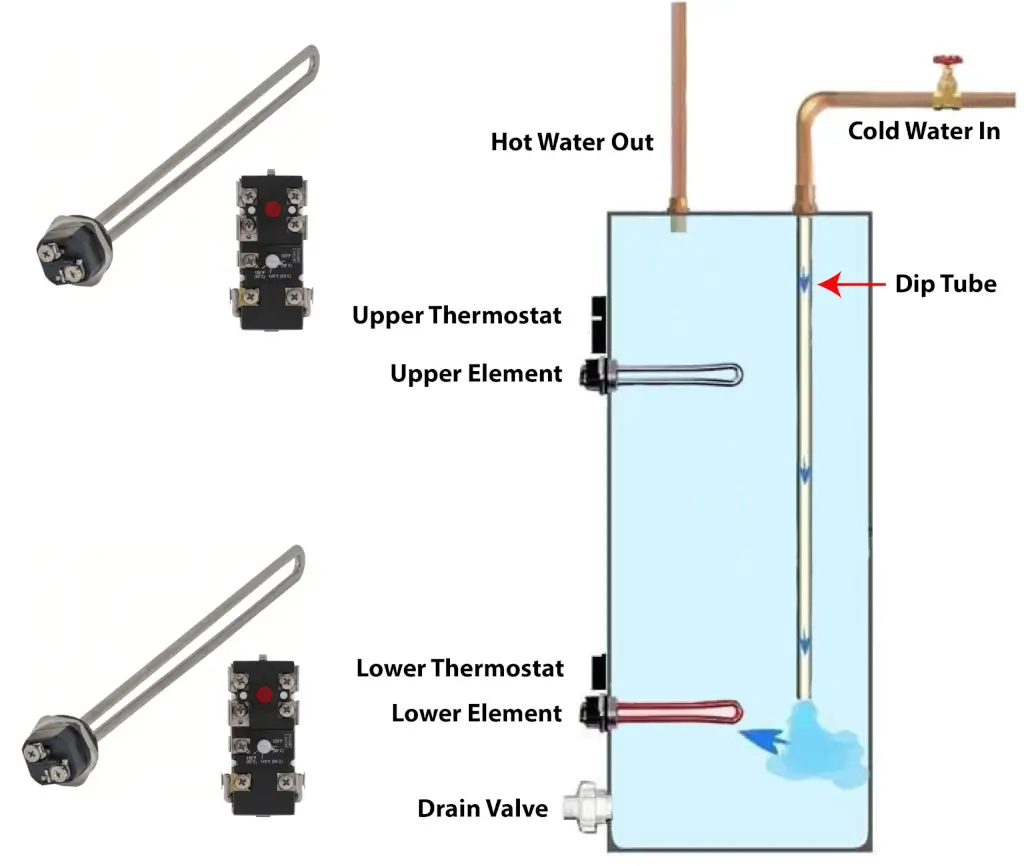
What to know about Water Heater Elements
Electric water heater elements convert electrical energy into heat, which is transferred directly to the surrounding water. Although they appear simple from the outside, modern heating elements are carefully engineered to maximize heat transfer, minimize scale buildup, and withstand years of operation in a corrosive environment.
A heating element consists of several layers:
Resistance wire – A nickel-chromium (nichrome) alloy wire that produces heat when electricity flows through it.
Magnesium oxide insulation – A densely packed powder that electrically insulates the resistance wire while conducting heat efficiently.
Metal sheath – Usually copper, stainless steel, or Incoloy, which protects the internal components from water while transferring heat into the tank.
When the thermostat calls for heat:
• 240-volt power is sent to the heating element.
• Electrical resistance in the nichrome wire converts electricity into heat.
• Heat passes through the magnesium oxide insulation.
• The outer metal sheath transfers that heat directly into the surrounding water.
• When the thermostat reaches the set temperature, it opens the circuit and turns the element off.
Upper and lower heating elements
Upper element — Heats the top portion of the tank first.
• Provides hot water quickly after a large draw.
• Controlled by the upper thermostat.
• Also supplies power to the lower thermostat after the upper portion reaches temperature.
Lower element — Heats the remainder of the tank.
• Maintains the tank temperature during normal use.
• Usually operates much longer than the upper element.
In most standard residential water heaters, only one element operates at a time (non-simultaneous operation). This limits the electrical load to about 4,500 to 5,500 watts instead of twice that amount.
The most common element shapes
1. Straight element — Straight elements are commonly found in older water heaters and inexpensive replacement parts. 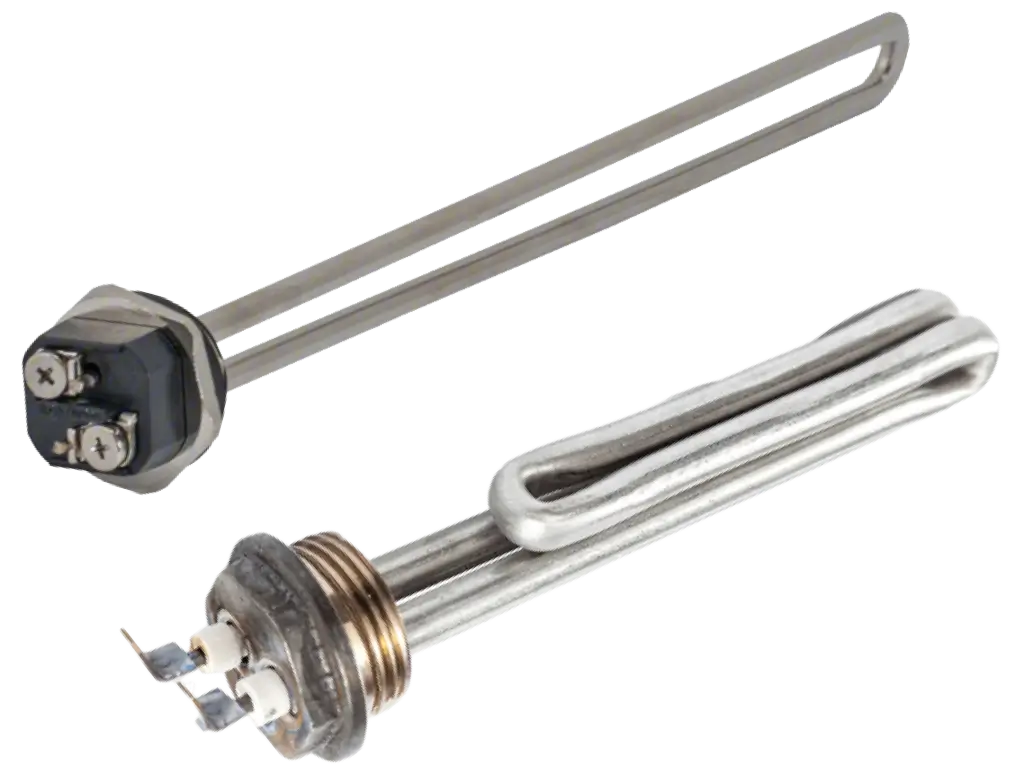
• Lowest cost
• Fits almost every water heater
• Easy to manufacture
• Less heating surface
• Higher surface temperatures
• More prone to mineral buildup
2. Fold-back element — The heating tube bends back on itself to create a U-shaped design. These are among the most common replacement elements today because they resist mineral deposits much better than straight elements
• Much larger heating surface
• Lower surface temperature
• Less scale buildup
• Longer life
3. Ripple or wave element — Instead of
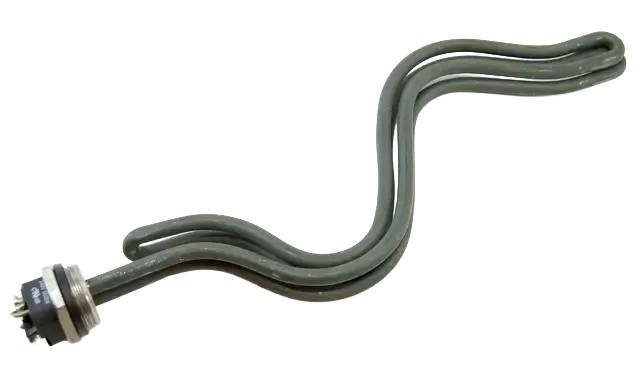
Ripple water heater element
being straight, the element contains gentle curves or waves. Many manufacturers now use ripple elements as original equipment.
• Increased surface area
• More even heat distribution
• Reduced hot spots
• Better efficiency in hard water
4. Lime Life (low-watt-density fold-back) — These elements combine a fold-back shape with very low watt density.
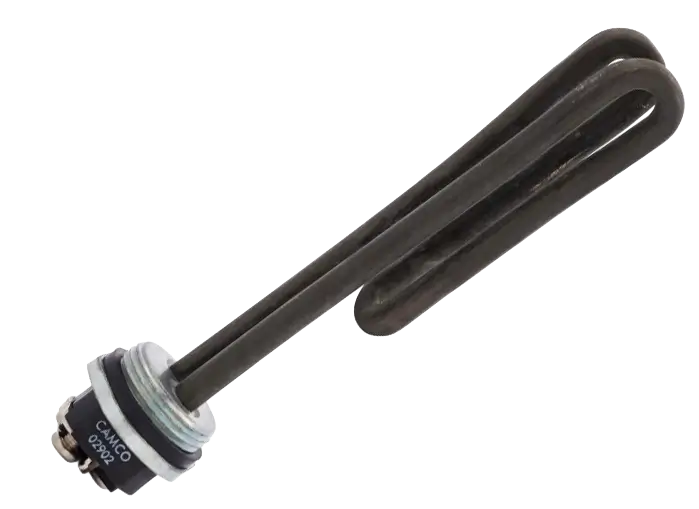
Lime life water heater element
They are often made with Incoloy sheaths for maximum corrosion resistance.
• Excellent resistance to lime scale
• Cooler operating temperatures
• Longer service life
• Ideal for hard-water areas
Watt density explained
One of the most important differences between heating elements is watt density. Watt density is the amount of heat produced per square inch of the element’s surface.
High Watt Density (HWD) — Generally, the lowest cost replacement
• Smaller heating surface
• Hotter operating temperature
• Lower cost
• More scale buildup
• Shorter life in hard water
When to install a HWD element:
• You have a water softener
• You’re looking for a budget replacement
Low Watt Density (LWD) — These are generally considered the best choice for most homeowners.
• Larger heating surface
• Cooler operating temperature
• Less mineral accumulation
• Longer service life
• Better heat transfer
Ultra-Low Watt Density (ULWD) — The premium option.
• Maximum resistance to lime deposits
• Lower operating temperatures
• Better energy transfer
• Excellent for well water and very hard water
• Sheath materials
The outside metal of the element greatly affects its lifespan.
Copper — Excellent heat transfer
• Least expensive
• Best for soft water
• Can corrode more quickly in aggressive water
Stainless steel — Better corrosion resistance
• Longer life than copper
• Moderate cost
Incoloy — Incoloy is a nickel-iron-chromium alloy specifically designed for high-temperature and corrosive environments.
• Outstanding corrosion resistance
• Excellent scale resistance
• Longer lifespan
• Ideal for hard water and softened water
Screw-in vs. bolt-on elements
Screw-in — Approximately 95% of modern residential water heaters use 1-inch National Pipe Thread (NPT) screw-in elements.
• Easy to replace
• Widely available
• Standardized
Bolt-on — Some older water heaters use four-bolt flange elements.
• Used on certain older designs
• Less common
• More expensive
• Fewer replacement options
• Common wattages
Water Heater Element Wattages
Always replace an element with one that matches the water heater manufacturer’s specified voltage and wattage.— Typical residential elements include:
3,000 watts
3,500 watts
3,800 watts
4,000 watts
• 4,500 watts (most common)
5,000 watts
5,500 watts
How an electric water heater works
The upper thermostat controls which heating element receives power.
1) When the tank is cold, the upper element heats the top of the tank first.
2) Once the upper water reaches the set temperature, power transfers to the lower thermostat.
3) The lower element heats the remaining water.
Because only one element normally operates at a time, diagnosing failures becomes easier.
Common Electric Water Heater Problems and Their Symptoms
No Hot Water — Most common causes
• Tripped circuit breaker
• Burned-out heating element
• Failed upper thermostat
• High-limit reset tripped
• Loose electrical connection
Testing procedure
• Verify the breaker is ON.
• Measure 240 volts at the water heater.
• Press the red high-limit reset button.
• Test both heating elements for continuity.
• Check thermostat operation.
Repair the failed component and restore power.
Water Isn’t Hot Enough — Common causes
• Lower heating element burned out
• Thermostat temperature set too low
• Heavy sediment covering lower element
• Thermostat calibration failure
Symptoms
• Hot water runs out quickly
• Water becomes lukewarm
• Long recovery time
How to Diagnose and Repair
• Test lower heating element.
• Replace defective thermostat.
• Flush sediment from the tank.
• Set thermostats to approximately 120°F.
Hot Water Runs Out Quickly — One of the most common electric water heater problems is insufficient hot water volume, and it’s usually caused by:
• Burned lower heating element
• Sediment reducing tank capacity
• Oversized household demand
• Cross-connected plumbing
The lower element performs most of the heating after the upper portion of the tank reaches temperature. If it fails, only the upper few gallons remain hot.
Water Is Too Hot — Possible causes include:
• Stuck thermostat contacts
• Thermostat out of calibration
• Incorrect thermostat adjustment
How to Repair
• Replace both thermostats if one fails. They’re inexpensive, and replacing both ensures proper calibration.
Breaker Keeps Tripping — Common causes
• Shorted heating element
• Grounded element
• Damaged wiring
• Loose electrical connections
• Defective breaker
How to diagnose and test
• Disconnect both heating element wires.
• Using a multimeter:
• Test continuity across terminals.
• Check resistance to the metal tank.
Any continuity from an element terminal to the tank indicates a grounded element that must be replaced.
Water Heater Won’t Reset — Common Causes
If the red reset button immediately trips again:
• Thermostat stuck closed
• Shorted heating element
• Loose wiring creating heat
• High-limit switch failure
Never continue resetting the switch without finding the underlying cause.
Rusty Water — Causes
Rust-colored water may come from:
• Worn anode rod
• Corroded tank
• Rusty galvanized piping
Inspect the sacrificial anode rod every 3–5 years. Replacing it can dramatically extend tank life.
Rumbling or Popping Noises — Causes
These noises usually indicate sediment buildup. Minerals settle on the tank bottom and trap water beneath them.
As water heats:
• Steam bubbles form.
• Bubbles collapse.
• Popping and rumbling occur.
How to Repair
• Flush the tank thoroughly.
• In severe cases, repeated flushing may be necessary.
Water Heater Is Leaking — Causes
Leaks may originate from:
• Drain valve
• Temperature and pressure relief valve
• Pipe fittings
• Heating element gaskets
• Corroded tank
If the steel tank itself leaks, replacement is the only permanent repair.
Testing Electric Water Heater Components
1) Always turn off power before removing covers.
2) Verify power is off with a voltmeter.
3) Testing Incoming Voltage With power ON:
Measure: L1 to L2: Expected reading: Approximately 240 volts
If voltage is missing:
• Check breaker
• Inspect wiring
• Verify electrical supply
Testing Heating Elements
1) With the power off, disconnect both wires.
2) Using the resistance setting on your multimeter:
Typical readings:
3,500 watt element: approximately 16 ohms
4,500 watt element: approximately 13 ohms
5,500 watt element: approximately 10 ohms
Infinite resistance indicates an open element.
Very low resistance may indicate a short.
Testing for Ground Fault
1) With the power off, measure resistance between:
Heating element terminal and the metal tank
Expected result: Infinite resistance.
Any measurable continuity means the element is grounded and requires replacement.
Testing Thermostats
1) With power OFF: Check continuity while rotating the temperature setting. A thermostat should open and close contacts as temperatures change. If contacts remain permanently open or closed, replace the thermostat.
Resetting the High-Limit Switch
The high-limit switch protects against overheating.
To reset:
• Turn off power.
• Remove upper access cover.
• Fold insulation aside.
• Press the red reset button.
• Restore power.
If it trips repeatedly, diagnose the overheating condition before operating the heater.
Preventing Electric Water Heater Problems
Routine maintenance greatly extends service life.
• Flush tank annually
• Test T&P relief valve yearly
• Inspect electrical connections
• Replace anode rod every 3–5 years
• Check thermostat settings
• Inspect for leaks
• Remove sediment buildup
Preventive maintenance reduces heating costs and improves recovery performance.
Final Thoughts
Most electric water heater problems can be diagnosed methodically without replacing parts unnecessarily. Begin by confirming power to the unit, then test the heating elements, thermostats, and high-limit switch using a digital multimeter. Pay attention to the specific symptoms—whether there’s no hot water, insufficient hot water, overheating, or breaker trips—as they often point directly to the failed component. With proper testing and routine maintenance, an electric water heater can provide reliable service for many years while avoiding costly emergency replacements.
©, 2026 Rick Muscoplat
Posted on by Rick Muscoplat