
Subaru P2763 Code: Causes, Symptoms, and Fixes
Common Causes of a Subaru P2763 Code and Torque Converter Solenoid Failure
Quick Summary
When I see a Subaru P2763 code, I know I’m dealing with a problem in the torque converter clutch (TCC) pressure control solenoid circuit inside the transmission. In plain terms, the transmission control module (TCM) is seeing a voltage or performance issue with the solenoid that regulates torque converter lockup. The most common causes are a failed solenoid, wiring issues, contaminated transmission fluid, or internal valve body problems. The fix usually involves testing the solenoid circuit, verifying fluid condition, and, in many cases, replacing the valve body or solenoid.
What the Subaru P2763 Code Really Means
The Subaru P2763 code is defined as: “Torque Converter Clutch Pressure Control Solenoid Control Circuit High.”
Your transmission uses a torque converter to transfer engine power smoothly. At cruising speeds, it locks up using a solenoid-controlled hydraulic circuit. That lockup improves fuel economy and reduces heat.
When the TCM detects that the TCC pressure control solenoid circuit voltage is too high—or the solenoid isn’t responding correctly—it sets the Subaru P2763 code.
This is not a minor issue. It directly affects transmission performance and longevity.
Symptoms of a Subaru P2763 Code
In my experience, this code usually comes with noticeable drivability complaints. Here’s what I typically see:
• Check engine light illuminated
• Transmission slipping or delayed engagement
• Harsh or erratic shifting
• Torque converter not locking up at highway speeds
• Increased engine RPM at cruising speed
• Reduced fuel economy
• Possible transmission overheating
One of the biggest clues is higher-than-normal RPM at steady speeds, which tells me the torque converter isn’t locking properly.
How a lock-up torque converter works
A torque converter’s job is to take the place of a mechanical clutch and transfer rotational torque from the engine to the transmission. In its simplest form, a torque converter works like two fans facing each other. One fan is connected to the engine, and it blows transmission fluid at the second fan, causing it to rotate. Some of the torque force is lost due to heat. To improve MPG, carmakers include a lock-up feature that locks the two fans together (again, a very simple explanation; it’s really more complicated than that).
To achieve the lock-up, a solenoid pulses transmission fluid pressure into a port on the torque converter, forcing a fan component to press against clutch material, effectively locking the two fans together.
During lock-up, high transmission fluid pressure forces the clutch disc against the cover, so the two rotate at exactly the same speed. The clutch hub is splined to the shaft that runs through the torque converter, so 1:1 torque is transmitted directly to the transmission, avoiding torque loss between the turbine and the impeller.
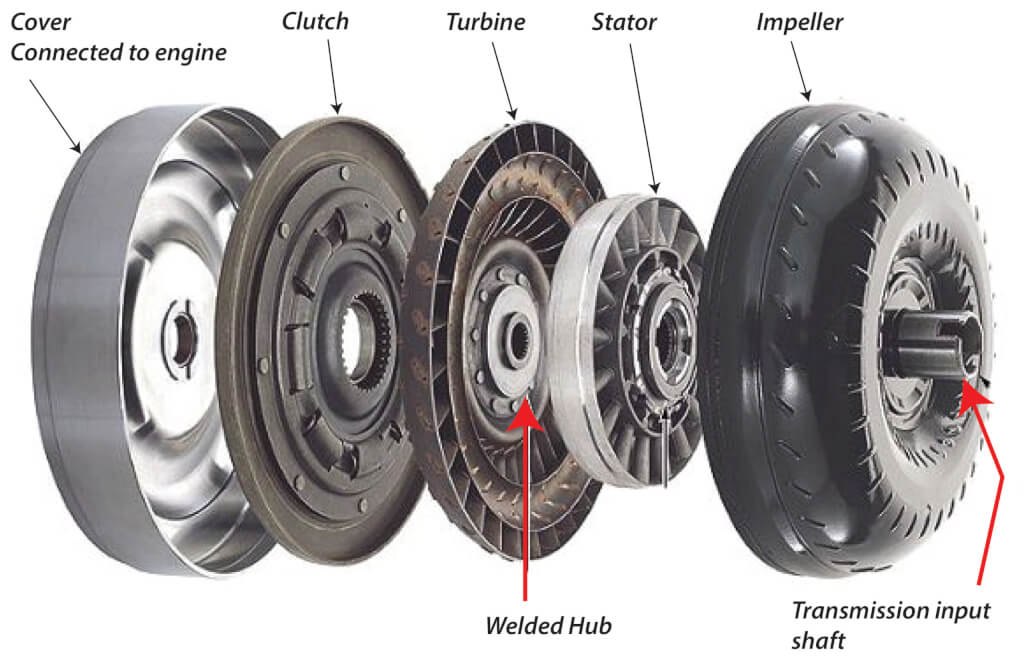
The torque converter clutch lock-up feature is controlled by the transmission control module and the lock-up solenoid. The TCM monitors the voltage to the solenoid to detect an open or short condition. In a P2763 code situation, the TCM detects high voltage, which usually indicates an open in the solenoid coil windings. In other words, the solenoid has failed.
After diagnosing a lot of Subaru CVT and automatic transmission issues, I can tell you these are the most likely causes:
1. Faulty TCC Pressure Control Solenoid — This is the top failure point. The solenoid can stick, short, or fail electrically.
2. Valve Body Failure — On many Subaru transmissions, the solenoid is integrated into the valve body. A failure here often means replacing the entire assembly.
3. Wiring or Connector Problems — Damaged wiring, corrosion, or poor connections can cause high circuit voltage and trigger the <strong”>Subaru P2763 code.
4. Contaminated or Degraded Transmission Fluid — Dirty fluid can clog passages and interfere with solenoid operation.
5. Internal Transmission Problems — Less common, but worn internal components can affect pressure regulation and trigger the code.
When I approach a Subaru P2763 code, I follow a systematic diagnostic routine. This isn’t a guess-and-replace situation.
Step 1: Scan Tool Analysis — I start by checking:
• Freeze frame data
• Transmission temperature
• Torque converter slip speed
• solenoid command vs. response
If I see excessive slip when lockup is commanded, I know I’m on the right track.
Step 2: Inspect Transmission Fluid — Fluid condition tells a story:
• Burnt smell = overheating
• Dark color = contamination
• Metallic debris = internal wear
If the fluid is compromised, it can directly affect solenoid performance.
Step 3: Electrical Testing of the Solenoid Circuit — I check:
• Resistance of the TCC solenoid
• Continuity of wiring harness
• Voltage supply and ground integrity
A high resistance or an open circuit confirms an electrical fault tied to the.
Step 4: Command the Solenoid — Using a bidirectional scan tool, I command the solenoid on and off and monitor the response. If the system doesn’t react, the solenoid or valve body is suspect.
Step 5: Inspect the Valve Body (If Needed) — If electrical tests pass but performance doesn’t, I move to hydraulic diagnosis, which often points to valve body failure.
How to Fix a Subaru P2763 Code
Once the root cause is identified, the repair path becomes clear.
Most Common Repairs:
• Replace the TCC pressure control solenoid
• Replace the valve body assembly
• Repair or replace damaged wiring/connectors
• Perform a transmission fluid service (if contamination is found)
On many Subaru models, I’ll be honest—the valve body replacement is often the real fix because the solenoid is integrated.
Pro Tips From the Shop
Here are a few things I’ve learned that will save you time and money:
• Always check the fluid condition before replacing parts
• Don’t ignore electrical testing—many failures are wiring-related
• If replacing the valve body, use OEM or high-quality parts
• Reset adaptive transmission values after repair
• Road test under steady cruise to verify torque converter lockup
• Why the Subaru P2763 Code Matters
This isn’t just a nuisance code. If you ignore the Subaru P2763 code, it can lead to:
• Increased transmission heat
• Premature wear of internal components
• Reduced fuel efficiency
• Eventual transmission failure
Fixing it early is far cheaper than replacing a transmission.
©, 2024 Rick Muscoplat
Posted on by Rick Muscoplat