
The Professional Guide to Conducting a Voltage Drop Test
Voltage Drop Test: The Acceptable Voltage Drop Numbers You Must Know
Quick Summary
A proper voltage drop test on battery connections and a thorough one on starter circuits are the best ways to find hidden resistance that static voltage checks completely miss. To get an accurate reading, the test must be measured while the circuit is operating, not at rest. Ideally, voltage loss on either the power or ground side should not exceed 0.1–0.2 volts per segment. When voltage is lost in cables or connectors rather than across the load, performance suffers. I’ll walk you through exactly how I perform a professional-level voltage drop test in the shop—and why it’s one of the most important diagnostic procedures you can learn.
Article
How to Perform a Voltage Drop Test on Battery and Starter Circuits the Right Way
Over the years, I’ve diagnosed thousands of no-crank and slow-crank problems. And I can tell you this with absolute confidence: most so-called “bad starters” are actually high-resistance connections. That’s why I never skip this test on battery cables or a complete voltage-drop test on starter circuits before replacing parts.
Voltage drop testing is simple in theory but powerful in practice. It allows you to measure the voltage loss as electricity flows through wires, connectors, and grounds. Remember this principle: voltage should drop across the load—the starter motor—not across the wiring feeding it.
Why You Must Test Under Load
One of the biggest mistakes I see is testing circuits without a load. That tells you nothing. Resistance only shows itself when current is flowing.
How I Perform a Voltage Drop Test on the Battery Positive Side
To test the battery-positive cables, I set my digital voltmeter to DC volts. I connect one lead to the battery positive post—not the terminal clamp, but the actual lead post—and the other lead to the starter’s main positive terminal. Then I crank the engine.
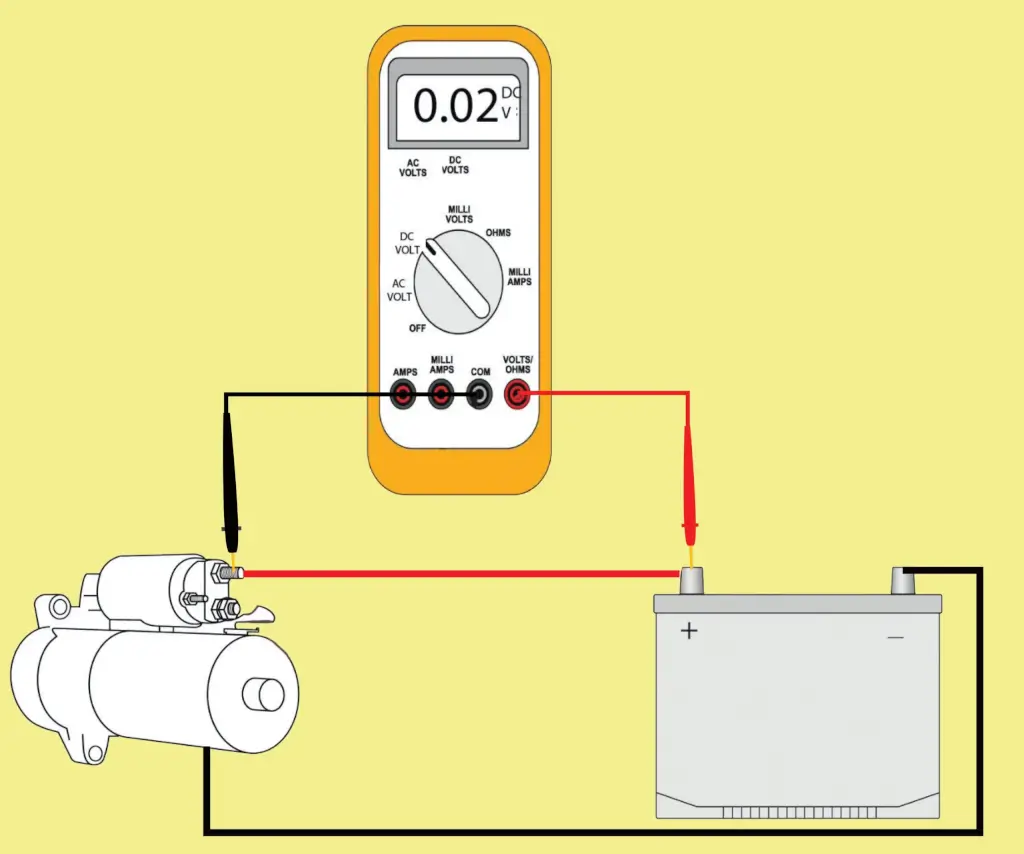
This image shows how to connect the meter leads when conducting a voltage drop test on the positive side of the battery and starter
The meter displays the difference in voltage between those two points. If I see more than 0.2–0.3 volts drop during cranking, I know there’s excessive resistance somewhere in that path.
If the reading is high, I move my meter lead down the circuit step by step.
Performing a Voltage Drop Test on Starter Ground Side
Most people forget the ground circuit. To perform the test on starter ground circuits, I connect one meter lead to the starter housing and the other to the negative battery post. Then I crank the engine again.
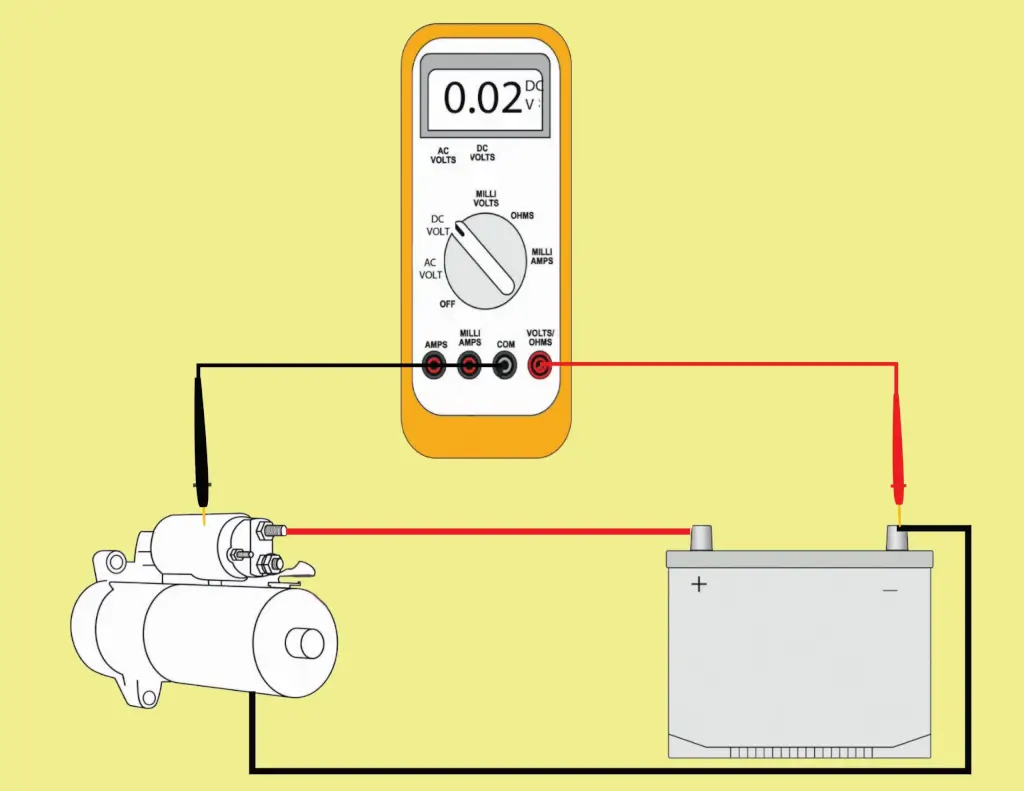
This image shows how to connect the meter leads when conducting a voltage drop test on the negative side of the battery and starter
If I see more than 0.2–0.3 volts, there’s excessive resistance in the ground path—possibly at the engine ground strap or battery negative cable.
A clean ground is just as important as a clean positive feed. A complete voltage-drop test of battery circuits must include both sides.
What Acceptable Numbers Look Like
In ideal conditions, the voltage drop per connection should stay under 0.1 volt, as referenced
In practical shop conditions, a voltage drop of less than 0.2 volts per segment is acceptable.
For the entire starter circuit, I like to see:
• Positive side under 0.5 volts total
• Ground side under 0.5 volts total
If the total exceeds 1 volt during cranking, I start looking more closely for high-resistance connections.
Why This Test Is Superior to Resistance Testing
Some technicians try to measure resistance with the engine off. That’s ineffective in high-current circuits. A starter can draw 150–250 amps. A small amount of resistance under load results in significant voltage loss. Only a dynamic voltage drop test on the battery and starter circuits can reveal this.
Electricity behaves differently under load. That’s why voltage drop testing is the gold standard.
Final Thoughts From the Shop Floor
If you want to diagnose electrical problems professionally, master voltage drop testing.
A proper voltage drop test on battery cables verifies that power delivery is clean and efficient. A complete voltage drop test on starter wiring confirms that the motor is receiving full available voltage.
This test takes only minutes but prevents costly mistakes.
It’s one of the most powerful diagnostic tools you can learn—and it separates parts replacers from true diagnosticians.
©, 2026 Rick Muscoplat
Posted on by Rick Muscoplat