
Torque to Yield Bolts Explained: Why You Can’t Reuse Them
Common Mistakes When Installing Torque-to-Yield Bolts
Quick Summary
Torque-to-yield bolts are designed to stretch permanently during installation to deliver a highly accurate and uniform clamping force. Carmakers use them in many locations on the engine and suspension because they compensate for expansion, contraction, and gasket compression. But here’s the key takeaway—once installed, torque-to-yield bolts can’t be reused. Reusing them risks bolt failure, blown gaskets, and expensive engine damage.
What Are Torque to Yield Bolts?
A standard bolt is tightened until it stretches slightly—but it 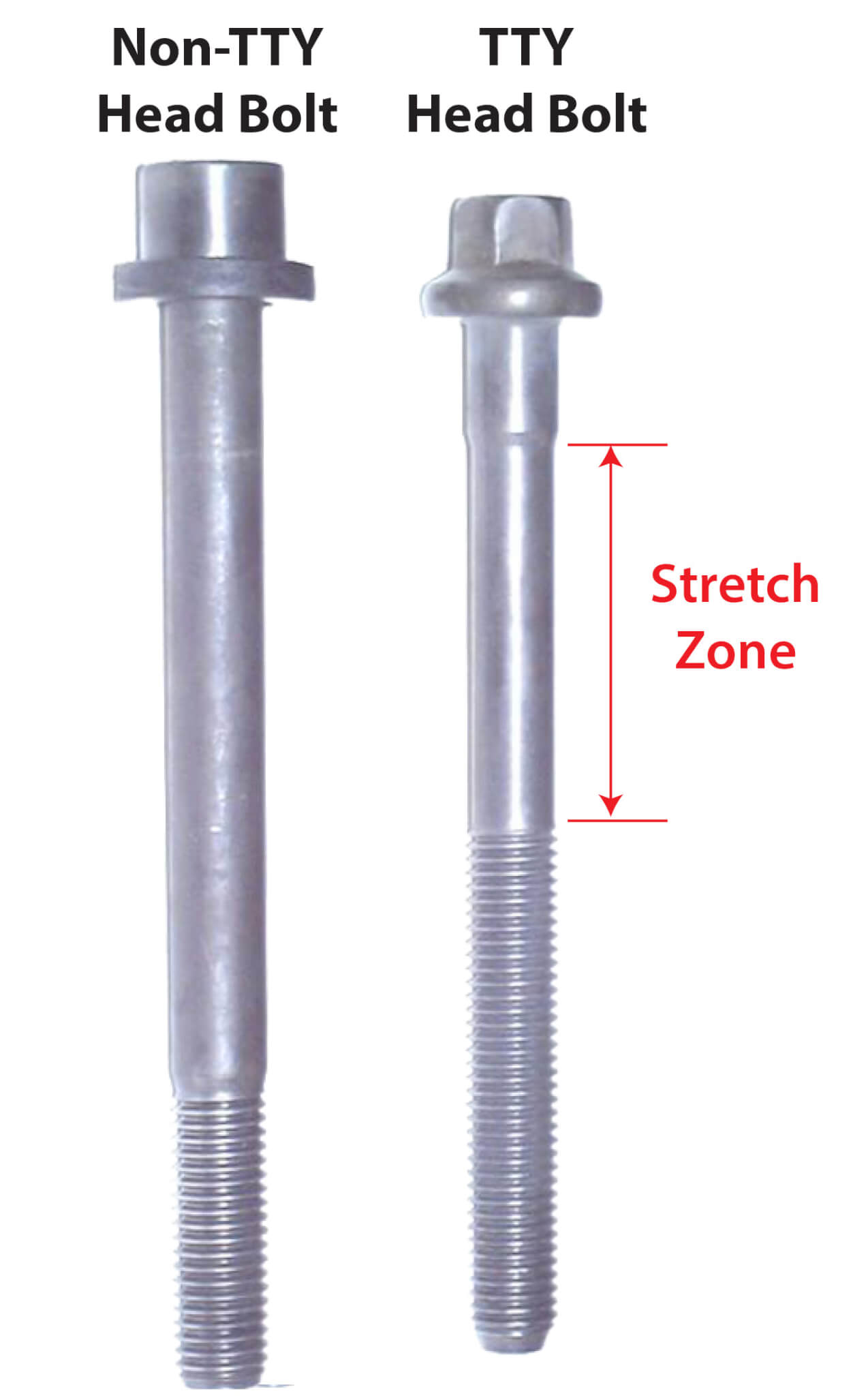
stays within its elastic range, meaning it springs back when loosened. Torque-to-yield bolts are completely different.
During the torquing process, these bolts are intentionally tightened past their elastic limit and into what’s called the yield zone, where they permanently stretch. That permanent stretch is not a defect—it’s the entire design strategy.
Why Carmakers Use Torque to Yield Bolts
Years ago, engines were mostly cast iron. The block and head expanded at roughly the same rate, so standard bolts worked fine. That’s no longer the case. Today’s engines mix materials like aluminum heads and iron blocks, which expand at different rates. Add in modern multi-layer steel head gaskets that compress over time, and you’ve got a moving target for clamping force.
Here’s where torque-to-yield bolts shine:
• They maintain a consistent clamping force despite temperature changes
• They compensate for gasket compression and relaxation
• They reduce the chance of head gasket leaks
• They resist loosening from vibration and heat cycles
This is exactly why you see them used on:
• Cylinder heads
• Connecting rods
• Main bearing caps
• Suspension components on modern vehicles
How Torque to Yield Bolts Work (What’s Really Happening)
When I tighten a bolt, it goes through several phases. With torque-to-yield bolts, we intentionally go further than normal.
Here’s the simplified version:
• Rundown phase – bolt contacts the surface
• Alignment phase – components are pulled together
• Elastic phase – bolt stretches but would return to shape
• Yield phase – bolt stretches permanently (this is where TTY bolts operate)
Once you reach that yield phase, the bolt necks down slightly and locks in a very predictable clamping load.
That’s the magic—not torque, but stretch controls the clamping force.
If a bolt is tightened past its point of elasticity, it will not return to its original shape when loosened. This is called the bolt’s “yield point.”
How to Torque Torque to Yield Bolts (The Right Way)
This is where I see many mistakes. You cannot install torque-to-yield bolts using torque alone.
You need two tools:
• A torque wrench
• A torque angle gauge
Here’s the correct method I follow every time:
• Step 1: Torque the bolt to the specified base torque
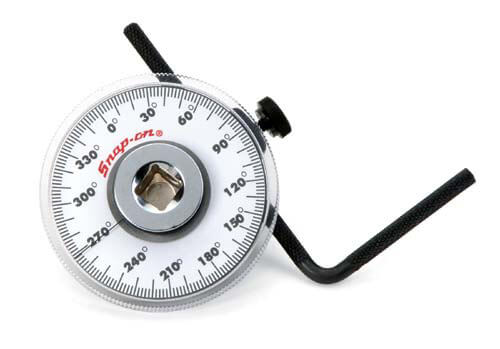
Torque angle gauge for TTY bolts
• Step 2: Switch to an angle gauge
• Step 3: Turn the bolt a specified number of degrees (often 90° + 90°)
• Step 4: Repeat angle steps if required
That second step—turning by angle—is what pushes the bolt into the yield zone and ensures consistent stretch. If you skip the angle step or guess at it, you’ll get uneven clamping—and that’s how head gaskets fail.
Why Torque-to-Yield Bolts Can’t Be Reused
This is one area where I don’t compromise, and neither should you. Once torque-to-yield bolts have been installed, they’ve already been stretched beyond their elastic limit. That means:
• They won’t return to their original length
• They’ve already lost their designed clamping characteristics
• Their structural integrity is reduced
Reusing them creates real risks:
• Bolt breakage during reinstallation
• Uneven clamping force
• Head gasket failure
• Engine damage
I’ve seen it firsthand—someone tries to save a few bucks reusing head bolts, and the job has to be done all over again. My rule: if it’s a torque-to-yield bolt, replace it.
Advantages of Torque to Yield Bolts (Why They’re Worth It)
Even though they’re single-use, torque-to-yield bolts offer major advantages:
• More accurate clamping force than torque-only bolts
• Better sealing for head gaskets and engine components
• Less sensitivity to friction variations
• Improved durability under thermal cycling
• Reduced chance of loosening
That’s why manufacturers rely on them in critical applications.
Common Mistakes I See with Torque to Yield Bolts
Over the years, I’ve seen the same errors repeated:
• Reusing old bolts
• Skipping the angle tightening step
• Using cheap aftermarket bolts
• Not following the tightening sequence
• Guessing instead of using a torque angle gauge
Every one of those mistakes can undo an otherwise perfect repair.
Pro Tip from the Shop
Here’s something most DIYers don’t realize:
With torque-to-yield bolts, the torque reading becomes less important once you hit the angle stage. The final clamping force is determined by bolt stretch—not torque. That’s why angle accuracy matters more than brute force.
How TTY Bolts Work
The working principle of TTY bolts revolves around their ability to achieve a more uniform clamping force.
Here’s a step-by-step outline of how they are typically used:
1) Initial Torque: The TTY bolt is first tightened to a specified initial torque value. This initial torque is usually lower than the final required clamping force.
2) Angular Tightening: After reaching the initial torque, the bolt is then tightened further by turning it at a specific angle, typically measured in degrees. This additional angular tightening ensures that the bolt stretches into the plastic deformation zone, providing a more consistent clamping force.
The Advantages of TTY Bolts
The use of TTY bolts offers several significant advantages, especially in applications where consistent clamping force is critical. Some of these advantages include:
1) Uniform Clamping Force: By stretching into the plastic deformation zone, TTY bolts provide a more uniform clamping force across all bolts in an assembly. This is particularly important in applications such as engine cylinder heads, where even distribution of pressure is crucial.
2) Improved Sealing: The consistent clamping force provided by TTY bolts enhances the sealing of components, reducing the likelihood of leaks in critical systems like engines and transmissions.
3) Vibration Resistance: TTY bolts are less likely to loosen under vibration compared to conventional bolts. This makes them ideal for use in high-vibration environments, such as automotive engines.
4) Reduced Risk of Over-Tightening: The angular tightening method reduces the risk of over-tightening, which can lead to bolt failure or damage to the components being fastened.
Where TTY Bolts Are Used On Late Model Vehicles
• The Engine— TTY bolts are commonly used to secure engine cylinder heads, ensuring a uniform and reliable seal between the head and the engine block. This helps maintain proper compression and prevents leaks.
• Transmission Systems— In automotive transmissions, TTY bolts are used to secure components that require precise clamping forces to function correctly.
• Suspension Systems— TTY bolts are used in suspension systems to maintain consistent clamping force, ensuring the stability and safety of the vehicle.
Why newer vehicles use TTY bolts; what was wrong with the old bolts?
When engine blocks and cylinder heads were made from cast iron, both expanded and contracted at the same rate. But newer engines are made with aluminum alloys that expand and contract at different rates. When you install a new gasket, it will relax over time as it “sets” and compresses. If you rely on torque during installation, the connection will loosen as the gasket relaxes. For example, it’s common for a composition head gasket to relax by up to 25%, causing a 0.011 loss of spacing.
The same is true with suspension components. Carmakers have switched from cast iron and steel control arms to lighter magnesium alloys. When you install a steel bolt in a magnesium alloy, you get two different rates of expansion/contraction, so a TTY bolt is required to maintain the proper torque.
The TTY torquing procedure is a multi-step process
Torquing a TTY bolt requires both a torque wrench and a torque angle gauge. You cannot torque these bolts without both or you risk damaging the bolt. Worse yet, you’ll screw up the head gasket and have to do the job all over again.
Step 1: Torque the bolt to a specified torque.
Step 2: Attach a torque angle gauge and turn the bolt the prescribed number of degrees.
Steps 3 & 4: This step may involve another torque step or another rotation.
Once TTY head bolts have been torqued, they generally cannot be re-used. However, some car makers do allow re-use. If you don’t know for sure whether your head bolts can be re-used, don’t risk it; use new head bolts. If you attempt to reuse a TTY head bolt that can’t be reused, you will either break the bolt or screw up the head gasket job. Don’t risk it. Buy new head bolts.
Considerations When Using TTY Bolts
While TTY bolts offer numerous benefits, there are some important considerations to keep in mind when using them:
• Single-Use— TTY bolts are designed for single use only. Once they have been stretched into the plastic deformation zone, they cannot be reused. Reusing TTY bolts can compromise the integrity of the assembly and lead to failure.
•Proper Tools— Proper tools and equipment are required to install TTY bolts correctly. This includes torque wrenches capable of precise angular measurements.
• Manufacturer Specifications— It is crucial to follow the manufacturer’s specifications for initial torque and angular tightening. Deviating from these specifications can result in inadequate or excessive clamping force.
• Inspection— TTY bolts should be inspected before use to ensure they are free of defects and damage. Damaged bolts can fail to provide the necessary clamping force and compromise the assembly.
©, 2019 Rick Muscoplat
Posted on by Rick Muscoplat