
Troubleshooting the :Chevy P0597 Code
Common Issues with the Chevy P0597 Code
A Chevy P0597 code indicates an issue with the thermostat heater control circuit. Specifically, this code is triggered when the Engine Control Module (ECM) detects a problem in the circuit that controls the thermostat’s heating element. The thermostat heater helps regulate the engine’s temperature by controlling the flow of coolant, and a malfunction in this system can affect engine performance and efficiency.
Late-model engines use an electrically heated thermostat. A Chevy P0597 Code is defined as: Engine Coolant Thermostat Heater Control Circuit Trouble.
What causes a Chevy P0597 code?
On GM vehicles, the heated thermostat is built in a plastic housing. Shops are reporting a very high failure rate for this item due to the plastic housing’s poor design. Aftermarket suppliers have determined that the plastic housing suffers from weak construction, a small tube diameter, and an insufficient gasket groove. Dorman Products and Gates both offer an upgraded part to replace the factory design.
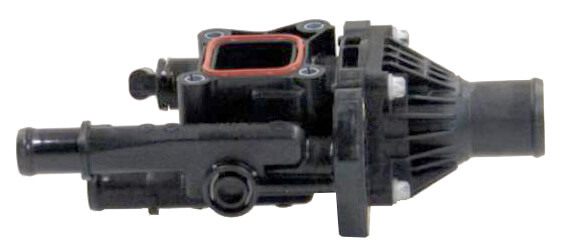
This is the original GM-designed plastic heated thermostat housing that causes the P0597 code

Gates 34710 redesign using a metal housing

The Dorman 902_033 is a redesigned heated thermostat and housing to eliminate the Chevy P0597 code for good
Symptoms of the Chevy P0597 Code
• Check Engine Light— The most obvious symptom is the illumination of the Check Engine Light on the dashboard. This general alert signals an issue within the engine management system.
• Engine Overheating— If the thermostat fails to open, the engine may overheat due to restricted coolant flow. Conversely, if the thermostat fails to close, the engine may not reach optimal operating temperature, leading to poor fuel efficiency and performance.
• Poor Fuel Efficiency— An improperly functioning thermostat can cause the engine to run at incorrect temperatures, impacting fuel efficiency.
• Erratic Temperature Gauge Readings—Drivers may notice unusual temperature gauge readings, either indicating the engine is running too cold or too hot.
Diagnosis and Repair
Diagnosing the P0597 code involves using an OBD-II scanner to confirm the code and check for any related codes. A mechanic will typically inspect the thermostat, thermostat heater, wiring, and the ECM to identify the exact cause. Repair may involve replacing the thermostat, repairing damaged wiring, or in rare cases, replacing the ECM.
Diagnose and fix a Chevy P0597 code
The thermostat/heater assembly can generate three distinct trouble codes:
P0597 – Engine Coolant Thermostat Heater Control Circuit
P0598 – Engine Coolant Thermostat Heater Control Circuit Low Voltage
P0599 – Engine Coolant Thermostat Heater Control Circuit High Voltage
P0597 or P0598 can be set by a short-to-ground condition or an open or high-resistance condition
P0559 can also be set by a short-to-voltage condition
P0597 Diagnostic steps
1) Remove the electrical connector from the thermostat housing. Check for corrosion, coolant infiltration, and bent pins.
2) Check the fuse to the thermostat heater.
Why does Chevy use a heated thermostat?
Car makers routinely install smaller turbocharged engines to lower vehicle weight and improve gas mileage and emissions. These smaller engines often run hotter when the turbo is in operation, but can fail to output enough heat to warm the passenger cabin when the vehicle is at idle in cold conditions. Car makers use various methods to improve cabin heating. Some rely on a radiator shutter mechanism to block airflow across the radiator to reduce heat loss on the engine coolant. But that can also impair engine cooling once the driver takes off from idle. So car makers also incorporate a heating element in the thermostat to speed up thermostat opening to provide optimum cooling.
GM uses a heated thermostat assembly as a single unit. The thermostat, housing, heater and sensor are a single unit. The thermostat begins to open at 221°F and is fully open at 248°F. The PCM monitors coolant temperature at the sensor and use a pulse width modulated power to regulate how much heat to apply to the wax pellet in the thermostat to speed up opening time. Unfortunately, these units have a high failure rate.
©, 2017 Rick Muscoplat
Posted on by Rick Muscoplat