
Understanding Brake Pad Quality Levels: A Guide
Choosing the Right Brake Pad Quality Level
Brake parts manufacturers often sell two or three different brake pad quality levels for a particular vehicle, and the prices vary accordingly. Many DIYers wonder if there’s really much of a difference between the different offerings. There is. The price difference comes down to the quality of the friction material, backing plate, and hardware. In order to make an informed choice, you need to understand the differences in brake pad quality levels. Let’s start by discussing what the terms mean in relation to brake pads.
What are Original Equipment (OE) brake pads?
The brake parts installed on new vehicles at the assembly plant must meet rigid Government safety standards. Those parts must pass laboratory tests that measure stopping power, fade, fire, and rust resistance. That testing is not only costly but the tests must be performed on the brake parts for every model variation. For instance, the brake parts for a 4WD or AWD version are often different than the brake pads for the same year, make and model with just 2WD, due to the difference in vehicle weight. That’s a lot of testing.
To develop brake parts that’ll pass muster, car makers work closely with their “Tier 1” brake parts suppliers (and trusted sub-contractors) to develop just the right combination of friction material, backing plate, and rotor metallurgy to pass the tests. The car makers keep those formulas and specifications a closely guarded trade secret. NO car maker would ever hand out those secret formulas or specifications to an aftermarket supplier. The fact that aftermarket suppliers aren’t privy to the OE formulas is an important fact to keep in mind when you see a brake part that claims to “meet or exceed OE quality.” More on that later.
What are Original Equipment Service (OES) brake pads?
If you buy brake parts from the car dealer, you won’t get the same ones installed at the assembly plant. Because they’re considered “aftermarket” parts, brake parts sold by dealers and auto parts sellers don’t have to meet any Government standards. However, car makers want dealer brake parts to be as close as possible to OE performance while still being competitively priced. So they supply their dealers with Original Equipment Service (OES) quality parts. Those parts are often manufactured by authorized “Tier 2” suppliers, using formulas and specifications provided by the car maker. OES brake parts are either the same or slightly lower quality than OE parts but perform nearly the same as the OE factory parts.
What are aftermarket brake parts?
All brake parts sold to repair shops and auto parts stores are aftermarket brake parts. Aftermarket parts can be made by a Tier 1 and 2 supplier and sold under a different brand name, or they can be made by a company that has no association with a car maker. Federal-Mogul, for example, supplies brake parts to car makers as Tier 1 or 2 suppliers. However, they also sell their brake parts to auto parts sellers under the Wagner brand name.
Many aftermarket brake parts are manufactured in North America and Europe by reputable, well-established, name-brand companies. But they can also be manufactured by third-rate knock-off offshore suppliers.
Since aftermarket manufacturers can’t get their hands on the original OE formulas and specifications, they either have to reverse engineer the OE brake parts or come up with their best guess for the OE formula. If they reverse engineer, they have to grab samples right from a brand-new vehicle, which is costly. The samples can’t come from the dealer parts department because those are OES parts.
During the reverse engineering process, the aftermarket manufacturer tries to duplicate the exact raw material content and percentages, the dimensional specifications, and the metallurgy used in the OE brake parts. However, even if they manage to reverse engineer the formula and metallurgy, they can’t possibly know if their efforts were successful until they subject their “knock-off” parts to the same laboratory testing the car makers performed. How else could they confidently say that their product “meets or exceeds OE” quality? Due to the high cost of those tests, only the largest and most reputable brake parts manufacturers test their products using the same tests as the car makers.
Third rate and knock-off aftermarket brake parts manufacturers face the same obstacles but with fewer resources. Some of those manufacturers skip the reverse engineering process altogether and simply come up with a friction formula they feel works best for a certain year, make and model. In addition, many smaller brake parts manufacturers can’t afford to run their own metal stamping or rotor casting operations, so they buy backing plates and rotors from outside vendors. Once the brake parts are built, those companies peddle their products through brokers or auto parts sellers, claiming the parts meet or exceed OE quality without any actual testing. That’s misleading at best.
But aren’t all brake pad quality levels safe?
Not always. A brake pad manufacturer can make brake pads that perform adequately in most cases but fail under severe conditions. A manufacturer can also make brake pads that perform well when new but degrade and fail over time due to the use of inferior raw materials. Those manufacturers may be willing to gamble on the odds of being sued for a brake failure that results in injury or death.
Knock-off brake pad manufacturers sell cheap low quality products and dirt cheap prices, but call them Premium Quality
Here’s an example from Alibaba showing how any chain repair shop, importer, or auto parts store can buy aftermarket brake pads for as little as $1.00/set.
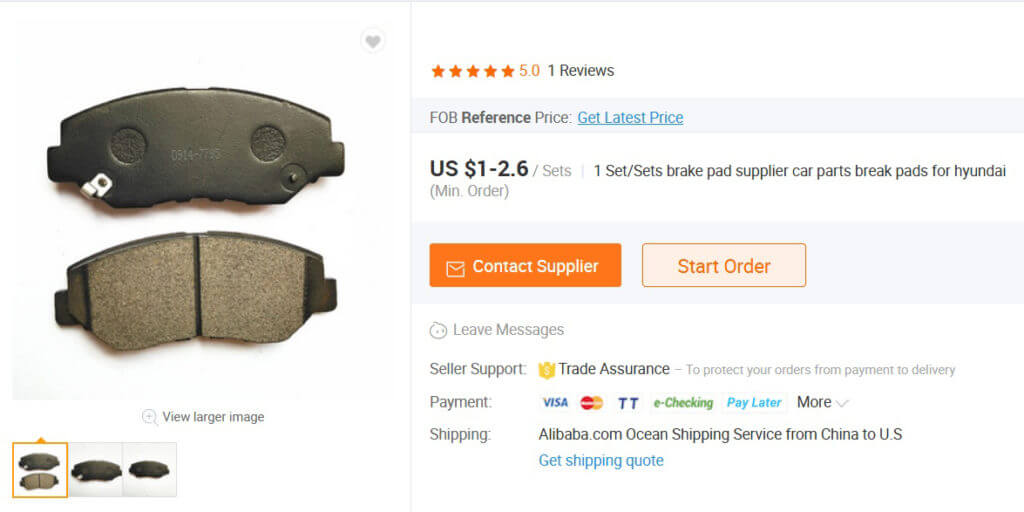
Want to sell brake pads online and make money? Buy them from Alibaba for $1.00 to $2,.60 per set.
Are those brake pads any good? Who knows? If you’re an importer or auto parts seller and they fail, how likely will you be sued? Not very.
What’s the lesson here?
The price difference between an economy brake pad versus a premium quality brake pad from a respected name-brand manufacturer is about $15. Since the quality difference is substantial, and since the brake pads are usually the smallest expense when performing a brake job, it pays to buy OE or premium pads and skip the store-brand parts.
Store-branded brake parts cost nearly the same as name-brand parts, but they’re usually lower quality.
What can you expect from an economy brake pad?
Economy brake pads are designed to appeal to “thrifty” buyers; yeah, cheapskates. Those “thrifty” buyers may assume they’re getting a brake pad that will perform as well as OE or OES brake pads but just won’t last as long. They’d be wrong in most cases. In fact, some economy pads are so bad that they require a longer stopping distance. Yet stopping in time to avoid a crash is just as important for an old car as a newer one. Not all economy pads perform as well as OE or OES.
Economy brake pads are often made from the lowest quality friction materials and obsolete formulas. They often use thinner backing plates made from low-quality “black” steel. A thinner backing plate will deflect during hard braking and under high heat conditions, causing a loss of braking power and a longer stopping distance. The deflection can cause friction material separation and even cause friction material to break off from the backing plate.
Low-quality steel backing plates have far less resistance to rust, which causes them to corrode. A corroded backing plate can also cause the friction material to “delaminate,” where it actually breaks away from the backing plate or falls off completely.
Bottom line: Economy brake pads often don’t brake as well under demanding conditions, corrode faster, and don’t last as long as a higher-quality brake pad.
What can you expect from OE-quality brake pads?
Reputable brake pad manufacturers that represent their products to meet or exceed OE quality should perform as well or better than the brake pads that came with the vehicle when it was new. In other words, they should brake as well, last as long and limit noise, vibration and harshness to the same level as the OE brake pads. In my opinion, they represent the MINIMUM quality level you should even consider replacing the factory pads.
What can you expect from premium brake pads?
Premium brake pads made by a reputable brake parts manufacturer should provide superior braking, last longer, and produce less noise, vibration, and harshness than OE products.
Summary of brake pad quality levels.
When it comes to buying replacement brake pads, my recommendation is to buy a premium brake pad from a reputable brake parts manufacturer like ACDELCO, Advics, Akebono, Bendix, Bosch, Brembo, Centric, EBC, Jurid, Hawk, Monroe, Rayloc, Raybestos, StopTech, Valeo or Wagner.
Since you have no idea who makes private label brake pads from auto parts sellers AND since you’re probably paying MORE than reputable, well-known name brands, you should BUY NAME BRAND BRAKE PARTS.
©, 2019 Rick Muscoplat
Posted on by Rick Muscoplat