
Understanding Pre ignition in Internal Combustion Engines
Learn what pre ignition is, what causes it and how to stop it
Pre ignition is a phenomenon that occurs when the air-fuel mixture ignites before the spark plug fires, causing a rapid buildup of pressure and heat while the piston is still on its upward movement in the compression stroke. Pre ignition poses a significant danger to engine components, and if left untreated, can cause costly engine failure. This article delves into the mechanics of pre-ignition, its causes, effects, and strategies to mitigate its impact on internal combustion engines.
Five Causes of Pre Ignition
In the simplest of terms, pre ignition is combustion that starts from a heat source other than the spark plug. There are only five things that can cause that kind of spontaneous combustion:
• Glowing carbon deposits in the combustion chamber, cylinder head, or a damaged spark plug tp
• Using a low-octane fuel in a high-compression engine that requires a high-octane fuel.
• A spark plug of the wrong heat range is installed in the engine
• An overheated engine
• Spark timing that’s way too advanced, leaving the cylinder head too hot between intake strokes
Most preignition is caused by carbon buildup or a sharp edge inside the combustion chamber that heats to cherry red. In addition to carbon buildup, preignition can also occur if the wrong spark plug has been installed in the engine. Using the wrong octane fuel can also cause preignition.
Every spark plug is rated for a certain heat range. To change the heat range of a spark plug, the manufacturers alter the design of the porcelain insulator, vary the length of the center and side electrodes or change how far the electrodes extend into the combustion chamber. The insulator and spark plugs threads are critical design elements to draw heat away from the electrode tips and keep them within a certain operating range temperature.
When the wrong spark plug is installed, the electrodes and insulator retain too much heat and can act as an ignition source before the spark is generated.
Pre ignition starts at the very beginning of the compression stroke, the opposite of detonation
The more compressed an air-fuel mixture is, the harder it is to ignite with a spark, much less a glowing carbon deposit. So pre ignition doesn’t happen at the top of the compression stroke. Instead, it occurs as the piston begins its rise from bottom dead center (BDC), where cylinder pressure is low and the air-fuel mixture can be easily ignited by a hot spot. This early ignition causes the flame front to expand while the piston attempts to compress the mixture. So, the piston’s upward motion is fighting the expanding combustion force. This adds a tremendous amount of heat and load to the engine, and it’s why pre ignition is responsible for much higher cylinder pressures than detonation.
The pressure rise from pre-ignition is not nearly as rapid as with detonation. However, it produces much higher pressure and lasts longer than detonation, which is why it is so destructive to an engine.
What does preignition do to an engine?
The high heat from preignition can melt holes in the tops of pistons, burn the electrodes off of spark plugs, and overheat and disintegrate the edges of valves.
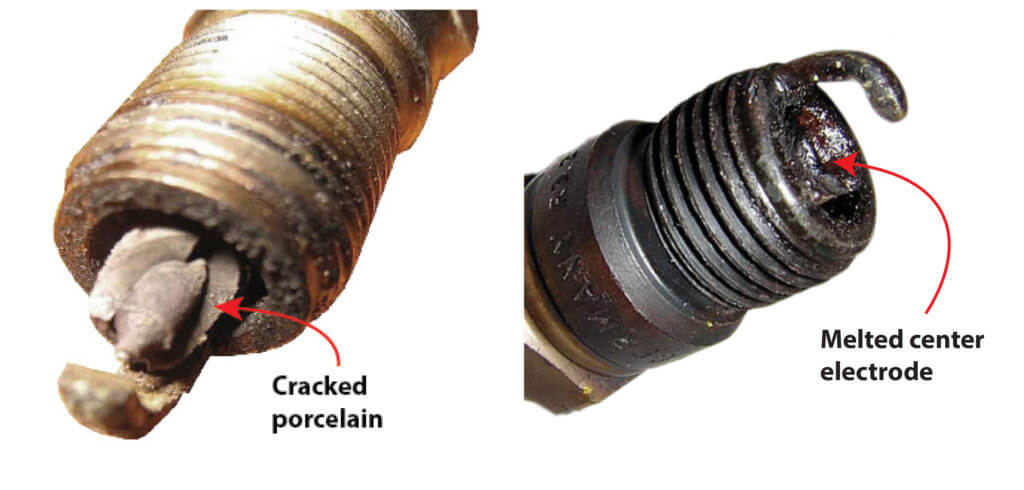
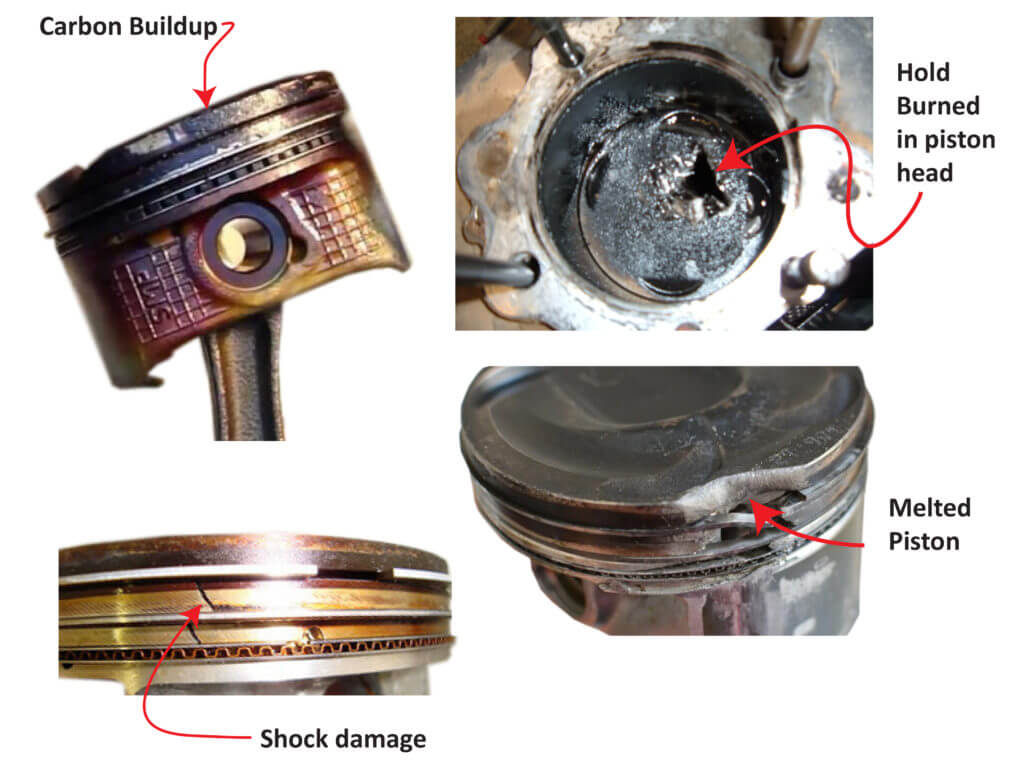
Preignition piston damage
How to Prevent Pre Ignition
Preventing and mitigating pre-ignition involves addressing its root causes and optimizing engine parameters. Key strategies include:
• Use a High-Octane Fuel On a High Compression Engine— Higher-octane fuels are more resistant to ignition from the heat created in high-compression engines.
• Clean The Combustion Chambers— Regularly removing carbon deposits through fuel additives or mechanical cleaning can eliminate potential ignition sources.
• Fix an Overheating Engine— Effective cooling systems and proper maintenance can prevent overheating, reducing the risk of hot spots
• Optimizing Ignition Timing— Ensuring that ignition timing is correctly set according to manufacturer specifications can prevent excessive combustion chamber temperatures.
• Use the correct spark plug heat range— Ensure that the spark plugs are the proper heat range for your engine and gapped according to specifications.
©, 2019 Rick Muscoplat
Posted on by Rick Muscoplat