
Understanding Starter Motor Solenoid: How It Works
Starter Motor Solenoid: What It Is, How It Works, and the Different Types
A starter motor relies on the start motor solenoid to switch high current power to the starter to run the motor. Some starter motors incorporate a starter solenoid to perform double duty by switching high current power to the starter motor while also moving a level to push the starter drive into the flywheel to start the engine. In this article, we’ll dive deep into what a starter motor solenoid is, how it functions, and the different types that exist.
What Is a Starter Motor Solenoid?
A starter motor solenoid is an electromagnetically controlled switch. It is mounted directly onto the starter motor in most vehicles, although in some setups, it is placed remotely. The solenoid’s primary function is to connect the high-current battery source to the starter motor to crank the engine. When you turn the key or press the ignition button, the solenoid activates the starter motor, which then engages with the engine’s flywheel to start the combustion process.
Essentially, the solenoid serves two purposes:
1) It acts as a high-current switch, engaging the starter motor to crank the engine.
2) It also helps to push the starter motor’s pinion gear into engagement with the engine’s flywheel.
How a Starter Solenoid High-Current Switch Works

In this application, the starter solenoid acts only as a high-current relay to switch power to the starter motor. Power runs from the battery to one terminal on the solenoid. When the ignition key is turned to the START position, it sends power to the “S” terminal on the starter solenoid. That powers the control coil inside the relay, causing it to close a set of contacts. The contacts connect the large battery cable power to the starter motor to operate the starter.
How a Starter Motor Solenoid Works
When you turn the ignition key or press the button in a modern vehicle, a small electrical current is sent from the ignition switch to the starter solenoid. This current energizes the solenoid, creating a magnetic field. The magnetic force pulls a plunger or lever inside the solenoid, which performs two key tasks simultaneously:

This image shows a cut-away view of a starter motor with an integral starter solenoid.
Connecting the Electrical Circuit: As the plunger moves, it closes the high-current circuit between the car’s battery and the starter motor. This allows a large flow of electrical current to power the starter motor.
Engaging the Pinion Gear: At the same time, the plunger or lever pushes the pinion gear of the starter motor outward so that it meshes with the engine’s flywheel. This mechanical action is necessary for the starter motor to turn the engine.
Once the engine starts running, the ignition switch is released, and the solenoid disengages. This action retracts the pinion gear from the flywheel and cuts off power to the starter motor, preventing any damage from continuous engagement.
Types of Starter Motor Solenoids
There are different types of starter solenoids used in automotive systems, each with specific designs and applications. These include integral solenoids, remote solenoids, and plunger-type solenoids.
1. Integral Starter Solenoid
The integral solenoid is the most common type
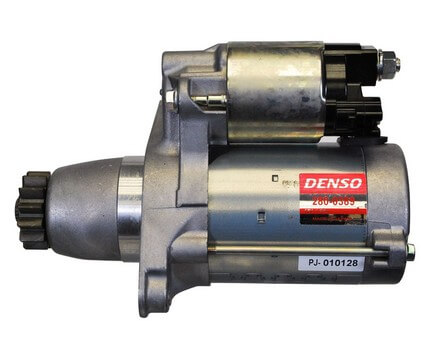
This image shows a starter motor with an integral starter solenoid
found in modern vehicles. This type is mounted directly onto the starter motor, usually as part of the starter assembly.
How It Works: When the ignition key is turned, the solenoid simultaneously engages the pinion gear with the flywheel and connects the high-current electrical circuit to the starter motor. Integral solenoids are compact and help simplify the design of the starter system since the solenoid and the starter motor are one unit.
Applications: Integral solenoids are widely used in most consumer vehicles due to their space-saving design and efficient operation.
2. Remote Solenoid
The remote solenoid is mounted away from

Remote mounted solenoid used as a relay to send battery power to the starter motor
the starter motor, often on the firewall or a fender. In this setup, the solenoid only acts as a switch for the electrical current, and the engagement of the pinion gear is done separately by the starter motor.
How It Works: The remote solenoid receives power from the ignition switch, which energizes the relay control coil, closes the electrical contacts, and sends the high current to the starter motor. However, unlike the integral solenoid, it doesn’t handle the engagement of the pinion gear. The starter motor performs this task via a separate mechanism.
Applications: Remote solenoids are more common in older vehicles, larger trucks, and some heavy-duty equipment. This design is often easier to service, as the solenoid is located separately from the starter motor.
3. Plunger-Type Solenoid
A plunger-type solenoid is a mechanical type

Plunger-style starter motor. In this older style starter motor, a solenoid under the brass colored cap energizes as soon as power is applied. The magnetic field pulls down on a lever that pivots the starter drive gear into the flywheel.
that operates through the movement of a plunger to close the circuit. It is commonly found in both integral and remote solenoids.
How It Works: When the ignition signal reaches the solenoid, the electromagnetic force moves the plunger, which in turn connects the electrical contacts. The plunger mechanism also helps push the pinion gear outward to engage the flywheel.
Applications: Plunger-type solenoids are often used in vehicles with high electrical demand or older ignition systems that rely on mechanical parts for activation.
Common Problems with Starter Motor Solenoids
Starter solenoids can experience a range of issues over time, leading to difficulties in starting the vehicle. Some common problems include:
Starter Solenoid Makes a Rapid Clicking Sound
If you hear a rapid clicking noise when you try to start your vehicle, this could indicate that the solenoid is trying to engage, but low current or low voltage is preventing the hold-in coil from completely closing. For more information on the causes of a rapid clicking sound, see this article.
No Response When Starting
A completely unresponsive ignition could indicate that the solenoid isn’t receiving the signal from the ignition switch, or the internal parts are worn or stuck.
Stuck Solenoid
If the solenoid fails to disengage after the engine starts, the starter motor may remain engaged, leading to serious damage to both the motor and the flywheel.
Burned or Pitted Contacts in the Starter Solenoid
Over time, the contacts inside the solenoid may become burned or corroded, reducing their ability to close the high-current circuit effectively.
©, 2024 Rick Muscoplat
Posted on by Rick Muscoplat