
Understanding the Causes of Head Gasket Failure
Learn the 5 most common causes of head gasket failure
A head gasket is a crucial component in an internal combustion engine, sealing the cylinder head and engine block. Its failure can lead to severe engine problems, including overheating, loss of power, and even complete engine breakdown. Understanding the common causes of head gasket failure can help catch problems early and prevent damage to the head gasket. I’ve listed the 5 most common causes of head gasket failure with suggestions on what you can do to avoid it.
Head gasket failure is common in late-model vehicles with aluminum engine blocks and cylinder heads. A head gasket failure can result in a check engine light, misfires, loss of coolant, loss of oil, coolant in the oil, coolant overflow at the radiator or recovery bottle, or bubbles in the coolant.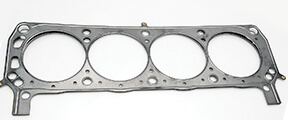
Engine overheating is the #1 cause of head gasket failure
Overheating causes the cylinder head to warp, which causes a space to form between the head gasket, cylinder head, and the engine block. Once a space opens, coolant can flow into the oil, oil can flow into the coolant, or hot exhaust gasses can flow into the coolant.
1) Engines overheat due to low coolant levels
Most low coolant issues are caused by cooling system leaks, like a leaking radiator, radiator hose or heater hose, heater core, or a even a leaking coolant reservoir. A symptom of overheating due to low coolant is an engine that runs at normal temperature at highway speeds but overheats at stop signs. This happens because the water pump spins faster at highway speeds and can force the remaining coolant through the radiator and engine. But at slower engine RPMS as idle, it can’t circulate the small amount of coolant, so it overheats.
2) Engines overheat due to radiator fan issues
Most late-model vehicles have a multi-speed fan or multiple fans to force the air across the radiator to keep the engine at the proper temperature. If the fans aren’t operating properly, you can get overheating, especially when idling, when there’s no “ram air” being forced through the engine like you’d find at highway speeds.
3) A worn-out water pump can cause overheating
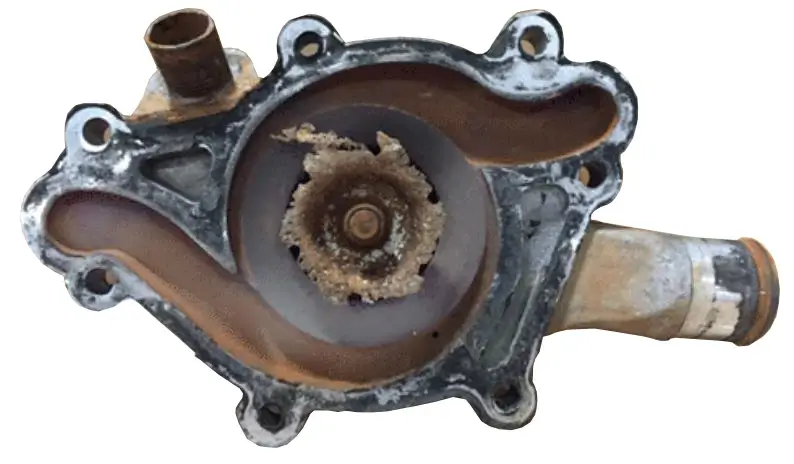
Notice how the impeller in this water pump is worn out to the point where the pump can barely pump coolant
Corrosion can erode the impeller in a water pump, causing it to pump less coolant per revolution, resulting in overheating
4) A clogged radiator can cause head gasket failure
If you don’t change your coolant on time, corrosion can build up in the system and clog the radiator, preventing it from removing heat from the coolant.
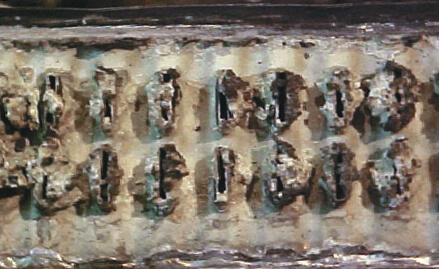
Notice how clogged the radiator fins are in this radiator. They can’t flow enough coolant to keep your engine at the proper temperature
5) Clogged radiator fins can cause overheating
Air has to flow through the radiator fins in order to remove heat. Dust, dirt, bug debris, pollen, cottonwood can build up on the radiator fins and block airflow
6) A clogged AC condenser or restricted grille can cause engine overheating
Air passes through the air conditioning condenser before it goes through the radiator. The condenser can be clogged with bugs, dirt, and dust, preventing good air flow to the radiator, which causes overheating.
In addition, some owners install cardboard in front of their radiator in the winter to increase cabin air temperature and then forget to remove it in summer. Anything that restricts airflow into the radiator will reduce engine cooling.
Worn-out coolant is the #2 cause of head gasket failure
Worn-out coolant can’t prevent corrosion, and the corrosion eats away at the edges of the head gasket
The anti-corrosion additives in coolant are critical to preventing cooling system corrosion. When a liquid flows between dissimilar metals, it produces electrolysis, the movement of some metal from one surface to another. So, the coolant’s anti-corrosion additives are designed to “passivate” the metal surfaces from the antifreeze electrolyte.
When the anti-corrosion additives are depleted, corrosion forms around the engine’s cooling passages. The corrosion spreads, damaging the head gasket by creating a breach between the cooling passage and an oil passage, or a cooling passage and the combustion cylinder.
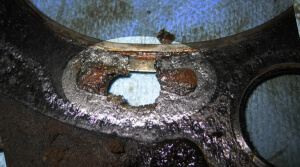
This image shows a corrosion buildup in the coolant passage of a head gasket. The narrowing of the passage reduces coolant flow, causing a hot spot at the fire ring of the gasket. That excessive heat can warp the head and gasket, causing a failure
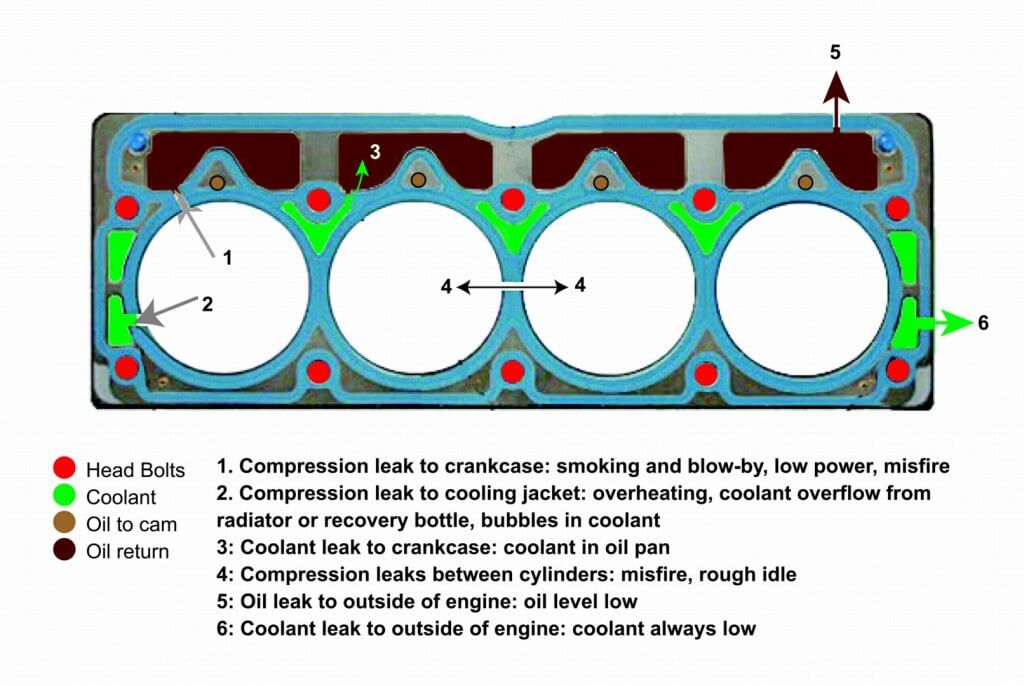
Typical head gasket
Detonation and pre-ignition are the 3rd most common causes of head gasket failure
Detonation is caused by using a lower octane fuel than recommended by the carmaker
Detonation is the spontaneous combustion of air-fuel pockets in the cylinder that self-combusts after the spark plug has fired and the piston is in its downward power stroke. The powerful explosion and extremely high temperatures and pressures created by detonation can burn through pistons, damage piston rods, and distort or melt the head gasket fire ring above each cylinder.
Pre-ignition is caused mostly by hot carbon deposits in the combustion chamber*
Pre-ignition, on the other hand, occurs before the spark plug has fired and is most often caused by hot carbon deposits in the combustion chamber. The air/fuel mixture starts the ignition, and then the spark plug fires, causing two flame fronts to collide while the piston is still in its upward compression stroke. The result is extremely high temperatures and pressures that can burn a hole in the piston and damage the fire ring in the head gasket.
*Pre-ignition can also be caused by using a lower octane fuel than the carmaker recommends. But that usually only happens when low-octane fuel is used in very high-compression performance engines.
Excessive boost is the 4th most common cause of head gasket failure
A properly operating turbocharger will boost combustion pressures within the acceptable range. However, if the turbo has been modified or is not operating properly, it can produce more boost than the engine was designed to handle. That excessive boost can cause head gasket failure
Performance tuning is the 5th most common cause of head gasket failure
Performance tuning alters factory programming to increase power by advancing spark timing, boosting air/fuel mixtures, and boosting turbocharger boost. In many cases, tuning can also include deleting the EGR valve. Any or all of these changes can damage the head gasket by increasing combustion temperatures and pressures beyond design specifications.
See this post for more information on head gasket sealers this post
©, 2015 Rick Muscoplat
Posted on by Rick Muscoplat