
Understanding the Shift to Electric Vehicles
Why Electric Vehicles Are the Future of Auto Transportation
by Rick Muscoplat
The global automotive landscape is undergoing a quiet and as yet unrecognized seismic shift in the U.S. The shift is driven by the undeniable fact that electric vehicles (EVs) represent the future of transportation. That consensus isn’t shared by the driving public in the U.S. currently, and there are many reasons for that reluctance. For example, the charging infrastructure in the U.S. and most other countries is woefully inadequate. The current battery range is too low, especially for the American market. The up-front cost of buying an electric vehicle is too high, even with tax incentive offsets, which are sure to disappear with the incoming U.S. administration. Then, there’s the “drill baby, drill” simplistic mindset that an increase in oil production and a drop in gasoline cost can fix all ills in the marketplace. However, this attitude is a head-in-the-sand approach that denies the market situation outside the U.S. In other words, the world is moving toward electric cars, and it’s coming whether U.S. drivers want it or not. The economic drivers pushing the change away from gasoline fuels and combustion engines are simply too strong to ignore.
Let’s talk about those drivers and the geopolitical implications of the delusional thinking in U.S. political circles that Americans can exert any control over the global forces pushing the technology away from fossil fuels and into EVs. It’s a hard fact that China is taking the lead in EV development, not the U.S. We don’t see many Chinese EVs on the road here, but that doesn’t mean they’re not on the roads in China and Europe.
• Two-thirds of the world’s EVs are made in China.
• Chinese consumers had their choice of 235 different EVs in the first half of this year, and paid on average $35,000 for a battery-powered vehicle.
• EVs will account for only 9% of auto sales this year in the U.S., compared with 18% in Ireland, 37% in Sweden, and 82% in Norway.
• For the United States, lagging in this race will have profound economic, environmental, and strategic long-term consequences.
— The problem with EVs is they’re made in China — Axios
Why China Is Leading the Shift — Nov. 24, 2023, Wall Street Journal
Why Electric Vehicles Will Become the Dominant Technology
It’s Simple: Combustion Engines Are Inefficient And Can’t Be Made More Efficient
One of the most persuasive arguments for EVs is their superior energy efficiency compared to internal combustion engine (ICE) vehicles. Internal combustion engines are notoriously inefficient, converting only about 20-30% of the energy from gasoline into usable power, on average. The remainder is lost as heat and friction. Even the most efficient ICE vehicles today max out at around 40-42% peak thermal efficiency, and then only under ideal conditions. Yes, there’s been an an astounding increase in fuel efficiency since the 1960’s when the average U.S.-made vehicle was only 15-20% efficient. But there’s no getting around the fact that we’ve plateaued at a 42% peak, and any future changes will be incremental and with diminishing returns.
In contrast, EVs boast an energy efficiency of approximately 85-90%, primarily because electric motors convert electricity directly into motion with minimal energy loss. Additionally, regenerative braking allows EVs to recapture energy wasted in conventional friction braking. This feature not only extends the vehicle’s range but also reduces wear on braking components, lowering maintenance costs. The net result is a vehicle that uses energy far more judiciously than its gasoline-powered counterparts.
This efficiency translates into significant cost savings for consumers. While EVs may currently have a higher upfront cost (more on vehicle cost later), their lower energy and maintenance expenses often make them cheaper to own over the vehicle’s lifetime. For example, electricity is generally cheaper per mile than gasoline, and EVs require fewer repairs since they have fewer moving parts. As battery technology advances, these upfront costs are expected to decrease, narrowing the affordability gap.
Why Electric Vehicle Costs Will Drop In The Future
The Declining Cost of Battery Technology
Battery technology is the linchpin of the EV revolution, and its rapid advancement is a critical factor in the adoption of electric vehicles. Over the past decade, the cost of lithium-ion batteries—the standard for EVs—has
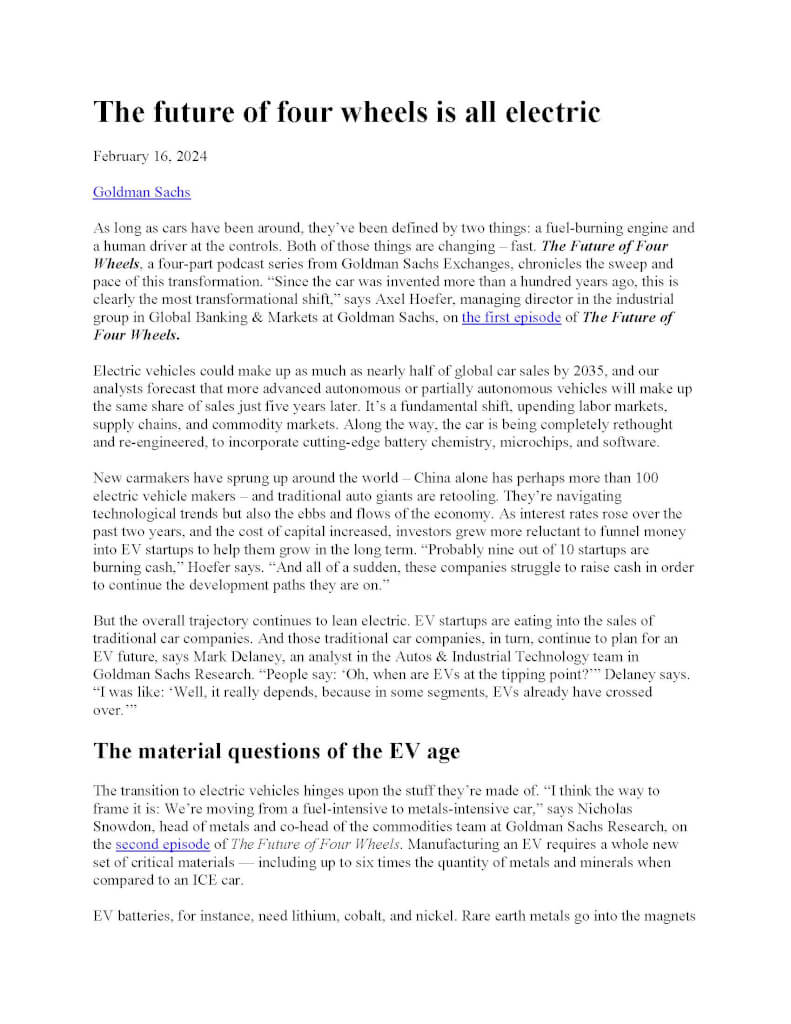
Click on this image to download a copy of Goldman Sachs white paper titled: The future of four wheels is all electric
plummeted by nearly 90%. In 2010, the cost per kilowatt-hour (kWh) was approximately $1,200; by 2023, it had dropped to around $130. Analysts predict this figure will fall below $100 per kWh by 2030, the tipping point at which EVs achieve price parity with ICE vehicles.
Several factors contribute to this cost decline. Advances in battery chemistry have improved energy density, enabling manufacturers to store more energy in smaller, lighter packages. Innovations in production methods, such as solid-state batteries, promise even greater gains in efficiency and safety. Furthermore, economies of scale driven by increased EV production and investments in battery manufacturing infrastructure have reduced per-unit costs.
The implications of cheaper batteries extend beyond passenger vehicles. Affordable, high-capacity batteries enable the electrification of buses, trucks, and other heavy-duty vehicles, further reducing greenhouse gas emissions. They also foster the growth of renewable energy systems, as batteries can store surplus energy generated by solar and wind power for later use.
The Role of Fuel Cells in the Long-Term EV Landscape
While battery-electric vehicles (BEVs) currently dominate the EV market, hydrogen fuel cell vehicles (FCVs) represent a real long-term future of auto transportation. In other words, BEV is an interim technology, much like compact fluorescent bulbs acted as an interim technology between high-wattage Edison filament technology and low-wattage LED lighting.
Fuel cells generate electricity through a chemical reaction between hydrogen and oxygen, emitting only water vapor as a byproduct. This makes them an attractive option for applications where batteries may fall short, such as long-haul trucking and maritime transport.
Fuel cells offer several other advantages, including fast refueling times and extended range capabilities. They are particularly well-suited for heavy-duty vehicles, where the weight and size of large batteries could be prohibitive. As hydrogen production becomes greener and more cost-effective—for example, through electrolysis powered by renewable energy—fuel cells could play a critical role in decarbonizing sectors that are hard to electrify with batteries alone.
Yes, significant challenges remain. The infrastructure for hydrogen production, storage, and distribution is underdeveloped, and the cost of fuel cells remains high. For these reasons, BEVs are likely to dominate the consumer vehicle market in the short to medium term, with FCVs finding niche applications until the necessary infrastructure is in place.
The Geopolitical Implications: The U.S. vs. China
The race to dominate the EV market is not just a technological competition; it is also a geopolitical one. China has emerged as a global leader in EV development, driven by aggressive government policies and substantial investments in battery production, EV manufacturing, and charging infrastructure. By 2023, China accounted for over half of global EV sales and controlled approximately 70% of the global battery supply chain.
China’s dominance in the EV sector gives it a significant strategic advantage. Controlling the supply chains for critical materials like lithium, cobalt, and nickel—essential for battery production—positions China as a gatekeeper in the transition to clean energy. This has prompted concerns about resource security and economic competitiveness in other nations, particularly the United States.
For the U.S., catching up in the EV race is
Click on the image to download a PDF copy of EV-Manufacturing-Investments-Environment Defense Fund
imperative. Falling behind would mean forfeiting a critical sector of the global economy to a rival nation, with far-reaching implications for manufacturing jobs, technological leadership, and energy independence. As much as right-leaning politicians like to criticize The Inflation Reduction Act of 2022 and its supposed responsibility for rising inflation, the Act also represents a step in the right direction, with provisions to incentivize domestic EV production and battery manufacturing. However, sustained investment and policy support are needed to close the gap with China and ensure that the U.S. remains a competitive player in the global EV market.
Environmental and Economic Benefits of Transitioning to EVs
The environmental case for EVs is well-documented. Transportation accounts for approximately 29% of greenhouse gas emissions in the United States, making it the largest contributor to climate change. Transitioning to EVs—especially when powered by renewable energy—can significantly reduce these emissions. A typical EV produces roughly half the lifecycle emissions of a comparable ICE vehicle, even when accounting for battery manufacturing.
Beyond environmental benefits, the shift to EVs has the potential to drive economic growth. The EV industry creates jobs across a wide range of sectors, from battery manufacturing and vehicle assembly to software development and charging infrastructure installation. Furthermore, reducing dependence on imported oil can enhance energy security and insulate the economy from volatile fuel prices.
Challenges and the Path Forward
Despite their advantages, EVs face several challenges that must be addressed to ensure their widespread adoption. Key among these are charging infrastructure, battery recycling, and grid capacity.
Charging Infrastructure: While the number of charging stations is growing rapidly, gaps remain, particularly in rural areas. Expanding the charging network is essential to alleviating range anxiety and making EVs accessible to a broader audience.
Battery Recycling: The environmental benefits of EVs could be undermined if battery recycling and disposal are not managed effectively. Developing robust recycling systems to recover valuable materials like lithium and cobalt is critical to creating a sustainable EV ecosystem.
Grid Capacity: Electrifying the transportation sector will place additional demands on the power grid. Investments in grid modernization and renewable energy generation are necessary to support the increased electricity consumption associated with EV adoption.
A Reality Focus — Let’s Get Real
The U.S. auto industry is not now, and has not been, the driving force in innovative automotive technology for at least the last decade. Asian carmakers have led the way in efficiency improvements with hybrid technology, but even they can’t lead the way into the EV future. Industry leader Honda recently merged with Nissan to combine capital and technological expertise to compete with China.
For the United States, the stakes are now particularly high. Falling behind in the EV race risks ceding economic and strategic leadership to China, with far-reaching implications for jobs, technological innovation, and energy security. By embracing EVs and investing in the necessary infrastructure and policies, the U.S. can position itself as a global leader in the transition to a cleaner, more sustainable future. The road ahead is clear, and the time to act is now.
The plain truth is that ICE technology is outdated. Although the rumors of ICE’s death are greatly exaggerated, stubborn flat-earthers continue to believe that we can drill our way out of the coming EV competition. They’re, ah, flat-out wrong. EV technology is coming. It’s the future, and the risks to our economic survival, jobs, and the environment are too great to ignore. Watts are where it’s at.
Posted on by Rick Muscoplat