
Should your retrofit a cold air intake in your car?
Learn what a cold air intake does and which engines benefit
If you own a vehicle with a carbureted engine and you want better performance, consider installing a cold air intake. That’s because your current factory setup is sucks in hot air from the engine compartment and hot air is less dense, containing less oxygen than cold air. Here’s what a cold air intake does, it reroutes the air intake to suck in cold air from the fender or grille area. That air is colder and more dense, so it’ll improve performance.
Fuel vaporization in a carbureted versus fuel injected engine
Let’s compare fuel vaporization techniques between carburetors and fuel injection. Carburetors are fuel atomizers, they simply spray fuel droplets into the intake manifold. To turn those fuel droplets into fuel vapor, carbureted engines rely on two systems, a thermostatic valve on the air cleaner snorkel and a heat riser valve on the exhaust manifold.
When cold, a carbureted engine sucks in heated air from around the exhaust manifold. That helps the fuel droplets vaporize. As the engine warms up, the closed heat riser valve routes hot exhaust to the underside of the carburetor to help vaporize the fuel. Once the engine heats up, the thermostatic valve on the snorkel closes, and the snorkel sucks in hot air from the engine compartment.
Fuel-injected engines, on the other hand, don’t have the same problem with fuel vaporization as carburetors. Since they inject fuel under higher pressure, the droplets are much smaller and vaporize faster from intake valve heat. That’s why all fuel-injected engines are equipped with a cold air intake from the factory. In other words, your fuel-injected engine is already drawing in cold air.
If you remove your factory intake and retrofit a cold air intake you won’t get more power or better MPG
Aftermarket cold air intake manufacturers want you to believe that the factory intake is substandard because it restricts airflow into your engine. They fail to tell you that the throttle body and valves are the biggest restrictions in the engine, not the air filter. You can’t overcome those restrictions by using a larger intake pipe or larger exhaust pipe. You’re still limited by the size of the throttle body and the size of the valves.
Aftermarket cold air intakes reduce performance compared to the factory cold air intake
Factory intake systems are already 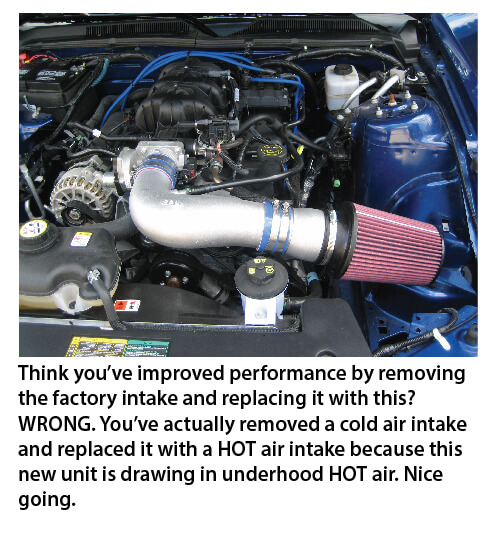 designed to give maximum performance. First, they already take in cold air from outside the engine compartment.
Second, the air filter box and ductwork is factory-tuned to minimize air turbulence going into the MAF sensor and the throttle body. If you change the ductwork, you screw up the factory tuning. Don’t believe me? Read this piece from the July 13, 2013 article of Brake & Front End magazine. This is a trade publication written for professional mechanics.
“Turbulence in the intake air stream can also affect MAF sensor calibration.” – Brake & Front End, July, 2013
Still don’t believe me? Watch this complete diagnosis on a Ford F-150 5.4 fitted with a CAI. It’s an 18-minute video, and all the owner’s problems come down to the CAI, which has poor laminar flow across the MAF from the crummy design on the aftermarket air intake.

Here’s the important point to remember; the original equipment air filter and intake air box are specifically designed to reduce turbulence of air flowing into the MAF sensor. Replacing the original equipment air intake system with various customized intake systems can increase air turbulence and, thereby cause a calibration error resulting in an engine performance complaint.
Still don’t believe me? Read this from one of the major mass airflow sensor manufacturers:
“Mass airflow sensors require laminar airflow, which occurs when the air flows in parallel layers, with no disruption between the layers. The MAF element only samples a small part of the incoming air stream, so if the laminar flow is not present, the air measurement and fuel delivery will be incorrect. Some older vehicles have a diffuser installed, but most rely on the air filter design to provide laminar airflow.
It’s crucial to have an OE-design air filter. Some oiled filters can get over-oiled, which ends up contaminating the MAF sensor and causing worse performance. Some cheaper replacement filters have a different design that alters the airflow direction, thus skewing the reading of the MAF.
Make sure there are no “performance” airflow devices installed in the air intake. These devices will disrupt the planar airflow that is crucial to accurate MAF readings.”
So, aside from the fact that aftermarket cold air intake systems don’t provide any better power or gas mileage over the factory intake systems, they can actually decrease performance.
To understand why aftermarket cold air intake kits don’t do what they claim, see this post.
Save your money and pass on the cold air intake.
© 2012 Rick Muscoplat
Posted on by Rick Muscoplat