
What is Ceramic Car Wax? A Complete Guide
The Benefits of Ceramic Car Wax for Long-Lasting Shine
Ceramic car wax represents a significant advancement in vehicle protection technology. Combining the benefits of traditional car wax with the durability of modern ceramics, ceramic car wax provides enhanced protection, gloss, and ease of maintenance. In this article, we’ll explore what ceramic car wax is, how it works, and the advantages it offers over traditional waxes.
First, there was carnauba wax. It provided a deep, warm shine, but that shine didn’t last long. Then came the polymer-based car waxes (also referred to as paint sealants) that imparted a wet-look shine. It lasted longer than Carnauba but didn’t provide as deep or warm a shine. Now, ceramic car wax is taking over.
What is ceramic car wax?
A ceramic car wax contains a hydrophobic (water repelling or “water fearing”) silicon dioxide (SiO2) component. SiO2 is produced from silica (sand) that’s chemically processed to form nanostructures that pack so tightly together into a structure they prevent water from penetrating through the structure. In other words, the particles fit together like a puzzle with only their sharp tips facing out. When water hits the tips, it bounces off. The SiO2 formula adheres to a substrate (your car’s paint) on one side but repels water on the other side.
Think of it-like the latest non-stick ceramic cookware or the latest water-repelling concrete waterproofing agents. In use, ceramic car wax behaves like Teflon (PTFE) in that it repels water. But it uses a completely different mechanism to provide the hydrophobic action. SiO2 provides much better protection than PTFE and lasts longer.
How is itapplied?
• Preparation— Before applying, the vehicle’s surface needs to be thoroughly cleaned and prepped. Any dirt, grime, or old wax residues should be removed to ensure that the ceramic wax can properly bond with the paint.
• Application— It is typically applied using a microfiber applicator pad. The wax is spread evenly over the vehicle’s surface and allowed to cure for a specified period. During this curing time, the wax bonds with the paint, forming a protective layer.
• Buffing— After the wax has cured, it is buffed off using a clean microfiber cloth. This process helps to remove any excess wax and enhance the shine of the vehicle’s surface.
Meguiars offers several versions of their ceramic car wax. The two most popular are a spray formula and a liquid version.
Meguiar’s® Hybrid Ceramic Spray Wax is a spray-on product that 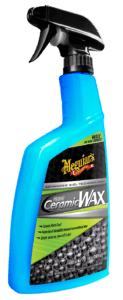 applies right on top of the rinse after you wash your car. It’s a two-step process: applying a foundational layer and then following up on routine maintenance applications.
Applying the foundational layer of Meguiar’s® Hybrid Ceramic Spray Wax
The very first time you use Meguiar’s Hybrid Ceramic Spray Wax you’ll apply a foundational layer. That involves washing the car and then rinsing off the soap. Next, spray the entire surface with Meguiar’s Hybrid Ceramic Spray Wax and wipe it off with a microfiber towel. That spreads the ceramic car wax uniformly over the entire painted surface. Applying the foundational layer is a one-time process.
Routine or maintenance applications of Meguiar’s® Hybrid Ceramic Spray Wax
Wash your car normally. Then rinse. Apply a light spray of Meguiar’s® Hybrid Ceramic Spray Wax over the surface. Then, rinse the treated areas with water. Dry the vehicle with a microfiber towel
Meguiar’s Hybrid Ceramic Wax – Easy to Use Ceramic Wax Protection – G190526, 26 oz $14.99
Meguiar’s Hybrid Ceramic Liquid Wax applies more like a traditional liquid wax. Wash the vehicle, rinse and dry. Then apply a thin layer of the ceramic liquid wax to a panel and let it cure for 3-5 minutes. Wipe off with a microfiber towel.
Meguiar’s Hybrid Ceramic Liquid Wax comes in a 16 oz. bottle 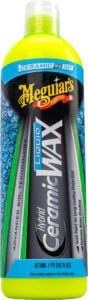 and has an MSRP of $22.99. It can be found on store shelves in major retailers, auto specialty stores and online merchants nationwide, beginning in December 2019.
©, 2019 Rick Muscoplat
Posted on by Rick Muscoplat