
When to get replacement brake rotor?
Learn when to replace brake rotors
Knowing when to get replacement brake rotors is essential for maintaining optimal braking performance and preventing costly repairs. This article will explore the signs that indicate it’s time to replace your brake rotors, the importance of timely replacement, and tips for proper rotor maintenance.
Understanding Brake Rotors
Brake rotors are disc-shaped components that work with brake pads to create friction and slow down your vehicle. When you press the brake pedal, the brake pads clamp down on the rotors, generating the necessary force to stop the vehicle. Over time, brake rotors can wear out due to various factors, leading to decreased braking efficiency and potential safety hazards. Whether you perform your own brake jobs or have a shop do it for you, a decision has to be make whether to reuse, machine, or replace the brake rotors.
How do you decide whether you need replacement brake rotors?
Brake rotors can look perfectly fine to the naked eye, making you think you can reuse them. But looks are irrelevant—brake rotors must be measured with a brake micrometer to determine whether they can be reused or resurfaced.
Step 1: How to measure brake rotor thickness
The legal minimum “discard” thickness is stamped into the rotor. Simply measure the rotor thickness in several places and compare your measurement to the discard thickness. 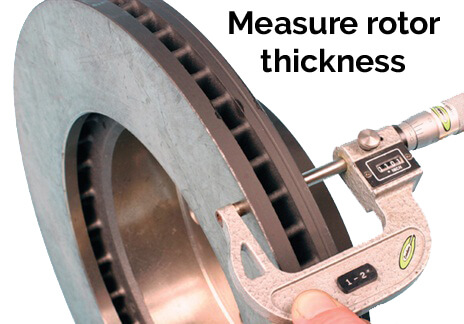 No eyeballing allowed. In order to be a candidate for resurfacing, the rotor must exceed the discard thickness by at least 0.015-in. That’s called the “machine to” thickness (discard thickness plus 0.015-in.). The machine-to thickness is calculated to leave enough metal on the rotor after resurfacing to allow for
 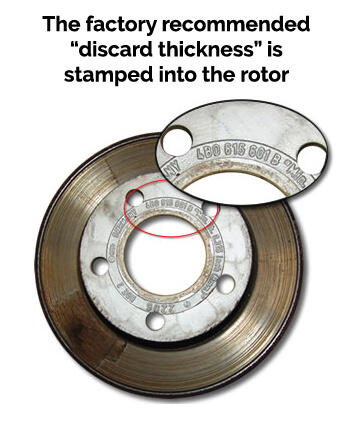 more rotor wear after the new brake pads are installed.
Step 2: Measure the groove depth on the rotor face
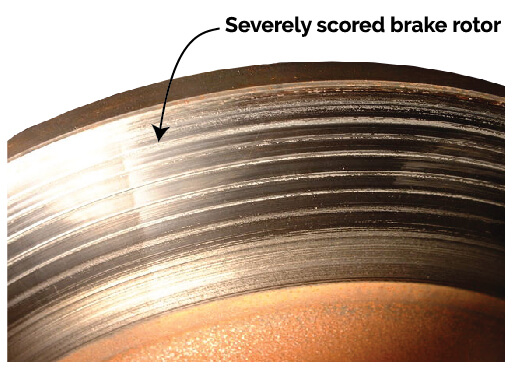
Brake rotors with groove steeper than one 16th of an inch can’t be reused
Brake rotors are exposed to road dirt and grit, and the grit can get trapped between the brake pad and rotor, causing grooves to form in the face of the rotor. A rotor with minor scoring can be reused as-is. However, if the groove depth reaches 0.060 in. it must be resurfaced or replaced.
To be a candidate for resurfacing, the technician must calculate how much rotor material must be removed to level the rotor face and remove the grooves, while still meeting the machine-to thickness. It must be replaced if the rotor won’t be thick enough after resurfacing.
Step 3: Measure disc thickness variation and parallelism
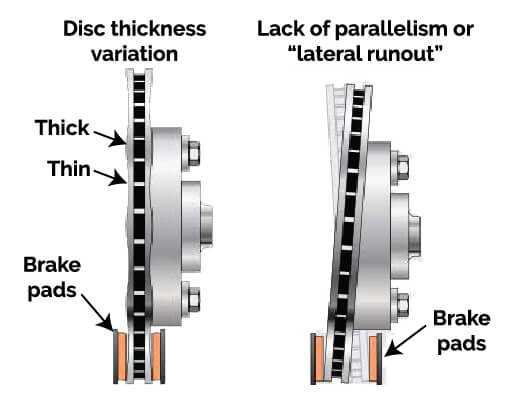 Improper lug nut tightening, sloppy brake installation, road impacts, and rust buildup on the wheel hub can cause a rotor to develop thickness variations and parallelism problems. If a rotor has these issues, the technician must calculate whether there will be enough remaining thickness to justify resurfacing.
If the technician makes all these measurements and determines the rotor will have enough metal remaining after resurfacing to meet the machine-to specification, then you can consider resurfacing as long as the shop uses an “on-car” brake lathe.
Step 4: Examine the condition of the rotor’s cooling vanes
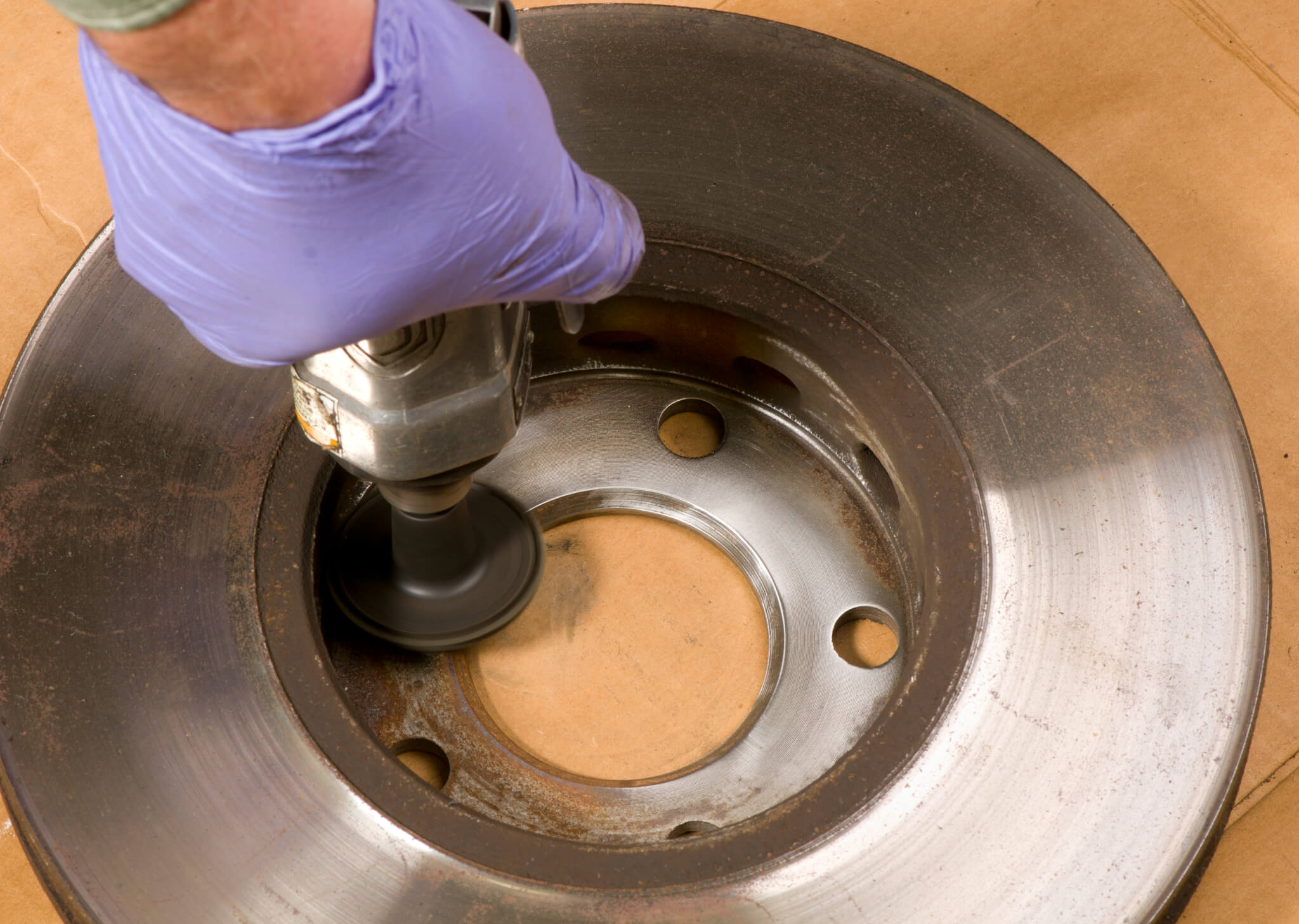 Rotors rust and the heavy rust accumulation inside the cooling vanes can greatly reduce the rotor’s ability to dissipate heat. The most critical areas are inside the cooling vanes and the mating area where the rotor meets the wheel hub. If the cooling vanes are clogged with rust scale, it must be removed and that can be labor-intensive to the point of making it uneconomical.
Step 5: Consider the costs of resurfacing versus brake rotor replacement
The labor required to resurface a brake rotor using an on-car brake lathe can often cost more than a new replacement brake rotor. Resurfacing a rotor takes three separate steps: rough cut, fine cut, 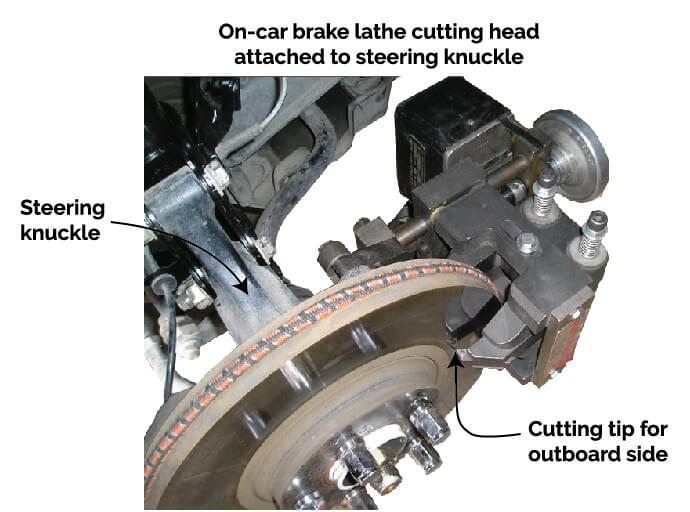 and non-directional finish application. It takes about 30- mins per rotor to install the on-car brake lathe and perform the resurfacing procedure. If the shop charges $140/hr. and a replacement brake rotor costs $70 each (2 required per brake job); you’re better off replacing the rotors as long as the shop uses professional-grade name-brand rotors. See this article on brake rotors
Step 6: Consider the brake noise issue
Shops generally don’t like to reuse old rotors with new pads because they develop noise issues and cause customer comebacks. The noise is caused by the new pads not sitting perfectly flat against the old rotor. They have to “wear in” to the rotor. You may think your old rotor is perfectly flat, but it isn’t on a microscopic level. In fact, it may take months of driving to get the new pads to wear in and quiet down. Are you willing to put up with brake noise that whole time? If not, replace the rotors when you replace the pads.
©, 2016 Rick Muscoplat
Posted on by Rick Muscoplat