
When You Should Replace Your Tires
When You Should Replace Your Tires: A Pro Mechanic’s Guide to Tire Age, Mileage & Safety
Quick Summary
You should replace your tires when you encounter any of these conditions:
• The tread depth is less than 4/32.” The legal minimum tread depth is 2/32″, but tires lose a considerable amount of stopping power once they wear down to 4/32″
• They’re 10 years old or older. Carmakers say to replace them at 6 years old, but tire manufacturers say 10 years is the magic number. TIP: It depends on how much sun exposure they’ve received.
• They have visible damage like bulges, cracks, cuts, or evidence of dry rot
Article
When to Replace Tires: It’s About More Than Just Tread
As a technician who has inspected thousands of tires, I can tell you there is no one-size-fits-all rule for when you should replace your tires. It’s a combination of science, safety, and experience. People often think tires should be replaced based solely on mileage, but mileage is just one clue—temperature, storage conditions, road surfaces, and daily habits matter more.
Tread Depth: The Most Important Indicator of When to Replace Tires
The legal minimum tread depth is 2/32″, but that doesn’t mean your tires are safe before you reach the legal limit. Test after test—including Tire Rack’s well-documented wet-braking studies—prove that by the time your tread reaches 4/32″, grip and stopping power have already taken a noticeable dive.
Let me put this into real-world terms:
A tire at 4/32″ can require 125 feet more to stop in the rain than a new tire. At 2/32″, stopping distance increases by over 250 feet—and vehicles may still be rolling when a similar car on fresh tread has already come to a complete stop. That’s why I always tell customers to replace their tires when traction

This illustration shows where the tread wear indicator bars are located on a tire
starts to go, not when the law forces you to.
Every tire has built-in tread wear indicator bars molded into the grooves. Once the tread is level with those bars, that tire has legally reached the end of its life.
If you want precision, grab a tread depth gauge (five bucks at any parts store) and measure regularly. Don’t wait until the last moment.
Or, you can measure the tread depth
Using a penny to check tread depth is just plain stupid. Your tires already have tread-depth indicator bars that denote the minimum tread depth. So why use a penny to tell you something that’s built into the tires?

Use a tread depth gauge to see how much tread is left on your tires.
Besides, you want to know tread depth before you’ve reached the legal minimum. To know that, you’ll need a tread depth gauge. Find one at any auto parts store or online at Amazon.
Push the gauge into the voids between the tread block and read the tread depth on the gauge. For more information about measuring tread depth, see this post.
Tire Aging: Why Time Alone Can Tell You When to Replace Tires
Your tires may have plenty of tread, but they can still be unsafe if they’re old. Rubber breaks down over time as oxygen penetrates the inner layers—a process called oxidation. Heat accelerates this breakdown, which is why tires in sunny states like Arizona age faster than tires garaged in Minnesota.
Most automakers recommend replacing tires every six years, regardless of mileage or tread depth. However, the tire companies sometimes stretch that to ten years. Which recommendation should you follow? It depends on climate, sun exposure, and how often you drive.
• Research by the National Highway Traffic Safety Administration (NHTSA) indicates that tires age more rapidly in heat. Warm climates and exposure to direct sunlight accelerate oxidation, speeding up the aging process. As a result, tires on vehicles stored outdoors, such as trailers or RVs, age faster than those stored in garages.
• How often and how long you drive affects tire condition. Tires contain anti-aging compounds known as antiozonants. These compounds keep the rubber soft, flexible, and grippy. As the tire flexes and heats up, the antiozonants migrate from the inside of the tire to its outer surface. Think of it as the tire constantly pushing a fresh layer of protection outward. If you don’t drive often, or drive short distances, the additive can’t migrate and you’ll experience tire blooming (see tire blooming below)
How to determine the “born on” date of your tires
Want to confirm a tire’s age? Look at the DOT code molded into the sidewall of the tire.
Tire dating was standardized starting in 2000— The date of manufacture is the last four digits of the DOT code. The first two digits tell you the week they were manufactured. The last two digits tell you the year. So, a data code of 0203 means the tire was manufactured during the second week of 2003.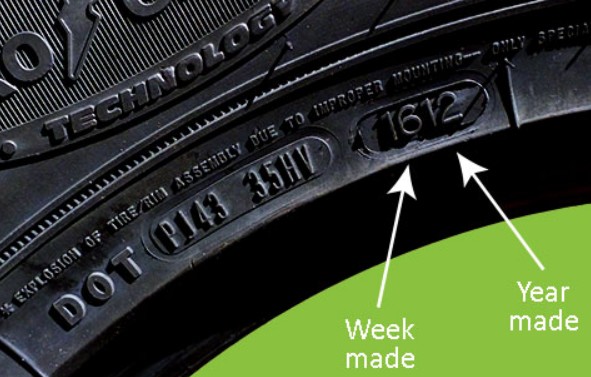
In addition, air permeates the tire wall, causing oxidation that weakens the tire’s structural integrity. This causes the tire to become brittle and lose strength.
Other reasons to replace your tires
Replace your tire immediately if you find any of these conditions:
• Tire bulge— A damaged belt causes a bulge in the tire. A tire with a bulge is a dangerous tire and must be replaced immediately

This image shows a tire bulge caused by a broken belt
• Sidewall cuts or gouges— Immediately replace any tire with a sidewall cut or gouge deeper than 1/16″.

This image shows a tire sidewall gouge that’s dangerous and must be replaced immediately
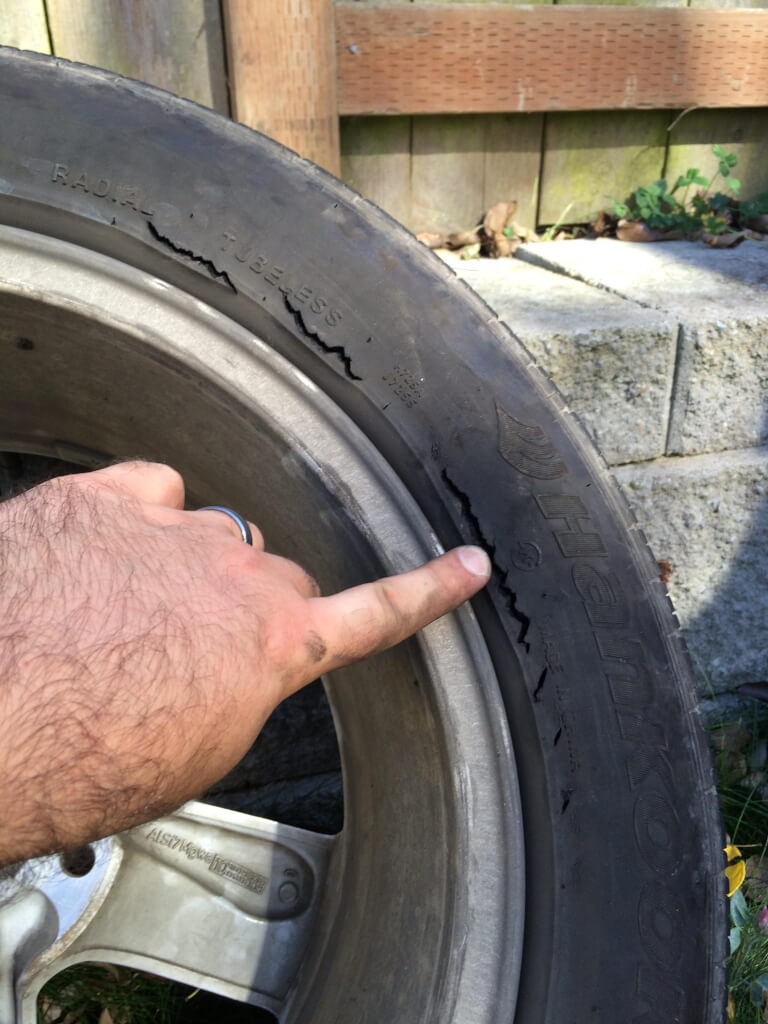
• Cracks— Cracks in the rubber are a sign of overheating and rubber degradation. Any tire with cracks must be replaced
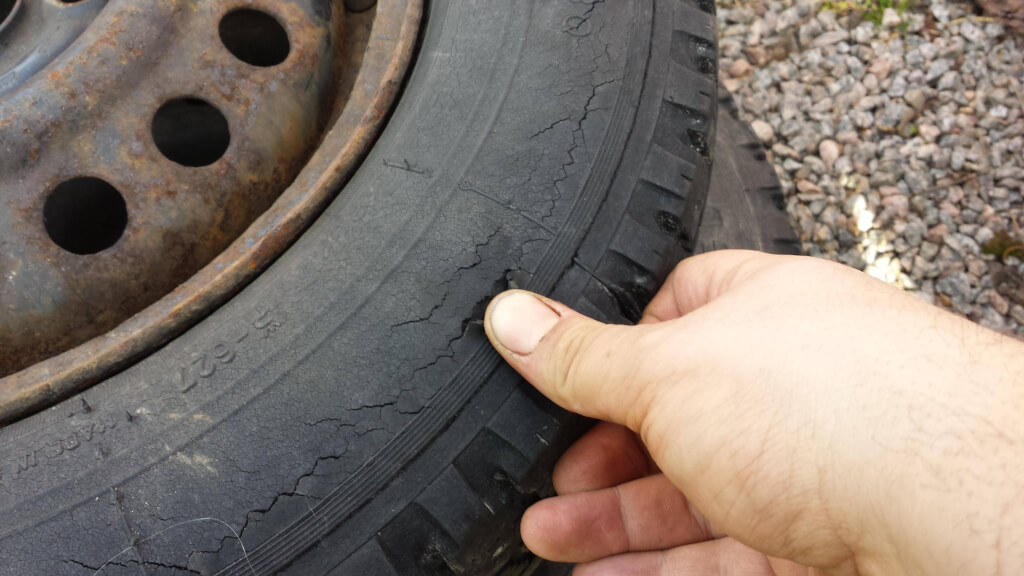
Tire showing age cracks in sidewall
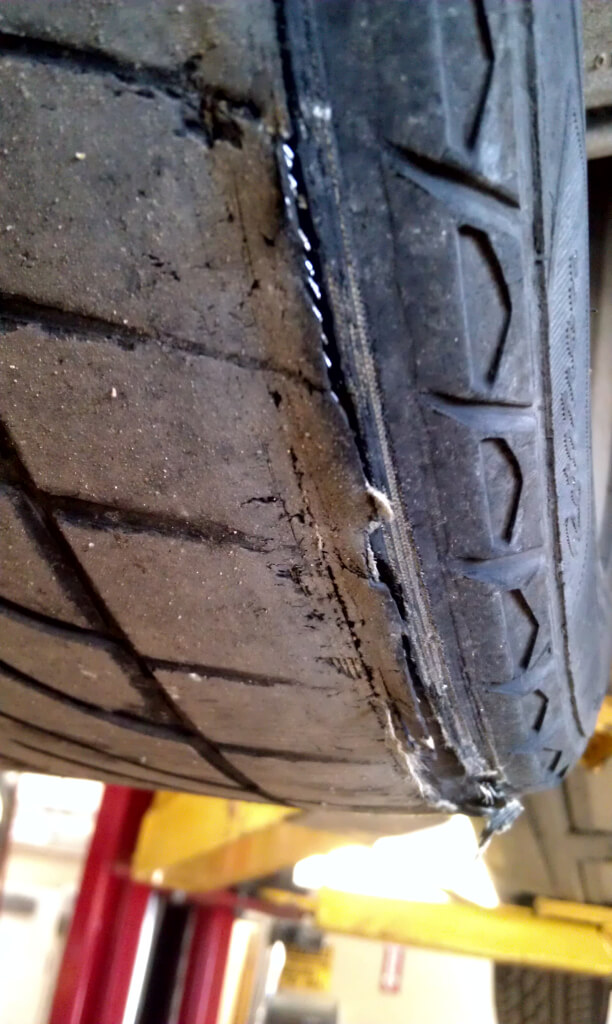
Tire damaged by driving with low tire pressure. Notice the wear on the edge and cracks.
What Is Tire Blooming?
Tire blooming is the brownish discoloration you sometimes see on tire sidewalls or between tread blocks. It happens because the antiozonants contain waxy compounds that rise to the surface, and when they react with air and moisture, they oxidize and turn brown.
So that brown coloring is actually the protective coating doing its job.
Tire blooming is:

Notice the brown appearance. This is tire blooming
✔ Normal
✔ Protective
✔ A sign that the tire is aging, and environmental exposure is occurring
It’s not dirt, but it can be washed off. The blooming will return because the tire continues pushing more antiozonant to the surface as it flexes.
Why Some Tires Bloom More Than Others
Not all rubber compounds are the same. Tires:
• Used in hot or sunny climates
• Installed on trailers or RVs that sit for long periods
• Exposed to road salt or chemicals
…will bloom more noticeably.
Premium touring tires with more complex compounds may bloom less. Off-road or economy tires often show more brown.
©, 2015 Rick Muscoplat except as noted
Posted on by Rick Muscoplat