
Which Headlight Bulbs Last Longest? Expert Breakdown
How Long Headlight Bulbs Last: Real-World Lifespan by Bulb Type
Quick Summary
Headlight bulb life depends entirely on the bulb type and how often you drive at night. Halogen bulbs burn out the fastest; HID bulbs last longer but degrade quickly; Xenon HID bulbs offer even longer life; and factory LED headlights last the longest. Knowing how long headlight bulbs last helps you plan maintenance, spot dimming early, and replace bulbs before visibility drops.
 How Long Headlight Bulbs Last
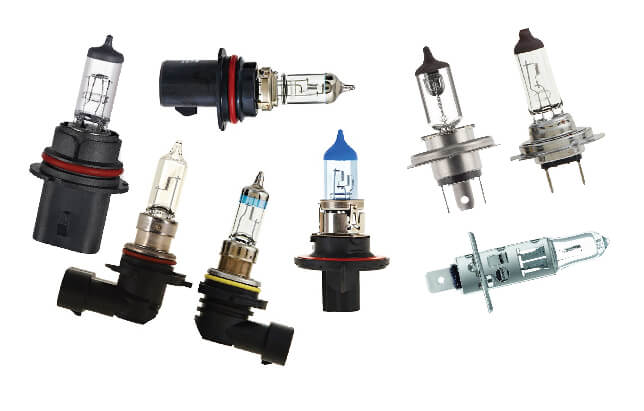
One of the most common questions I get from motorists is how long headlight bulbs last in real-world driving. I’ve tested thousands of headlights over the course of my career, and I can tell you firsthand that how long headlight bulbs last depends on two things:
What type of headlight do you have?
There are five types of headlight bulbs
• Sealed beam halogen
• Halogen capsule or
• High intensity discharge (HID)
• Xenon HID
• LED (factory)
How long does a headlight bulb last?
• Standard Halogen — capsule or sealed beam 500 – 1,400 hours
• HID — 2,000 hours
• Xenon HID — 10,000 hours
• LED — OE up to 30,000 hours
Headlight bulb life in hours based on brand and brightness
Sylvania Silver headlight bulbs claim to be brighter or to help you see farther down the road. But they’re much more expensive, so look at the reduced lifespan.
Here’s a comparison of standard and brighter headlight bulbs according to bulbfacts.com
Sylvania Basic Halogen headlight bulb 1504 Lumens 1,134 hours
Hella Standard Halogen headlight bulb 1482 Lumens 1,205 hours
GE Standard Halogen headlight bulb 1458 lumens 2,074 hours
Sylvania SilverStar Ultra Halogen headlight bulb 1626 lumens 458 hours
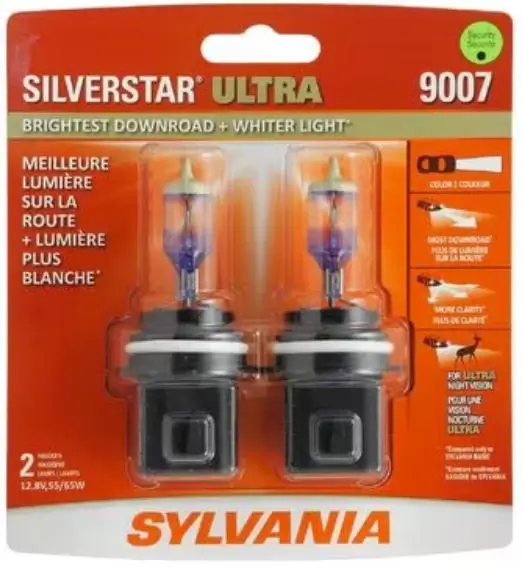
$58 at Autozone
Sylvania SilverStar Halogen headlight bulb 1622 lumens 621 hours
Sylvania SilverStar zXe Gold Halogen headlight bulb 1345 lumens 667 hours
Sylvania SilverStar zXe Halogen headlight bulb 1448 lumens 744 hours
Philips Xtreme Vision 1586 lumens 802 hours
Philips Vision Plus Halogen headlight bulb 1613 lumens 997 hours
Philips White Vision Halogen headlight bulb 1411 lumens 864 hours
Philips Diamond Vision Halogen headlight bulb 769 lumens 824 hours
GE Megalight Ultra Halogen headlight bulb 2036 lumens 585 hours
GE Megalight Halogen headlight bulb 1635 lumens 773 hours
Halogen headlight bulb life
The halogen light bulb capsules used in late-model cars last about 4,000 hours continuously under ideal laboratory conditions. But in the real world, where they’re subjected to more vibration and hot/cold cycles, you’ll be lucky to get 1,200 hours out of them. Depending on how often you drive at night, that translates into about two years for the average driver. When one headlight bulb burns out, the other is right behind, after all, they’re both on for the same amount of time. That’s why you should always replace headlight bulbs in pairs.
HID bulb life
Early HID bulbs are rated at about 2,000 hours. However, since HID bulbs produce light using an arc, their actual life depends on the number of start-up cycles rather than hours burned. The more you turn on your HID headlights, the faster the electrodes burn out.
Xenon HID bulb life
More recent Xenon HID headlights last much longer than the earlier designs. However, their life is still directly related to the number of start-up cycles. Again, the more you turn on your HID headlights, the more you burn out the electrodes.
How sealed beam headlights work
Sealed beam and capsule bulbs use a filament. When power is applied, the filament heats up, and that heat creates light. However, the heated filament also evaporates, and that evaporated tungsten can deposit on the lens or the interior of the capsule, reducing the brightness. Tungsten evaporation is greatest when the bulb is built with just a vacuum. So manufacturers inject a gas into the bulb.
A sealed beam headlight is a single unit that contains the reflector, filament and lens. When it burns out, you replace the entire unit.
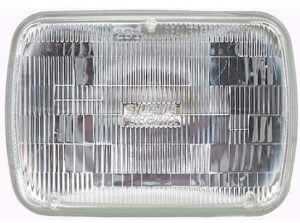
Rectangular Sealed Beam Headlight
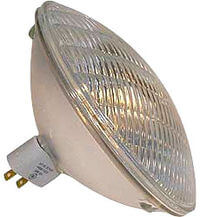
Round Sealed Beam Headlight
Sealed beam headlights usually contain a mixture of 88% argon and 12% nitrogen. The gas reduces the rate of tungsten evaporation. Lower evaporation rates mean the bulb experiences less blackening. The gas also allows the filament to operate at a higher temperature, giving off more light.
How halogen headlights work
A halogen capsule bulb also contains a filament, but it doesn’t have a reflector or lens; those are built into the headlight assembly. When a halogen headlight burns out, you replace just the bulb and reuse the car’s reflector and lens.
Halogen is also an inert gas. Halogen offers a significant advantage over argon and nitrogen. When a halogen bulb operates, the tungsten molecules evaporate and cling to the halogen molecule. When you turn off your headlights and the filament cools, more tungsten molecules return to the filament. So a halogen bulb filament lasts longer than a sealed-beam bulb and darkens less because more molecules return to the filament.
How high-intensity discharge headlights work
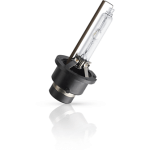
HID bulb
A high-intensity discharge (HID) bulb doesn’t have a filament. Instead, it has two tungsten electrodes inside the glass envelope. Xenon gas and metal or mineral salts fill the glass envelope between the electrodes. When you turn on HID headlights, an igniter creates a high initial current
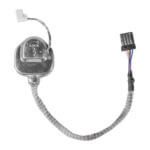
HID ignitor
that causes an electrical arc to jump between the two electrodes. Once the arc is established, a ballast maintains the proper current to keep the arc burning. Metal or mineral salts conduct electricity and glow to provide illumination. So an HID bulb is
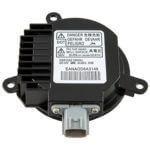
HID ballast
more like a neon sign or fluorescent tube.
Unlike a filament bulb, which creates a single “hot spot” of light, an HID produces two hot spots, one near each electrode. That’s why you can’t convert a standard halogen headlight assembly to HID by simply replacing the halogen bulb with an HID bulb. See this post for more information on why this conversion is not only illegal, but actually throws less light on the road.
HID bulbs are more energy efficient than either sealed beam or halogen capsules, so they create more light with less power. Plus, HID bulbs last much longer than a filament-style bulb. No filament means no evaporation.
However, there’s no free lunch with HID bulbs. Their light output deteriorates more than that of a sealed beam or halogen bulb. In fact, HID bulbs lose almost 70% of their light output over their life. In addition, HID lighting is far more costly to install and maintain. HID replacement bulbs cost around $100 each. A replacement HID ignitor costs around $40 and an HID replacement ballast can run as high as $400.
LED headlights
Late model vehicles now come equipped with LED lighting. LED lighting lasts longer than halogen or HID bulbs.
However, you cannot legally retrofit aftermarket LED bulbs into your current halogen or HID headlight assemblies. In fact, LED bulbs are not approved for street use; they all contain a disclaimer: “For off-road use only.” That’s because they can’t produce the same beam pattern as the halogen or HID bulb and instead produce glare.
Don’t wait until your headlights burn out
Most cars and trucks are equipped with incandescent halogen headlight capsules, bulbs that fit into a headlight assembly that contains the lens and reflector, so you only have to replace the bulb itself. All incandescent bulbs work by passing an electrical current through a filament until it gets “white” hot and emits light. 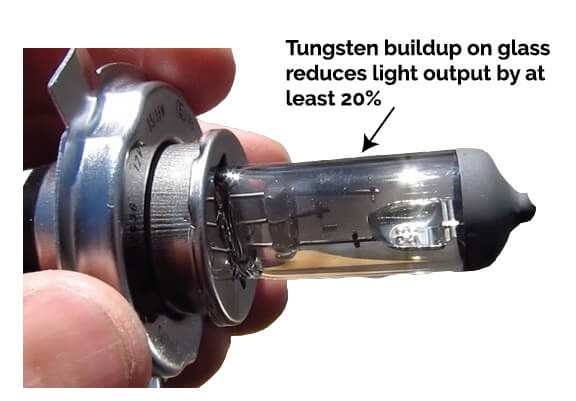 Over time, the high heat evaporates a small amount of the tungsten filament, turning it into vapor. Since the glass portion of the bulb is cooler than the filament, the liquid tungsten settles on the glass, turning it black. Those black deposits reduce the amount of light the headlight bulb casts on the road. By filling the bulb with halogen gas, bulb manufacturers reduce the buildup of molten tungsten on the glass, but they can’t totally eliminate it.
Filament deposits reduce light output by 20%
How fast the tungsten builds up on the bulb’s glass envelope depends on how often you drive at night. But in a recent survey, typical drivers found that most headlight bulbs develop enough tungsten buildup to reduce light output by 20% within two years. The survey also shows that 55% of drivers have never changed their headlight bulbs. That’s an amazing statistic—it means that most drivers have reduced visibility from their headlights, making it harder for them to see you, pedestrians, bikers, and road issues.
©, 2016 Rick Muscoplat
Posted on by Rick Muscoplat