
Why Your Headlights Don’t Work
Common Headlight Problems and A Step-by-Step Diagnosis Path
As a professional auto technician with years of hands-on experience, I’ve seen all the reasons why headlights don’t work—and I’ve solved them all. Whether one headlight doesn’t work or both are out, headlight problems can pose a serious safety risk, especially at night. Here’s exactly what I check when I’m faced with a vehicle where the headlights don’t work.
One Headlight Doesn’t Work? Start With the Bulb
If one headlight doesn’t work, I always begin with the simplest step: checking the headlight bulb itself. Your

Notice the two filaments in this headlight bulb. One is for the low beam, the other for the high beam
owner’s manual will show you how to access the headlight housing, but in many late-model vehicles, replacing a headlight bulb can be far from easy—it often requires removing the bumper cover to reach the bulb.
Once I’ve got the bulb out, I inspect the filaments. Some halogen bulbs contain two filaments—one for the low beam and one for the high beam. If one headlight doesn’t work, it could mean only one filament is blown.
• Visually inspect the bulb for broken or burnt filaments.
• If I can’t tell by looking, I swap the bulb from the working side.
• If the headlight problem moves with the bulb, I know the bulb is bad.
• If swapping bulbs doesn’t fix it, the issue runs deeper, usually to the fuse or wiring.
When Both Headlights Don’t Work, Check the Fuses Next
If both headlights don’t work, I always go straight to the fuse box. In most vehicles, each headlight circuit has a dedicated fuse.
Here’s my quick fuse check method:
• I locate the fuse diagram (usually printed on the fuse box cover or in the owner’s manual).
• I remove the fuse for each headlight circuit and check it for continuity or damage.
• If the fuse is blown, I replace it and retest.
• If it blows again, that tells me I’ve got a short circuit somewhere in the wiring or a faulty headlight component drawing too much current.
Modern Headlight Problems Require a Different Approach
Back in the day, if your headlights didn’t work, the issue was likely a simple switch or relay. That’s not the case anymore.
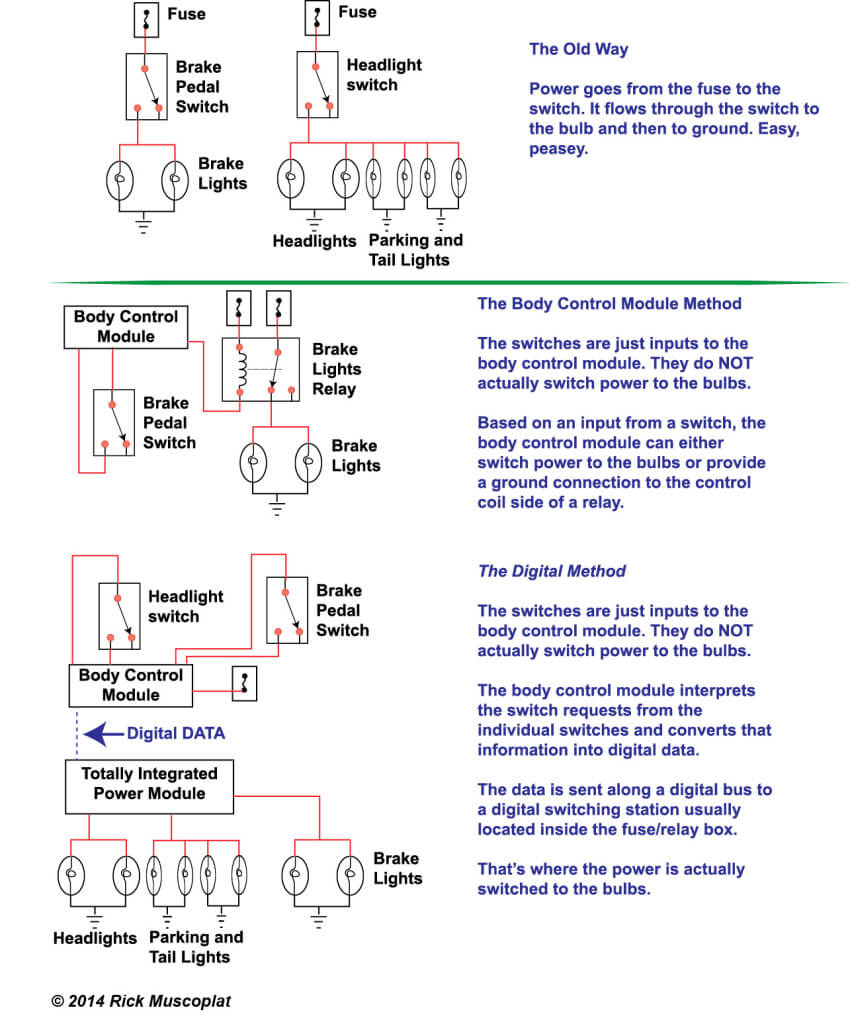
Today’s vehicles use a body control module (BCM) to manage lighting. The headlight switch doesn’t send power to the headlights—it sends a request to the BCM, which then decides how and when to activate the headlights.
Depending on your vehicle’s year and make:
• The BCM might ground a headlight relay’s control coil.
• Or, it may send a command to a smart fuse box to power the headlight circuit.
In short, if your headlights don’t work on a modern vehicle, you can’t just poke around and hope for the best. You need a wiring diagram—no exceptions.
You Need a Wiring Diagram—Here’s Why
If your headlights don’t work and you’ve already checked the bulbs and fuses, it’s time to dig deeper. But without a wiring diagram, you’re just guessing.
I’ve had countless customers come to me after spending days replacing parts based on bad advice. Without the wiring diagram, you don’t know whether your headlight circuit is controlled by a relay, a solid-state device, or a module.
So if you’re troubleshooting:
One headlight doesn’t work? Check if the headlight circuit is independently controlled.
Both headlights don’t work? Look for module failures or communication issues on the network bus.
Intermittent headlight problems? Inspect connector pins, ground points, and module logic.
It is simply IMPOSSIBLE to answer your question without that information. Anybody who does, it just throwing outdated information your way that may cause you to chase your tail in a fruitless effort to solve the problem.
©, 2015 Rick Muscoplat
Click on this image to see a full-size PDF