
Why LED Bulbs Don’t Work in Halogen Housings
Why Retrofit LED Bulb Conversions Usually Make Visibility Worse
Quick Summary
Many drivers believe that installing LED bulbs in a headlight designed for halogen bulbs is an easy way to get brighter headlights. Unfortunately, that’s not how headlight optics work.
Here’s what you need to know:
• It’s optically impossible for a retrofit LED bulb to produce the proper beam pattern when used in a headlight designed for a halogen bulb.
• LED bulbs create excessive glare that can blind oncoming drivers.
• LED bulb conversions throw less usable light on the road, even though they appear brighter when viewed directly.
• Halogen reflectors and projector housings are engineered around the exact shape and location of a halogen filament.
• There are currently no U.S.-approved street-legal LED replacement bulbs approved to replace a halogen bulb in a halogen headlight assembly.
• Most of the advertised benefits of LED conversions are based on brightness at the headlight, not illumination where you actually need it—on the road.
If you’re considering an LED bulb conversion for halogen headlights, understanding the physics behind headlight optics can save you money and improve safety.
Why I Never Recommend Retrofit LED Bulbs in Halogen Headlights
As someone who has spent decades diagnosing and repairing automotive lighting systems, I understand why drivers are attracted to LED headlight conversions. They look modern. They’re marketed as brighter. They’re relatively inexpensive and often promise a simple plug-and-play installation.
But here’s the reality:
When you retrofit LED bulbs in halogen headlight assemblies, you’re asking an optical system designed for one type of light source to suddenly work with a completely different light source. The result is almost always poor performance.
The issue isn’t the LED technology itself. Factory LED headlights can work exceptionally well. The problem arises when DIYers attempt to retrofit their headlights by installing an LED bulb into a housing specifically engineered for a halogen filament.
Why LED Bulbs Don’t Work in Halogen Housings
To understand why LED bulbs don’t work in halogen housings, you first need to understand how a halogen headlight is designed.
A halogen bulb contains a cylindrical tungsten filament positioned at an exact location inside the bulb. That filament emits light in a nearly 360-degree pattern.
Every reflector surface, projector bowl, shield, and lens inside the headlight assembly is designed around:
• The size of the filament
• The shape of the filament
• The location of the filament
• The way the filament emits light
Engineers spend thousands of hours designing a headlight around that specific light source. When you replace the filament with LED chips, everything changes.
The Optical Problem With LED Headlight Conversions
Most retrofit LED bulbs use two flat LED chips mounted on opposite sides of a metal substrate. Unlike a halogen filament, LED chips:
• Are flat instead of cylindrical
• Emit light differently
• Occupy a different physical space
• Cannot perfectly duplicate filament dimensions
• Create dead zones where light isn’t emitted
Because of these differences, the reflector can no longer focus the light properly. The result?
A proper headlight beam pattern should:
• Concentrate light on the road
• Provide long-distance visibility
• Maintain a sharp cutoff
• Prevent glare to oncoming traffic
When the light source changes, the reflector can no longer direct light where engineers intended. Instead of producing a focused beam, the housing scatters light in unwanted directions. This is one of the biggest problems with LED headlight conversions.
Retrofit LED Conversions Create Glare
One of the most dangerous side effects of LED retrofits is glare. Many drivers assume glare occurs because LEDs are brighter. That’s only partially true. The real problem is that the reflector is no longer directing light to the proper locations.
Instead of focusing light on the pavement, significant amounts of light are projected:
• Above the cutoff line
• Into the eyes of oncoming drivers
• Into the mirrors of vehicles ahead
• Into roadside areas where it isn’t needed
To the driver installing the LEDs, the headlights often appear brighter because more reflected light returns from signs, buildings, and other vehicles. However, brightness and visibility are not the same thing.
Why LED Bulbs Often Put Less Light on the Road
This surprises many people. A retrofit LED bulb may produce more lumens than the original halogen bulb, yet still provide less useful visibility. Here’s why.
• The goal isn’t producing more light.
• The goal is to place light precisely where it’s needed.
When the beam pattern is distorted:
• Hot spots develop in some areas
• Dark spots appear in others
• Distance illumination decreases
• Foreground lighting becomes excessive
The driver sees a bright area immediately in front of the vehicle, but less illumination farther down the road. That reduces reaction time and overall nighttime visibility.
Why Projector Headlights Don’t Solve the Problem
One of the biggest myths online is that LED conversions work fine in projector headlights. I hear this claim all the time. The physics says otherwise. A projector headlight still relies on a reflector bowl that creates a concentrated focal point. The lens then projects that focused light onto the roadway.
When you install an LED bulb in a projector headlight:
• The focal point changes
• The reflector cannot create the correct hot spot
• The lens projects a distorted image
• Road illumination decreases
• Glare increases
Even though projector headlights may hide some of the worst glare issues, they still cannot produce the beam pattern the headlight was designed to create.
That’s another reason why LED bulbs don’t work in halogen housings, whether they’re reflector or projector designs.
Are Retrofit LED Bulbs Legal?
This is another area filled with misinformation. Many LED conversion kits claim to be DOT-approved. In reality, the DOT does not approve replacement bulbs. Federal Motor Vehicle Safety Standard (FMVSS) 108 requires the entire headlight system to meet specific performance standards. When you install a light source different from the one for which the headlight was designed, the headlight no longer meets the requirements of 108.
To get around that legality (or illegality) retrofit bulbs are labeled:
• Off-road use only
• Show use only
• Not for highway use
Most LED bulb longevity and lumens specifications are greatly exaggerated. They can’t be trusted. To learn more, read this article: Evaluation of LED Headlight Bulbs: Test Results and Findings
The blue light from LED retrofit bulbs produces more glare
• Traditional halogen bulbs produce light at around 3,000° Kelvin, towards the red end of the spectrum. But LED bulbs produce light in the 5,000 to 6,000° K spectrum.
• Blue light has shorter wavelengths (450 to 495 nanometers) and higher frequencies, causing air particles to oscillate faster and scatter more in the atmosphere than other colors. This applies to ALL blue light sources, whether LED or HID.
• That’s why the headlight assembly must be explicitly designed for the bulb type. Installing an LED bulb in a halogen headlight assembly increases glare, and the blue tint reduces driver visibility.
How a projector headlight works
The reflector focuses the light to a “hot spot” located at a midway point between the reflector and the lens. The lens then projects this hot spot onto the road.
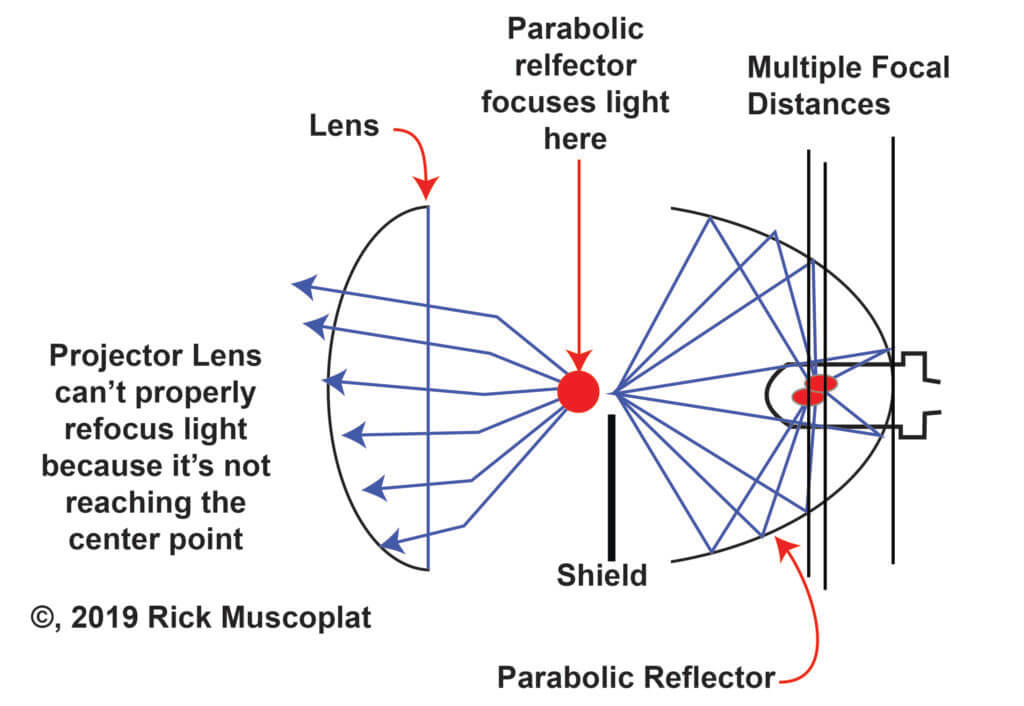
Change the bulb, and the beam no longer focuses midway between the reflector and the lens. So less light gets refocused on the road, and since the focus is off, more light ends up as glare.
Better Alternatives to Retrofit LED Headlight Bulbs
If your halogen headlights aren’t providing enough light, I recommend:
• Restore Cloudy Headlight Lenses — Oxidized lenses can reduce output dramatically.
• Upgrade to Premium Halogen Bulbs — High-performance halogen bulbs often provide noticeable improvements while maintaining the correct beam pattern.
• Verify Headlight Aim — Many headlights simply need adjustment.
Or, Upgrade the Entire Headlight Assembly
If you want LED lighting, install a complete assembly designed and certified for LED operation.
Final Thoughts
I understand the appeal of LED conversions. On paper, they sound like an inexpensive way to improve nighttime visibility. But after studying headlight optics and seeing countless conversions in the real world, I’ve reached the same conclusion every time:
• A retrofit LED bulb in halogen conversion cannot duplicate the optical characteristics of a halogen filament.
• The result is usually more glare, a distorted beam pattern, reduced roadway illumination, and poorer overall safety.
• If you want better headlights, focus on improving the entire lighting system—not simply replacing the bulb.
• The laws of optics are impossible to overcome, no matter what the marketing on the package claims.
©, 2021 Rick Muscoplat
Posted on by Rick Muscoplat