
Why Subaru Misfires Happen
Phantom Subaru Misfires and False PCM Codes
Quick Summary
Certain Subaru models can store misfire codes even when the engine runs perfectly. In those cases, the root cause isn’t the engine at all—it’s excessive vibration from the accessory drive system that tricks the crankshaft sensor into reporting a misfire. Understanding that distinction saves time, money, and a lot of unnecessary parts replacement.
Article
Subaru Misfires: Why Diagnosis Always Starts With a Test Drive
Anytime I’m dealing with Subaru misfires, the very first thing I do is take the car for a test drive. I don’t care what the scan tool says yet—I want to know how the engine actually behaves. If the engine hesitates, stumbles, idles roughly, stalls, or feels down on power, then yes, there’s a genuine misfire happening, and it needs to be diagnosed the traditional way.
True Subaru misfires almost always fall into one of four categories:
• Ignition problems — Worn spark plugs, failing ignition coils,
• Fuel delivery issues — Fuel pressure issues, clogged injectors
• Air leaks — vacuum leaks
• Mechanical faults inside the engine — low compression in a cylinder
But things get interesting when none of that is happening.
When Subaru Misfires Show Up on the Scanner—but Not on the Road
Here’s where many technicians and DIYers get burned. I’ve seen plenty of Subarus come in with multiple misfire codes stored in the PCM, yet the engine runs beautifully. It starts easily, idles smoothly, accelerates cleanly, and never stumbles. No hesitation. No shake. No loss of power.
When that happens, I stop chasing spark plugs and coils immediately. That’s when I start thinking about false or phantom Subaru misfires.
In certain Subaru models, especially some 2014–2017 Subaru Foresters, Subaru identified a condition in which misfire codes can be triggered even when no actual combustion misfire is occurring. Subaru acknowledged this problem and released a technical service bulletin to address it
The Hidden Cause of Phantom Subaru Misfires
What causes these false Subaru misfires isn’t fuel or ignition—it’s vibration.
The original factory alternator on some of these vehicles used a defective clutch pulley assembly. Over time, that pulley could introduce excessive harshness, belt vibration, and even momentary belt slippage in the accessory drive system. That vibration travels through the crankshaft and interferes with the crankshaft position sensor signal.
The PCM relies on extremely precise changes in crankshaft speed to detect misfires. When belt vibration or pulley harshness disrupts that signal, the computer interprets it as a cylinder misfire—even though combustion is perfectly normal. The result is stored Subaru misfire codes that don’t match the way the engine actually runs.
This is one of the most misunderstood Subaru misfires I see in the field.
Subaru’s Official Fix for False Misfire Codes
Subaru’s solution wasn’t software—it was hardware. The service bulletin calls for replacing the original alternator
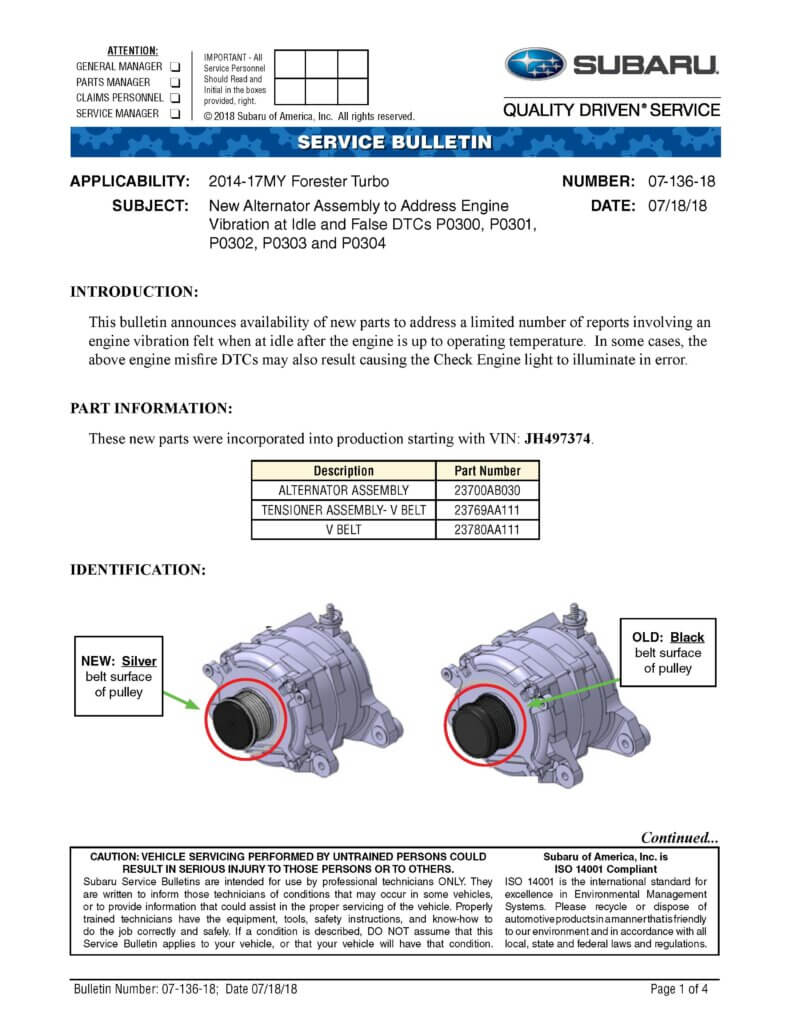
Click on the image to download the PDF
with an updated unit that uses an improved clutch pulley assembly. Subaru also specifies replacing the accessory drive belt tensioner and the belt itself to ensure proper belt control and eliminate vibration.
Once those components are replaced, the false Subaru misfires disappear because the crankshaft sensor signal stabilizes. No vibration. No belt slip. No phantom misfire codes.
Importantly, this issue only affects vehicles that still have the original factory alternator. If the alternator has already been updated, the problem won’t occur.
How to Tell If Your Subaru Has the Updated Alternator
Fortunately, identifying whether this fix has already been performed is easy. The original alternator’s clutch pulley is painted black. The updated alternator uses a silver or metallic-colored clutch pulley.
That visual check alone can save hours of unnecessary diagnostic work. If the pulley is silver, you can rule out this particular Subaru misfire cause and proceed with conventional diagnostics.
Why Understanding Subaru Misfires Saves Real Money
Misfires are one of the most expensive trouble codes to misdiagnose. I’ve seen people replace spark plugs, coils, injectors, and even engines, trying to fix Subaru misfires that were never real in the first place. Understanding how Subaru’s misfire detection system works—and how vibration can fool it—keeps you from throwing parts at a problem that doesn’t exist.
Whether you’re a technician or a Subaru owner, the key is this: always match the scan tool data to how the engine actually runs. If the symptoms don’t line up, step back and look at the bigger picture.
Final Thoughts on Subaru Misfires
Subaru misfires aren’t always what they seem. Sometimes they’re the result of ignition or fuel problems that need straightforward repairs. Other times, they’re nothing more than a vibration issue masquerading as a serious engine fault. Knowing the difference is what separates accurate diagnostics from guesswork.
Once you understand that, your Subaru can be truly misfire-free—and ready to hit the road with confidence.
©, 2026 Rick Muscoplat
Posted on by Rick Muscoplat